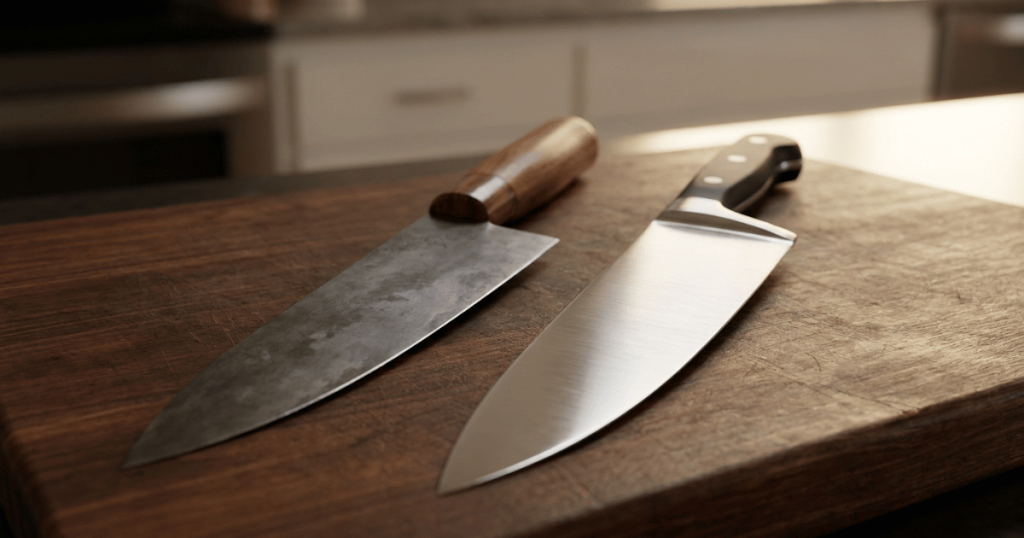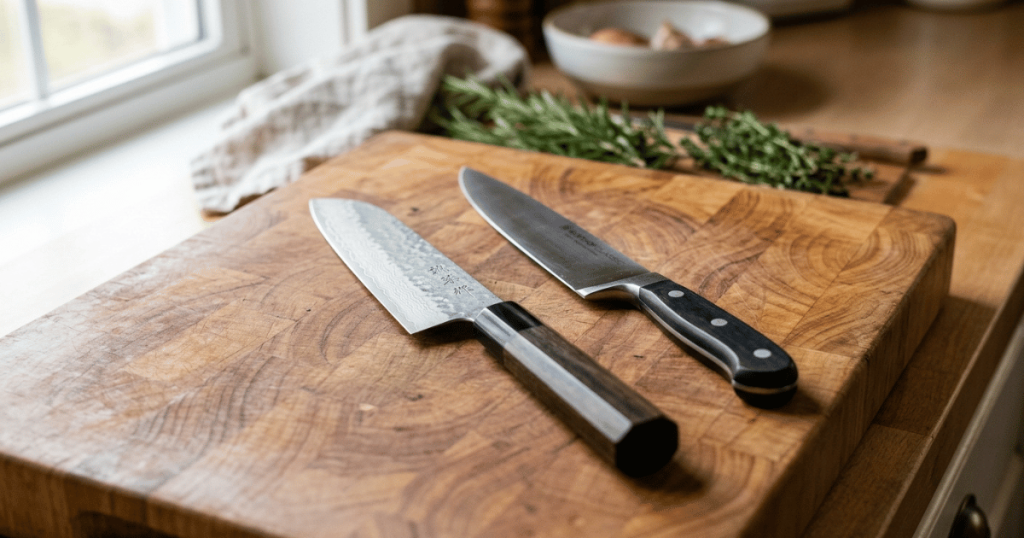
Forged vs stamped knives comes down to how the blade blank is made: a forged blade is heated and shaped from a single bar of steel, usually ending in a hardness around 58 Rockwell and a bolster, while a stamped blade is laser-cut from a sheet of steel and typically lands a few points softer, around 55 to 57 Rockwell, with no bolster. That gap sounds small, but it changes weight, balance, price and how the edge behaves under stress. It does not mean one process makes objectively stronger steel, whatever the marketing on the box implies.
Most buying guides stop at bolster, weight and price. Before any of that, it helps to know what forging and stamping actually do to the steel itself, because one popular claim about forging does not hold up under a metallurgist’s scrutiny.
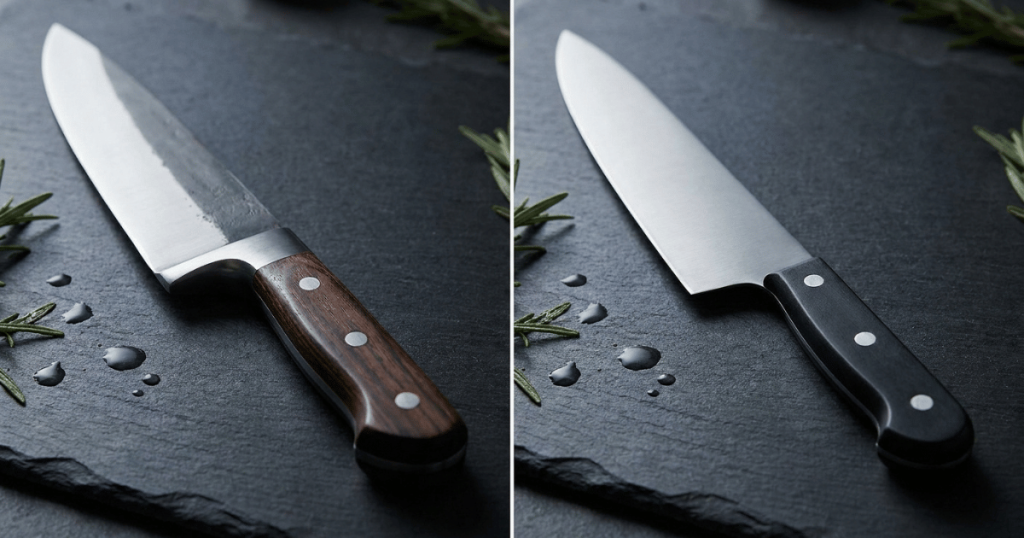
What Forging Actually Does to a Knife Blank
Forging starts with a single bar or blank of steel that gets heated, usually past 2000°F, then compressed and shaped under pressure or hammer blows before it is tempered and hardened. WUSTHOF’s own account of its process describes the forged Classic line going through over fifty-four manufacturing steps (read 2026-09-18), including heating the center of a steel blank and pushing both ends inward to form the bolster, then hardening the finished blade to 58 Rockwell. That bolster, the thickened collar where blade meets handle, is the one visual tell that a knife was forged rather than cut from sheet, and it is where most of the extra weight and the finger guard come from.
It is worth being precise about what “forged” means in a factory. A mass-produced forged kitchen knife is not a bladesmith hand-hammering a bar of steel through dozens of heat-and-strike cycles the way a custom knifemaker does. It is closer to a controlled press-forging step, one or a few heated compressions into a die, followed by conventional heat treatment. That distinction matters for the next section.
What Stamping Actually Does
Stamped blades start as a flat sheet of steel. Despite the name, almost no modern stamped knife is punched out with a mechanical die the way the word suggests; most manufacturers cut the blank with a precision laser, then grind, bevel and heat-treat it the same way a forged blade is finished. WUSTHOF describes its own non-forged line as going through roughly 35 manufacturing steps, ending at a published hardness of 55 to 57 Rockwell, a few points softer than its forged line. There is no bolster, because there is no compressed collar of extra steel to form one from. The blade is thinner and lighter because it was never built up from a thick bar in the first place.
None of this makes a stamped blade a lesser piece of steel. It is a different, faster, less labor-intensive way to arrive at a finished edge, and the steel alloy underneath can be identical to what a forged line from the same maker uses.
The Grain-Refinement Claim, and What a Metallurgist Actually Found
The claim that shows up in almost every forged-vs-stamped article is that hammering or pressing the steel “refines the grain,” aligning its internal structure to make it inherently tougher and longer-lasting than steel that was simply cut to shape. It is repeated as settled fact across the retail and blog articles that dominate this search, almost never with a source attached.
Metallurgist Larrin Thomas, who tests knife steel professionally and publishes the results on Knife Steel Nerds (published 2019-07-22, read 2026-09-18), found the opposite is usually true. At the temperatures and reduction levels typical of knife forging, forging tends to increase grain size rather than refine it, and a coarser grain is not the improvement the marketing implies. Whatever fine, uniform grain structure a finished blade ends up with comes from the heat-treatment cycle applied afterward, a step that happens whether the blank was forged or cut from sheet. Thomas notes the one place forging can offer a real, measurable benefit is with high-alloy steels that carry heavy carbide banding, where hammer work can break up and redistribute those carbides. That is a narrow, steel-specific case, not a blanket rule that forged always beats stamped.
The practical takeaway: if a listing tells you a knife is “superior” because it is forged, without naming a hardness figure, a steel grade or a heat-treatment detail, that claim is doing the work a spec sheet should be doing.
Forged vs Stamped Knives: The Differences You Can Actually Measure
Strip away the marketing language and three measurable differences remain: hardness, weight distribution, and manufacturing cost passed on as price.
| Forged (WUSTHOF example) | Stamped / non-forged (WUSTHOF example) | |
|---|---|---|
| Starting material | Single steel bar or blank | Flat sheet steel, laser-cut |
| Published hardness | 58 Rockwell | 55 to 57 Rockwell |
| Bolster | Yes, formed during forging | No |
| Weight and balance | Heavier, weight concentrated near the handle | Lighter, more front-heavy or neutral |
| Manufacturing steps (WUSTHOF’s own count) | About 54 | About 35 |
The hardness gap is the part most comparisons skip entirely, and it cuts against the assumption that “forged equals tougher.” A blade closer to 58 Rockwell holds a sharpened edge longer between touch-ups, a difference covered in more detail in the site’s guide to how often to sharpen kitchen knives. But harder steel is also less forgiving of a twist, a bone strike, or a drop, so it can be more prone to a small chip at the edge rather than a soft roll, the failure mode covered in the guide to how to fix a chipped knife edge, and when not to try. A stamped blade at 55 to 57 Rockwell gives up a little edge life in exchange for tolerating more abuse before it chips.
When a Forged Knife Is Worth the Price
A forged knife earns its higher price when the bolster’s weight and finger guard matter to how you hold and control the blade, when you want a heavier knife that carries its own momentum through dense vegetables and cuts of meat, and when the harder published edge matters more to you than resistance to chipping. The extra manufacturing steps and material also tend to come with a warranty and resale reputation that reflect the brand’s confidence in the line, which is worth checking on the maker’s own page rather than assuming from the word “forged” alone.
When a Stamped Knife Is the Right Choice
A stamped knife is the better fit for a cook who wants a lighter blade for long prep sessions, is building a first set on a budget, or wants a utility or paring knife where a bolster would only get in the way of grip near the tip. Because the steel is a touch softer, it is also more tolerant of an inconsistent hand while learning to sharpen, a point worth reading alongside the site’s sharpening angle guide before deciding how much precision your first knife actually needs to survive.
How to Check What You Are Actually Buying
Marketing copy is not a spec sheet. Before trusting the words “fully forged” or “hand forged” on a listing, look for three things on the maker’s own product page: a named steel grade, a published hardness figure in Rockwell, and whether a bolster is shown in the product photos. If none of the three appear, the knife may still be a perfectly good tool, but any claim about it being tougher because it was forged is unverified. The same applies in reverse: a stamped knife with a clearly published hardness and steel grade is a more honest purchase than a “forged” knife with none of that information at all.
Caring for Either Type the Same Way
Once a knife is in your kitchen, forged or stamped stops mattering for day-to-day care. Both need prompt drying, a stable cutting surface, and the same rust and storage habits, all covered in the site’s guide to how to take care of kitchen knives: what ruins them. The construction method decided how the blade behaves under stress before you bought it; it does not change what keeps either one working well afterward.
Frequently Asked Questions
Is a forged knife always better than a stamped knife?
No. Forged knives are generally heavier, carry a bolster, and in at least one maker’s published specs run a few points harder on the Rockwell scale, but harder is not automatically better since it trades some chip resistance for edge life. A well-made stamped knife with a clearly published steel grade and hardness can outperform a poorly heat-treated forged knife.
Does forging really make the steel stronger?
Not in the way most marketing implies. Metallurgist Larrin Thomas’s testing, published on Knife Steel Nerds, found that forging at typical knife-shop temperatures tends to increase grain size rather than refine it, and that the fine, even grain structure of a finished blade comes from heat treatment, which applies to forged and stamped blanks alike.
Why do forged knives cost more than stamped knives?
More material, more manufacturing steps, and more labor. WUSTHOF’s own account of its process lists about 54 steps for its forged line versus about 35 for its non-forged line, plus the extra steel used to form the bolster, all of which add to production cost.
Can a stamped knife be just as sharp as a forged knife?
Yes. Sharpness is a function of the edge angle and how well it is maintained, not the forming method. A stamped blade sharpened correctly on a whetstone or a guided system is every bit as sharp as a forged blade at the same angle.
How can I tell if a knife is actually forged without a bolster?
Some forged blades are ground with the bolster removed or minimized for a specific grip style, so the presence of a bolster is a clue, not proof either way. Check the maker’s own product description or spec sheet for the word “forged” or “stock removal,” and look for a stated hardness figure, since a maker confident in its process usually publishes both.