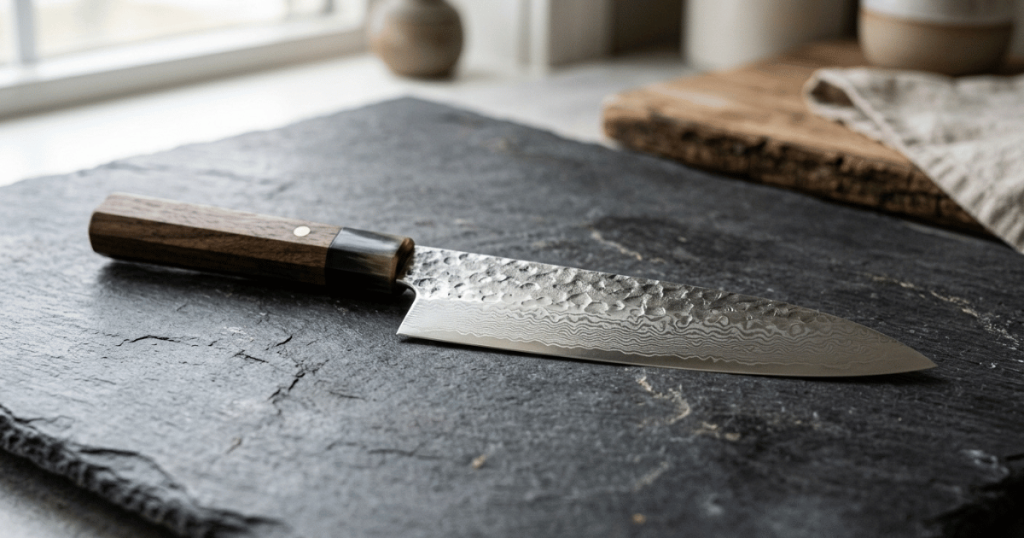
Three knives cover almost everything a home kitchen does: an 8-inch chef’s knife, a small paring knife and a serrated bread knife. Buy those three well before you buy a block of fifteen. When you compare specific models, judge them on what the manufacturer will state in writing, which is the steel designation, the hardness, the construction and the country of origin, because that is the only part of a product listing anyone can check.
The rest of this guide applies that test to the knives and sets people actually shop for, and shows you how to run it yourself on anything not named here.
How this guide decides, and what it will not claim
Criteria first, because a list with no stated criteria is an advertisement. Four things are weighed here. Does the maker publish a specification you can check, rather than adjectives. Does the piece count on the box correspond to actual knives. Does the maker’s own care instruction match how the buyer will really wash up. And what is each option plainly wrong for.
What is not weighed: our own testing, because there is none. This site has not cut anything with these knives, has not measured an edge and does not own them. Every specification below was read on the manufacturer’s own product page on 30 August 2026 and is attributed to it in the same sentence. Where a maker publishes nothing checkable, that is reported as a finding rather than filled in from memory. These knives are listed here, not reviewed.
You will find no prices on this page. Prices move faster than articles do, and a figure that is wrong when you click is worse than no figure. You will also find no star ratings or review counts, because a retailer’s rating measures satisfaction, not steel.
Type: start with three knives, not fifteen
The chef’s knife does most of the work in a home kitchen: chopping, slicing, dicing, breaking down produce. Eight inches suits most people and most boards. A paring knife handles the small in-hand jobs a chef’s knife is clumsy at, such as coring, peeling and trimming. A serrated bread knife exists because a straight edge cannot saw a crust without crushing the loaf, and no amount of sharpening changes that. A santoku is a reasonable swap for the chef’s knife if you prefer a shorter, flatter blade.
Everything past those three is either a specialist or a duplicate. Steak knives, shears, a honing steel and the block itself are what a set adds, and they are worth having. They are just not knives you are choosing between.
The single-knife route has an obvious candidate on most shopping lists. Victorinox’s own page for the Fibrox chef’s knife, model 5.2063.20, gives the blade as 20 cm, the weight as 182 g, the handle material as thermoplastic elastomers, dishwasher safe as yes, and construction under a field labeled plainly “Forged: No” (victorinox.com, read 30 August 2026). Where it is wrong for you: it is a light stamped knife with no bolster and a plastic handle, and Victorinox publishes no steel grade and no hardness figure for it. If you want heft in the hand or a spec sheet to compare, this is not the knife.
If you are adding to a chef’s knife rather than replacing everything, Henckels sells a Forged Accent 2-piece set of 3-inch and 4-inch paring knives, which its own page describes as having “forged bolster construction” and being “crafted from high-quality German stainless steel” (henckels.com, read 30 August 2026). Where it is wrong for you: two paring knives an inch apart is a duplicate for most cooks, and nothing in the box slices bread.
The piece count is not the knife count
This is the single most useful thing to check before you compare two sets, and almost nobody does it. A piece is anything in the box. Guards, shears, a steel and the block all count as pieces, so a bigger number can mean fewer knives. All contents below are as listed on each maker’s own product page, read 30 August 2026.
This page may contain affiliate links; see our Affiliate Disclosure.
| Set | Pieces on the box | Knives among them | What the rest of the count is |
|---|---|---|---|
| Cuisinart Advantage C55-01-12PCKS | 12 | 6 (chef, slicing, serrated bread, santoku, utility, paring) | 6 blade guards |
| Henckels Statement | 15 | 12 (6 kitchen knives plus 6 steak knives) | Kitchen shears, honing steel, hardwood block |
| McCook MC29 | 15 | 12 (6 kitchen knives plus 6 serrated steak knives) | 2 pairs of kitchen shears, block with built-in sharpener |
| Astercook 15-piece | 15 | 12 (6 kitchen knives plus 6 steak knives) | Kitchen shears, block with built-in sharpener |
| ZWILLING TWIN Signature | 19 | 16 (8 kitchen knives plus 8 steak knives) | Kitchen shears, 9-inch honing steel, 20-slot block |
Read the middle column and the ranking reorders itself. The 12-piece Cuisinart set is a six-knife set with covers, which is honest enough once you know it, and six is a sensible number of knives. The 19-piece ZWILLING set is genuinely the largest here, but half its knives are steak knives. A honing steel in the block is a real inclusion rather than padding, provided you know how to use a honing steel, since an unused rod is just an expensive dowel.
Steel: judge a maker by what it will put in writing
Nearly every listing in this category says “German stainless steel” or “high carbon”. Neither is a grade. A grade is a designation you can look up and compare across brands, and a hardness figure is a number the maker is committing to. Here is what each of these manufacturers publishes on its own site, and what it leaves out.
| Product | Steel named | Hardness published | Construction stated | Country of origin stated |
|---|---|---|---|---|
| ZWILLING TWIN Signature 19-pc | “Ice-hardened FRIODUR blade” (no grade designation) | Yes: “57 Rockwell Hardness” | “Single-piece, precision-stamped blade”, bonded to full tang | “Made in Germany” |
| Victorinox Fibrox chef’s knife 5.2063.20 | No | No | “Forged: No” | “Switzerland” |
| Henckels Statement 15-pc | “High-quality stainless steel” | No | “Single-piece, precision-stamped”, full tang | No |
| Henckels Forged Accent 2-pc | “High-quality German stainless steel” | No | “Forged bolster construction” | No |
| Astercook 15-piece block set | Yes: “German 1.4116” | No | Full tang, double bolster | No |
| McCook MC29 15-pc | “Forged, high-carbon one-piece German stainless steel” | No | “Forged”, one-piece | No |
| Farberware 22-piece | No manufacturer product page found for this set on our research date. Specification unverified. | |||
| Amazon Basics 12-pc and 14-pc | Retailer’s own label. No separate manufacturer product page found. Specification unverified. | |||
All fields read on each maker’s own site on 30 August 2026. The pattern is the useful part. Exactly one product here publishes a hardness figure, and it is the most expensive one. Exactly one budget block names an actual grade, and it is not the one with the best-known brand. Two of the ranges people buy most have no manufacturer page publishing anything at all, which does not make them bad knives, but it does mean nobody can tell you what is in them.
Use the table as a method rather than a verdict. Open the maker’s page for whatever you are considering, look for those four fields, and treat a listing that fills none of them as a knife you are buying on trust alone.
Forged or stamped settles less than the box implies
Forged blades are shaped from a heated billet and usually carry a bolster and more weight. Stamped blades are cut from rolled sheet and are lighter. The marketing has hardened this into a hierarchy, and the manufacturers’ own pages quietly refuse to support it.
ZWILLING describes the premium TWIN Signature set as “single-piece, precision-stamped”, in the same panel as its 57 Rockwell figure and its “Made in Germany” line. McCook describes its budget MC29 block as “forged, high-carbon one-piece German stainless steel”, and publishes no hardness, no grade and no country of manufacture. Henckels puts “precision-stamped” on the Statement block and “forged bolster construction” on the two-piece paring set, both from the same brand. On these pages, construction describes how the blade was made. It is not a ranking of what the blade will do.
What construction does reliably tell you is weight and feel. A forged knife with a full bolster is heavier in the hand and has a finger guard where the blade meets the handle. A stamped knife is lighter and easier to move quickly. That is a preference, and it is worth settling before you spend, because it is the one difference you will notice every single day.
Origin is a per-model fact, not a brand fact
Here is something we did not expect to find, and it is a good reason to read the maker’s page for the exact model rather than the brand. On victorinox.com, the product page for the Fibrox chef’s knife, model 5.2063.20, gives “Country of origin: Switzerland”. The product page for the Fibrox 8 Piece Block Set, model 5.1193.8-X1, gives “Country of origin: United States” and adds that all knives in it are “National Sanitary Foundation (NSF) approved and dishwasher safe”. Both were read on 30 August 2026, both are the maker’s own field, and they are two products in the same collection.
We are reporting the field, not interpreting it, and a set’s origin field may describe where the set was assembled rather than where each blade was made. The practical lesson stands either way. “Swiss made”, “German”, “made in USA” are claims attached to a model number, not to a logo, and the only place to settle one is the maker’s page for that exact model. Every origin claim on this site is quoted from a manufacturer field with the date it was read.
Budget: three routes that all make sense
There is no single best kitchen knife, because the three buyers below want opposite things and all three of them are right.
Route one, one good knife plus two. Buy the best chef’s knife you will actually maintain, then add a paring knife and a bread knife when you notice you need them. The Victorinox Fibrox 5.2063.20 is the standard example of this route because it is light, Swiss made per its own page, dishwasher safe per its own page, and sits at the budget end of the market rather than the premium one. Not for you if you want a spec sheet, a bolster, or a handle you enjoy looking at.
Route two, a budget block you will actually use. If the household reality is several people reaching for knives at once, a block of twelve is not indulgence, it is logistics. Among the budget blocks, the Astercook 15-piece is the one whose maker names a steel grade, German 1.4116, and states full tang construction. The McCook MC29 calls its steel forged, high-carbon one-piece German stainless. The Cuisinart Advantage 12-piece is six coated knives with six guards and no block at all, which is a different proposition from a block set and should be compared as such. Not for you if you want one excellent knife, because the same money spent on a single blade buys more knife than it does spread across twelve.
Route three, the premium block. ZWILLING’s TWIN Signature 19-piece is the most transparent product on this page: a named hardness of 57 Rockwell, ice-hardened FRIODUR blades, full tang, made in Germany, all on the maker’s own page. Henckels’ Statement 15-piece sits below it from the same house, precision-stamped and full tang, with no hardness or origin published. Not for you if you were hoping the price buys forged blades, since ZWILLING states plainly that these are stamped, or if you have no use for eight steak knives.
Read the maker’s care line before you buy, not after
A care instruction is a purchase constraint, and the makers here do not agree. ZWILLING and Henckels both put “dishwasher safe, hand washing recommended” on the pages above. Victorinox marks the Fibrox chef’s knife “Dishwasher safe: Yes” outright and lists NSF approval for the Fibrox block set. McCook asks for “hand-wash for best results” on the MC29. If nobody in your house will hand wash a knife, that last line rules a set out before any question of steel arises.
The second constraint is sharpening. Every knife on this page dulls, and the method that suits it depends on the steel, the grind and how the knife is used. Deciding that before you buy is cheaper than discovering it afterwards, and our guide to sharpening kitchen knives lays out what each method costs in metal and in time. A block with a built-in sharpener, as the McCook and Astercook blocks have, takes that decision away from you and applies the block’s angle to your blade. That is convenient, and it is not free.
What we could not verify
Naming the gaps is part of the method. We found no manufacturer product page publishing a specification for the Farberware 22-piece block set, and none for the Amazon Basics 12-piece color-coded or 14-piece full tang sets, which are a retailer’s own label rather than a maker with a spec-publishing site. Those three appear on this page as options people buy, with no claims attached to them.
Only ZWILLING published a hardness figure. No maker on this page publishes an edge angle for these knives. We have not seen independent laboratory testing of any of them, we ran no tests ourselves, and we have quoted no retailer ratings or review counts. Where this guide carries a number, a manufacturer printed it and we have said where and when we read it.
Frequently asked questions
What are the best kitchen knives for a home cook?
For most kitchens, an 8-inch chef’s knife, a paring knife and a serrated bread knife, bought as well as the budget allows, beat any large set. Add steak knives and shears later if you want them. Choose between specific models by what the maker publishes about steel, hardness, construction and origin.
Is a 15-piece knife set better value than three good knives?
It depends on how many people cook at once. A 15-piece set is usually six kitchen knives, six steak knives, shears, a steel and a block, so most of the count is not chef’s-knife money. If one person cooks, three good knives will feel better every day. If a household cooks together, a block solves a problem that three knives do not.
Does “forged” mean a knife is better than “stamped”?
Not on its own. ZWILLING describes its premium TWIN Signature blades as precision-stamped while publishing a 57 Rockwell hardness figure and a Made in Germany line, and budget sets describe themselves as forged while publishing no hardness at all. Construction reliably tells you about weight, bolster and feel. It does not tell you about the steel.
What steel should I look for in kitchen knives?
Look first at whether the maker names one. A designation such as 1.4116 is checkable and comparable between brands; “German stainless steel” or “high carbon” is a description, not a grade. Among the sets on this page, Astercook names a grade on its own listings and ZWILLING publishes a hardness figure. Most of the others publish neither.
Can I put kitchen knives in the dishwasher?
Check the maker for your model, because they differ. ZWILLING and Henckels state dishwasher safe with hand washing recommended. Victorinox states dishwasher safe as yes for the Fibrox chef’s knife. McCook asks for hand washing for best results on the MC29. The company that sold you the knife is the only authority on this, and the answer can decide which set is right for your household.