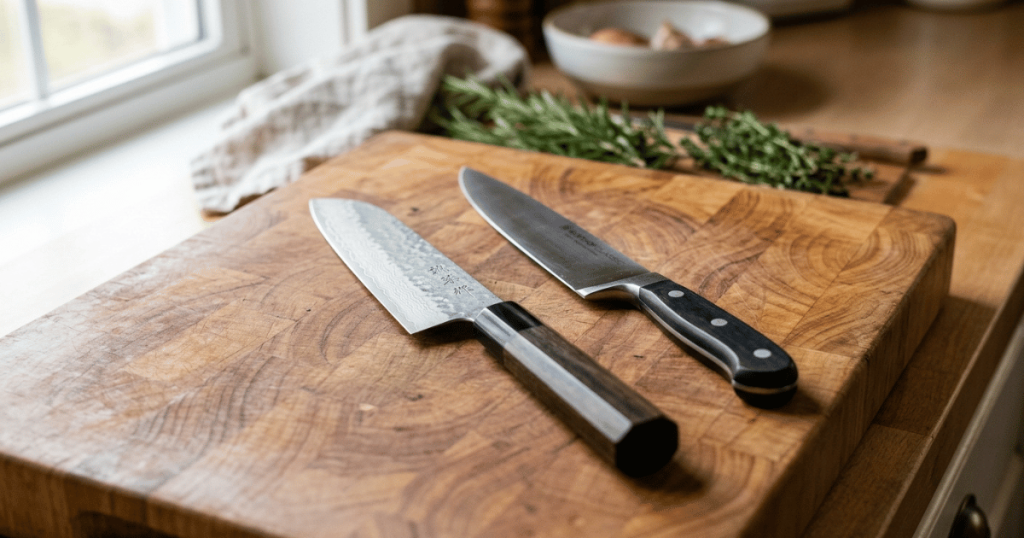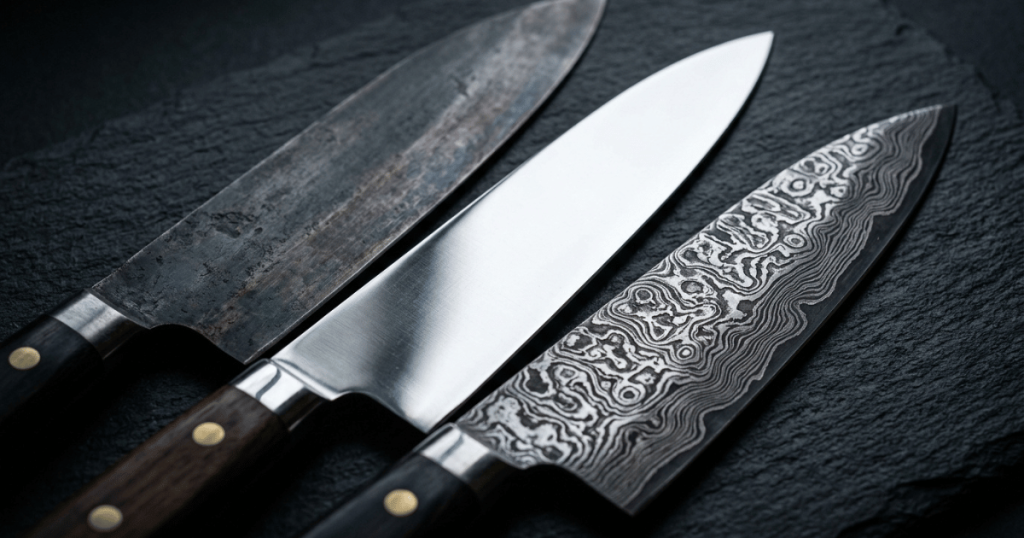
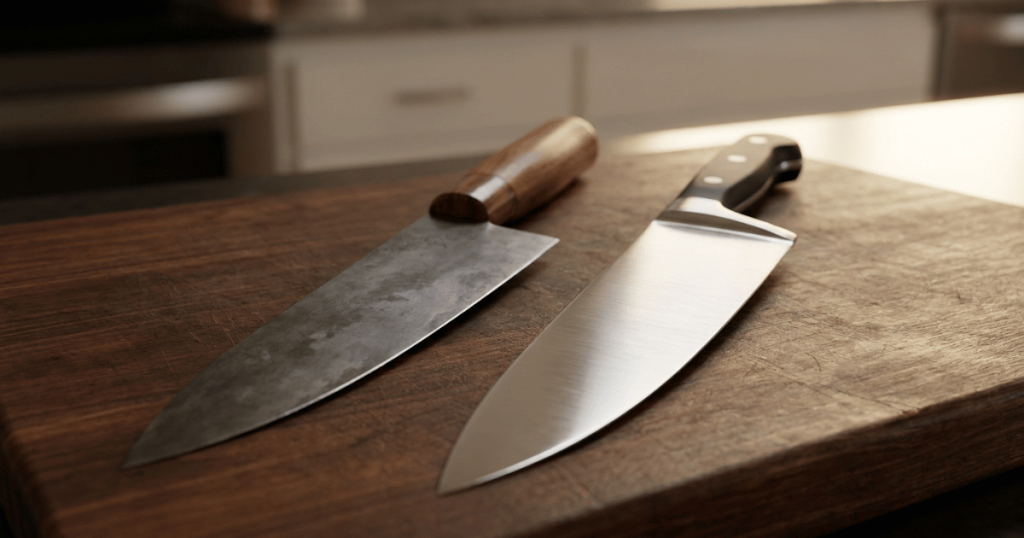
The short answer to carbon steel vs stainless steel knives: carbon steel is a plain iron-carbon alloy that takes a sharper edge and is easier to resharpen, but it rusts within minutes if left wet. Stainless steel adds at least 10.5% chromium, which forms a self-repairing oxide layer that resists corrosion, at the cost of being somewhat harder to sharpen at home. Neither steel is objectively “better.” The right one depends on how much drying and oiling you’re willing to do between cuts.
What Actually Makes a Steel “Stainless”
Every kitchen knife blade starts as an alloy of iron and carbon. The carbon is what lets the steel be hardened at all; without it, you have soft, unhardenable iron. Plain carbon steel stops there, iron plus roughly 0.5% to 1.5% carbon, sometimes with trace manganese or silicon added for workability.
Stainless steel takes that same base and adds chromium, and it takes a specific amount to change the steel’s behavior. Once chromium reaches approximately 10.5% by weight, a thin, transparent layer of chromium oxide forms on the surface. That layer is what makes the steel “stainless”: it blocks oxygen and moisture from reaching the iron underneath, and if you scratch it while cutting, it reforms on its own within minutes, as long as the blade sees air. Below that chromium threshold, the same protective layer does not form reliably, which is why a blade advertised as “high-carbon steel” with no stated chromium content should be treated as a carbon steel for care purposes, whatever the marketing copy calls it.
Why Carbon Steel Takes and Holds a Sharper Edge
Edge sharpness comes down to how fine a grain structure the steel can hold at the very apex of the edge, and how hard that apex is. Plain carbon steel has a simpler crystal structure than stainless because it isn’t carrying large chromium-carbide particles through the matrix. Those chromium carbides are what give stainless steel its corrosion resistance, but they are also physically harder and coarser than the surrounding steel, which makes the edge slightly more prone to micro-chipping at very acute angles and marginally harder to refine to a fine apex on a stone.
That difference is also why sharpening technique diverges between the two. A carbon steel edge raises a burr quickly and predictably under a whetstone, which is the tactile signal most sharpening guides tell you to feel for before moving to the next grit; our guide on what a burr is and why a knife stays dull on the board walks through that signal in detail. Stainless steel’s harder carbides mean the burr forms less obviously, which is one reason beginners on stainless blades benefit more from a fixed-angle system; see our breakdown of sharpening angle guides and jigs for beginners if you’re deciding whether to freehand or use a jig.
The Corrosion Tradeoff: Reactive Steel vs Passive Layer
This is the practical difference that decides most buying decisions. A plain carbon steel blade left wet on a cutting board starts to discolor within roughly 30 minutes and can show visible rust spots within two to three hours, depending on humidity and what you just cut (acidic produce and salt both accelerate it). That reactivity is not a manufacturing flaw; it’s the same iron-carbon chemistry that lets the steel sharpen so easily. Owners of carbon steel knives typically build a patina deliberately, a dark gray oxide layer formed by controlled exposure, which slows further corrosion without the chromium layer stainless steel gets for free.
Stainless steel’s chromium oxide layer means a quick towel-dry after washing is usually enough. It will not rust from a normal wash-and-dry routine, though pitting can still occur if it sits wet in a sink for days, or if it’s washed with anything containing chlorine bleach. For a fuller list of what actually damages either type of blade over time, our guide to what ruins kitchen knives covers storage, dishwashers and cutting surfaces beyond just rust.
High-Carbon Stainless: The Middle Ground
Steelmakers have spent decades trying to close the gap between the two categories, and the practical answer is high-carbon stainless steel: a stainless alloy with a carbon percentage pushed higher than a typical corrosion-resistant grade, so it can be hardened further before the chromium carbides start working against edge geometry. BÖHLER N690, a stainless knife steel from Böhler-Uddeholm, is a documented example: the manufacturer’s own product page lists a composition of roughly 1.08% carbon and 17.3% chromium, well above the stainless threshold, plus molybdenum, vanadium and cobalt additions for wear resistance (Böhler-Uddeholm N690 product page, read 2026-09-18). Knife-steel composition trackers that compile published supplier spec sheets list N690’s recommended working hardness at 58 to 60 HRC (zknives.com steel composition database, read 2026-09-18), which sits close to what a mid-range plain carbon blade can reach, while still carrying the stainless classification’s corrosion resistance.
Steels like this are why the carbon-versus-stainless line has blurred at the higher end of the market. A high-carbon stainless blade will not sharpen quite as fast as a plain carbon blade of similar hardness, but it closes most of the practical edge-retention gap while removing the rust risk. It costs more to produce than a basic stainless grade, which is usually reflected in the knife’s price.
Edge Retention and Sharpening Ease Compared
Edge retention is a function of hardness, carbide structure and how thin the edge geometry is, not the steel category alone. A well-heat-treated plain carbon blade at 61 to 63 HRC will generally outlast a soft stainless blade at 54 to 56 HRC in a home kitchen, but a well-made high-carbon stainless blade at 60 HRC can outlast both. What changes between categories is how the edge dulls and how you restore it. Carbon steel tends to roll or fold at a microscopic level before it chips, which a few passes on a fine stone or a strop correct quickly. Stainless steel tends to dull more gradually and evenly, and once it does, its harder carbide structure means more passes are needed to reset the same edge. Tracking that dulling pattern rather than a fixed schedule is the more reliable approach either way; our guide to how often to sharpen kitchen knives explains the signals to watch for instead of guessing by the calendar.
Which Should You Buy?
Choose carbon steel if you cook daily, you’re willing to dry the blade the moment you set it down, and you want the sharpest possible edge with the least sharpening effort. It rewards attention and punishes neglect quickly and visibly.
Choose stainless steel, or high-carbon stainless if your budget allows it, if you want a blade that tolerates a busy kitchen, a shared household, or occasional forgetfulness about drying it immediately. You’ll sharpen it slightly less easily at home, but you won’t be checking it for rust spots the next morning.
Neither choice is a downgrade. Professional kitchens run both, often choosing carbon steel for prep stations with constant attention and stainless for service stations where a knife might sit wet for an hour during a rush.
FAQ
Does carbon steel actually get sharper than stainless steel?
At comparable hardness levels, plain carbon steel can be sharpened to a finer apex because it lacks the large chromium carbides that make stainless steel’s structure coarser at the edge. The difference is measurable on a microscope but often marginal in daily cutting feel once both blades are properly sharpened.
How fast does a carbon steel knife actually rust?
Left wet, discoloration can begin within about 30 minutes, with visible rust spots possible within two to three hours depending on humidity and what was cut. Drying the blade immediately after washing prevents this almost entirely.
Is high-carbon stainless steel worth the extra cost?
If you want most of carbon steel’s edge performance without the rust maintenance, yes. Steels like BÖHLER N690 push carbon content higher than typical stainless grades while keeping chromium well above the stainless threshold, which is why they cost more to produce than basic stainless.
Can a stainless steel knife rust at all?
Yes, though rarely from normal use. Prolonged soaking, dishwasher cycles, or contact with chlorine bleach can pit even a properly stainless blade over time, because the chromium oxide layer can be worn away faster than it reforms under those conditions.
Do carbon steel and stainless steel knives need different sharpening angles?
Not fundamentally, but stainless steel’s harder carbide structure makes consistent angle control more important, since it’s slower to feel the burr forming. A fixed-angle guide can help beginners get consistent results on stainless blades before moving to freehand sharpening.