In the serrated vs non serrated steak knives question, the short answer is this: a straight (non serrated) edge cuts cooked meat more cleanly and is far easier to resharpen, while a serrated edge keeps cutting longer between sharpenings because its teeth protect most of the edge from the plate. If you will hone and sharpen your steak knives, buy straight edges. If you want knives that keep working for years with little care, and you accept a slightly rougher cut, buy serrated.
The rest of this page explains why, starting with the part most comparisons skip: the plate under the steak does more to your edge than the steak does.
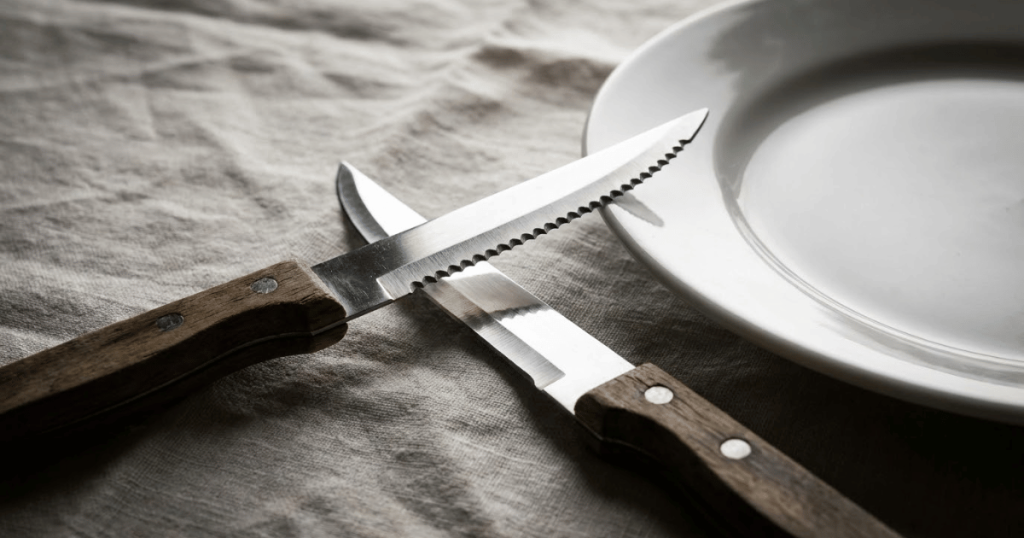
Serrated vs non serrated steak knives at a glance
| Straight (non serrated) edge | Serrated edge | |
|---|---|---|
| How it cuts | Slices: one continuous edge severs fibers | Saws: points pierce, gullets tear through |
| Cut surface on a steak | Smoother, less torn | Rougher, more shredded fibers |
| What the plate touches | The whole edge, every stroke | Mostly the tips of the teeth |
| How long it feels sharp | Shorter, especially on glazed plates | Longer, often much longer |
| Resharpening | Any stone, rod or sharpener | Tapered rod, one gullet at a time, or a professional |
| Best for | Cooks who maintain knives, quality steaks | Low-maintenance homes, heavy daily use |
Why a straight edge cuts cooked meat more cleanly
A straight edge works by concentrating force on a very thin line. When it is sharp, that line parts muscle fibers as it draws through, and the cut face is left smooth. Cooked steak is soft and fibrous, not hard, so it does not need the grip of teeth to start a cut. A keen edge slides in on its own.
A serrated edge works differently. Each point concentrates force on a tiny area and pierces; the scalloped gullets between the points then drag through the fibers in a sawing stroke. That is ideal for a hard crust over a soft interior, which is why bread knives are serrated. On a tender steak it means the fibers are torn as much as they are cut.
The most detailed hands-on comparison in the current search results, from Prudent Reviews (article by Andrew Palermo, updated June 3, 2026, read September 28, 2026), found exactly this. Testing filet mignon, New York strip and skirt steak, the reviewer reports that the straight edge cut cleanly with minimal juice loss, while the serrated knife caused fibers to “rip and shred slightly,” including on skirt steak, the cut where serrations are often said to help. That is their test, not ours; we report it as their finding.
What the plate does to your edge
This is where the argument usually gets thin, so it is worth being precise.
A steak knife almost never dulls on steak. It dulls on what is under the steak. A glazed dinner plate is a glass-like surface that is harder than knife steel, which is why knife makers routinely warn against cutting on stone, glass or ceramic. Every time a straight edge finishes its stroke on the plate, the thinnest part of the edge, the apex, is pushed sideways or worn flat. A few meals of that and the edge rolls, and the knife starts to skate on the sear instead of biting.
A serrated edge meets the plate differently. Only the tips of the teeth touch it. The cutting edge inside each gullet sits up off the plate and is shielded from contact. The tips wear, but the recessed edges behind them keep doing the work. That is the whole mechanism behind the “serrated knives stay sharp longer” claim, and it is real.
What it means in practice: a straight-edge steak knife is not failing when it feels dull after a few weeks of dinners. It is behaving exactly as steel against glaze predicts, and it needs honing more often than your chef’s knife, which spends its life on a wooden or plastic board.
What the edge retention data actually shows
The best published measurement of plain versus serrated wear comes from Knife Steel Nerds, the metallurgy site run by Larrin Thomas. In Which Steel Has the Best Edge Retention? Part 2 (published November 26, 2018, read September 28, 2026), he compares CATRA cutting results for the same steel with a plain edge at 26 degrees and a serrated edge at 22 degrees.
The results show both sides of the trade:
- At the start, the plain edge cuts better. The serrated edge only overtakes it in cutting ability at about 18 cuts, and in total cardstock cut at about 47 cuts.
- Over the standard 60 cut test, serrated edges come out ahead. The plain edge cut 732 mm in total and the serrated edge 837 mm. Thomas notes the edge angles were not identical and suspects the totals would be similar if both were at 22 degrees.
- Over a long run, serrated edges barely fade. He describes the serrated edge’s wear between cuts 120 and 200 as “essentially flat.”
His conclusion fits the steak knife question almost word for word: if you accept “moderately low cutting ability along with the more saw-like cutting of a serrated edge,” the blade “will keep cutting for much longer than a plain edge.”
Note what CATRA measures: cutting ability through an abrasive test medium, not smoothness of the cut surface. It tells you how long each edge keeps working. It does not tell you how the steak looks afterward. The two findings above, cleaner cuts from straight edges and longer life from serrated ones, are not contradictions. They are the two halves of the same trade.
Prudent Reviews simulated plate wear separately, sliding each knife across a ceramic dinner plate 300 times to stand in for roughly 30 steaks, and found both types “still performed effectively” afterward, with the straight edge showing some dullness. The gap is real but slow to build.
Not all serrations are the same
“Serrated” covers several different edges, and the difference matters when you buy.
- Scalloped serrations. Rounded, fairly widely spaced waves, like a bread knife. They tear less than pointed teeth and can be resharpened one scallop at a time.
- Pointed or saw-tooth serrations. Sharper, more aggressive teeth. They grip a charred crust well and tear more on tender meat.
- Micro-serrations. Very fine teeth, often on inexpensive sets sold as never needing sharpening. The teeth are too small to resharpen individually in any practical way. When they wear out, the knife is effectively done.
If you want a serrated set you can keep for decades, look for teeth large enough to see clearly and a maker that states the edge can be resharpened.
Sharpening each type
A straight-edge steak knife sharpens like any other kitchen knife. A whetstone, a guided system or a sharpener all work, and between sharpenings a few strokes on a rod straighten the rolled edge the plate leaves behind. Our guide to using a honing steel covers the angle and pressure; steak knives respond to it well because most of their dullness is a rolled edge rather than lost metal.
A serrated steak knife is sharpened one gullet at a time with a tapered rod, working only the beveled side, then removing the burr from the flat back. It is slow on a set of six or eight knives, but it is needed rarely. Our step-by-step on how to sharpen a serrated knife, one tooth at a time walks through it; the method is the same for steak knives as for bread knives. Keep serrated knives out of pull-through and electric sharpeners designed for straight edges, which grind across the teeth and flatten them.
The steel matters less than you think
With steak knives the edge style usually matters more than the steel grade. Two things explain why.
First, the plate wins against any knife steel. A harder steel resists rolling a little better, but against a glazed plate it is still the softer material. You will not buy your way out of plate contact with a premium alloy.
Second, harder steel is less forgiving of a hard strike. A very hard, thin straight edge that meets a plate at an angle is more likely to chip than roll. A slightly softer steel rolls instead, and a roll is fixed with a honing rod in seconds, while a chip needs real sharpening. For a knife that will hit ceramic at every meal, a tough, moderately hard steel is often the better match than the hardest steel a maker offers. Check the maker’s own published specification for the steel and hardness rather than a marketing claim, and treat a set with no stated steel as an unknown.
Which should you buy?
- You cook good steaks and do not mind honing before dinner. Straight edge. You get the cleaner cut every time, and the upkeep is a minute with a rod.
- Your steak knives go in a drawer, get used daily and are rarely sharpened. Serrated, with visible scalloped teeth rather than micro-serrations, so the set can be restored later.
- You serve on stoneware or heavy glazed plates. Expect straight edges to need honing often. If nobody in the house will do that, serrated knives will serve you better.
- You already own good straight-edge knives and a whetstone. Stay straight; you have the tools to keep them working.
Whichever you choose, keep steak knives out of the dishwasher. Rattling against other cutlery and plates dulls both edge types, and our explainer on whether you can put knives in the dishwasher covers what else the cycle does to a blade and handle.
A note on safety at the table
A dull straight-edge steak knife is the one that slips. When the edge skates on a seared crust, people press harder, and a sudden release sends the blade toward the plate or the hand holding the fork. Hone straight-edge knives before a steak dinner, cut with the fork holding the meat away from the blade’s path, and keep the knife pointed down and away from others when passing it.
FAQ
Are serrated or non serrated steak knives better?
Non serrated steak knives cut cooked meat more cleanly and are easy to resharpen. Serrated steak knives keep cutting longer without maintenance because the plate mostly touches the tips of the teeth. Choose by how much upkeep you will actually do.
Why do serrated steak knives stay sharp longer?
The cutting edge sits inside the gullets between the teeth, raised off the plate. Only the tips make contact with the glaze, so most of the edge is protected from the surface that dulls a straight edge fastest.
Do non serrated steak knives dull faster on plates?
Yes. The whole edge meets the plate at the end of each stroke, and a glazed plate is harder than knife steel. Regular honing straightens the rolled edge and keeps a straight-edge set working between sharpenings.
Can you sharpen serrated steak knives?
Knives with visible scalloped or pointed teeth can be sharpened one gullet at a time with a tapered rod. Very fine micro-serrated edges are generally not practical to resharpen, so treat them as knives with a limited working life.
Should steak knives go in the dishwasher?
No. Contact with other cutlery and dishes during the cycle dulls straight and serrated edges alike, and heat and detergent are hard on many handle materials. Wash them by hand and dry them right away.