Wash each knife by hand right after you use it, dry it straight away instead of leaving it wet on a rack, never let it sit in a full sink, keep the edge straight with a honing rod between real sharpenings, and read the care page published by whoever made your knife before you follow any universal rule, because the makers do not all say the same thing. That is routine care in one paragraph. The rest of this guide is about what to do when something has already gone wrong, and about which damage is worth worrying over.
This is the care guide for the knife itself: the sink, the edge, the steel and the handle.
How to take care of kitchen knives, in the order that matters
Almost every care article gives the same five instructions, and they are not wrong. Hand wash. Dry. Hone. Sharpen. Do not abuse the edge. What those articles rarely do is tell you which of those five actually decides whether your knife is still good in twenty years, or admit that the companies who built the knives disagree with each other on the details.
Two things decide the outcome. The first is time in contact with water, salt and acid, which is where corrosion starts. The second is how much steel gets removed over the knife’s life, which is the one cost you can never reverse. Nearly everything below traces back to one of those two.
Rank the damage by whether it comes back
Most people worry about the marks they can see and ignore the loss they cannot. Water spots are the least important thing on this list. Metal that is gone is the most important, and it is invisible until the day the blade looks noticeably shorter from spine to edge.
| What you see | What it actually is | Does it come back? |
|---|---|---|
| Dull, tearing edge | An apex that has rolled over or worn away | Yes, fully. Seconds with a rod if it rolled, one sharpening session if it wore |
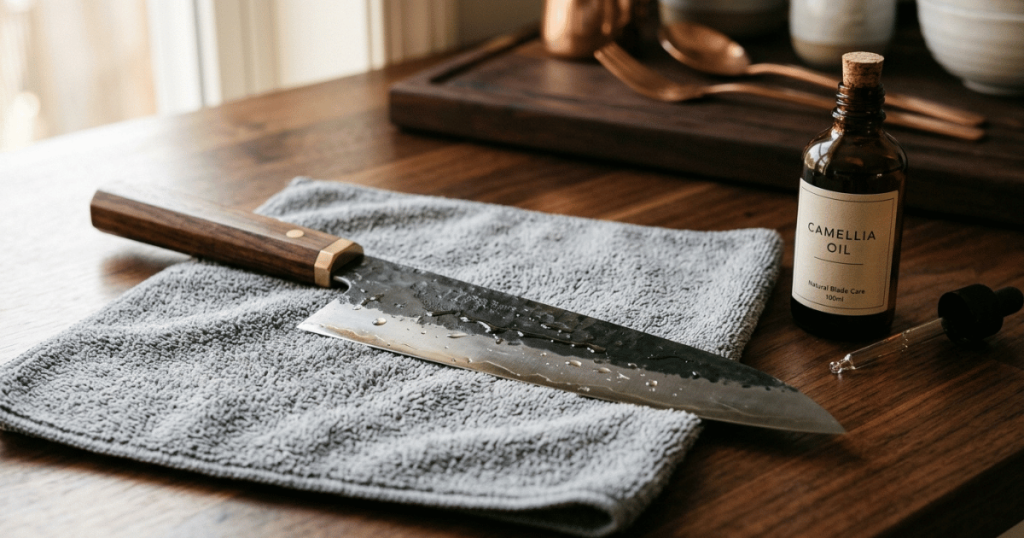
| Cloudy spots after drying | Mineral deposits from water left to evaporate | Yes. A towel prevents them |
| Gray, blue or brown film on carbon steel | Patina, a settled oxide layer that does not wipe off | It does not need to. Cosmetic, and generally stable |
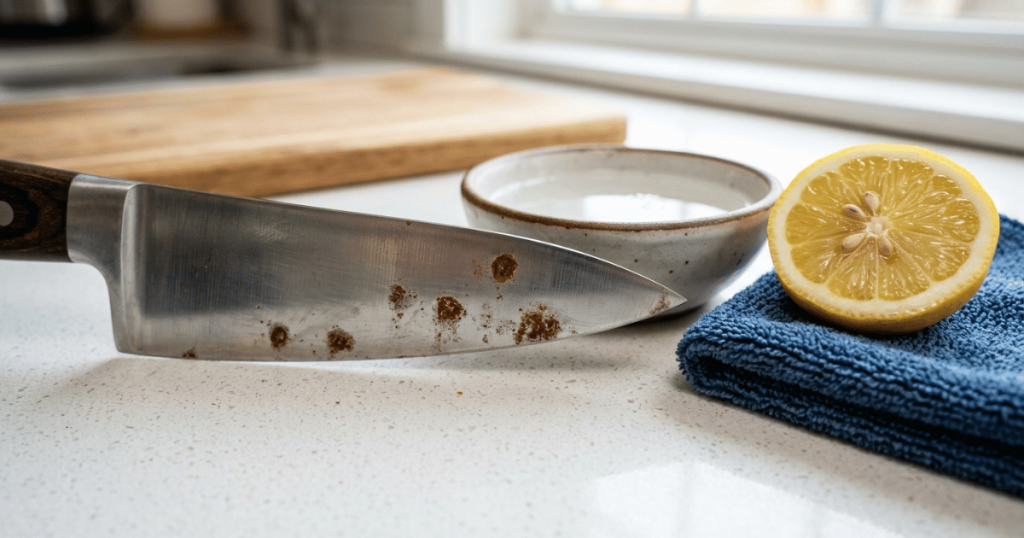
| Orange bloom or spotting | Surface rust that has not eaten into the steel yet | Usually. It comes off, but find the cause or it returns |
| Dark pits that stay after the orange is gone | Corrosion that has eaten into the steel | No. Permanent, and serious if it reaches the edge |
| A blade that has lost height, or a bolster standing proud of the edge | Years of sharpening, one session at a time | No. This is the knife’s life being spent |
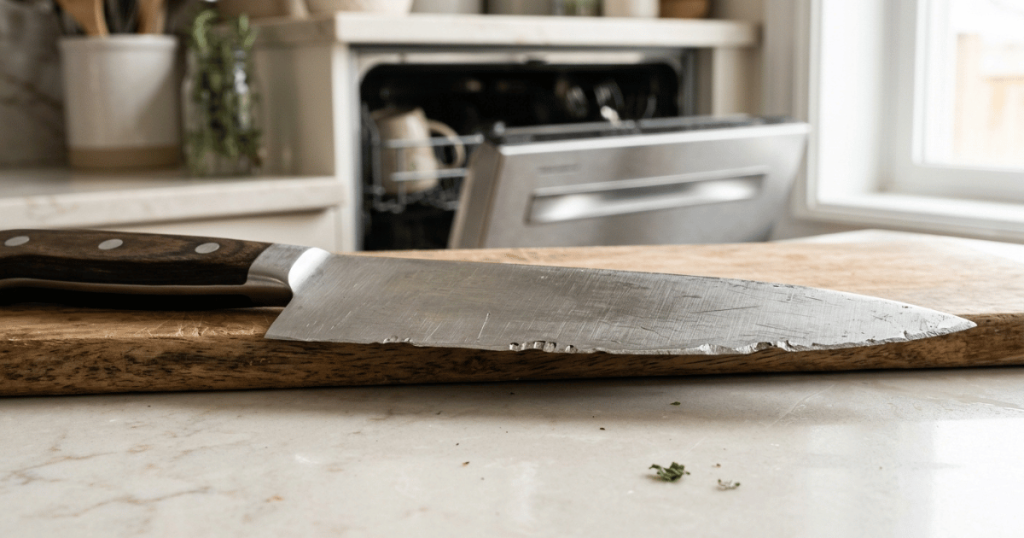
| A chip or a snapped tip | Mechanical damage | Only by grinding the edge back behind it, which costs blade height |
| A swollen, cracked or loose wooden handle | Water that got into the wood or under the rivets | Sometimes, if caught early. Otherwise it is a rehandle |
Read that column on the right and the priorities reorder themselves. Drying a knife takes four seconds and prevents two rows. Choosing a gentler way to restore an edge protects the row that can never be undone.
The sink is where most kitchen knives die
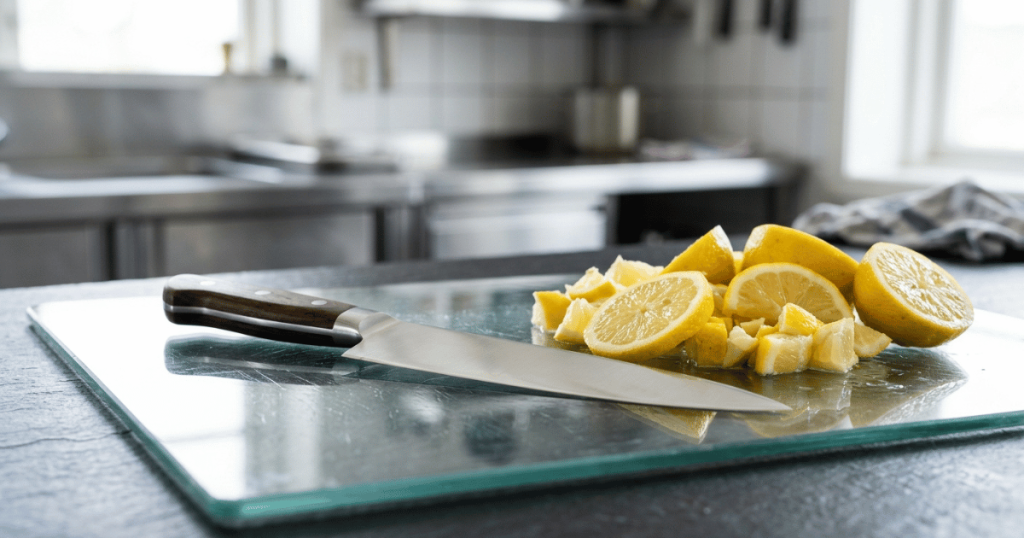
Not the cutting, the cleaning. Wusthof’s care page tells owners to hand wash knives right after use in warm water with mild dish soap, and adds a line that matters more than it sounds: “Do not leave knives sitting or soaking in the sink,” because food residue and juices can damage blades and cause corrosion. Victorinox makes the same point from the other end, warning that leaving food on the blade, especially acidic ingredients such as tomatoes or citrus, can cause discoloration or pitting.
So the rule is not really “hand wash.” It is “do not let anything sit on the steel.” A rinse under the tap in the ten seconds after you finish is worth more than a careful scrub twenty minutes later.
Do it one knife at a time, with the edge turned away from your hand and the cloth moving along the spine rather than across the edge. A knife hidden under soap suds in a full sink is the single most likely way a home cook gets cut while cleaning up, and it is entirely avoidable. If a knife slips as you wash it, step back and let it land. Nobody catches a falling blade well.
The dishwasher question the internet answers wrong
Search this and you will be told never, by everyone. The makers are less unanimous than that. Wusthof’s instruction is flat: do not place knives in the dishwasher, because of the heat and the knocking about during the cycle. Victorinox states on its own care page that all of its household knives with synthetic handles are dishwasher-safe, and then recommends hand washing anyway, to protect both blade and handle and to keep the edge sharper for longer.
Both of those are correct, for their own knives. That is the point. A dishwasher-safe rating is a claim the manufacturer makes about a specific handle material and a specific steel, so the only authority for your knife is the company that sold it. Two things are agreed across both pages: wooden handles never go in a dishwasher, and hand washing is the recommendation even where the machine is permitted. When the maker and the hobbyist disagree, follow the maker for what the knife can survive and the hobbyist for what keeps it at its best.
Drying, and the one place the sources genuinely conflict
Victorinox says not to let knives air-dry, because that leaves limescale spots, and to use a cotton or linen towel immediately after washing. NC State Extension’s kitchen knife guidance, by Christa Snyder, published in March 2023 and updated in August 2024, says to wash by hand and let the knife air dry alone on a towel.
They agree on more than they disagree. Both want the knife out of the pile, on its own, not dripping among other steel. The disagreement is about evaporation, and it is cosmetic rather than structural on stainless. Towel-drying immediately satisfies both, so that is what we suggest. On carbon steel there is no debate at all: dry it now, because carbon steel can start to bloom orange within hours of being left wet.
The edge: honing is maintenance, sharpening is surgery
A knife that feels dull is usually not worn out. Its edge has bent over to one side under normal use, and a rod pushes it back. That takes seconds, removes almost no metal, and can be done weekly or more often without cost. Our guide to using a honing steel covers the grip, the angle and how to tell the rod is doing anything at all.
Sharpening is different in kind, not in degree. It grinds a new apex by removing steel, which is the one thing on the damage table that never comes back. That is not an argument against sharpening a knife that needs it, since a dull knife is a knife you stop using. It is an argument against sharpening on a schedule. Sharpen when honing stops bringing the edge back, and choose a method that removes as little as the job requires. The trade-offs between a stone, a pull-through and a machine are laid out in our guide to sharpening kitchen knives.
We are not going to print an angle or a frequency here as if one number fitted every knife. Both depend on the steel, the grind and how the knife is used, and where a maker publishes a figure for its own knives, that figure is the one to follow.
Rust, stainless, and what “stainless” does not mean
Stainless steel contains chromium, which forms a protective layer that resists corrosion. It resists it. It does not prevent it. Salt, acid, standing water and time will mark stainless too, which is why the Victorinox warning about tomatoes and citrus applies to everyday stainless kitchen knives and not only to carbon steel.
When you find marks, work out what you are looking at before you attack it. A gray or blue film on a carbon steel blade that will not rub off is patina, and it is doing a job: many carbon steel owners encourage it. Orange bloom that wipes or scrubs away is surface rust, treatable, and a signal that something in the routine is leaving the knife wet. Dark pits that remain after the orange has gone are pitting, and no method restores the steel that has left. If pitting reaches the cutting edge, the question stops being cleaning and becomes whether the knife can be ground back past the damage, or whether it is finished.
Handles fail before blades do
The blade is often the most durable part of the knife. Wooden handles are the part that actually ends knives in home kitchens, because water wicks in around the rivets and the tang, then swells the wood, then loosens it. Wusthof’s advice for wooden handles is a few drops of food-grade mineral oil buffed in with a soft cloth. Victorinox similarly treats wooden handles as a separate case that must stay out of the dishwasher and out of long soaks.
The practical version: never leave a wooden-handled knife submerged, dry the handle as carefully as you dry the blade, and if the wood starts to feel dry or chalky, oil it. Once a handle is cracked or moving on the tang, oil will not save it, and a loose handle on a sharp blade is a safety problem rather than a cosmetic one.
When care and food safety are not the same instruction
Everything above is about protecting the knife. Food safety is a separate standard, and it is stricter. USDA’s Food Safety and Inspection Service tells home cooks to wash the knife, along with the board and the countertops, in hot, soapy water after cutting raw meat, because bacteria in raw meat and poultry juices spread to other foods, utensils and surfaces.
A quick rinse is fine for an apple. It is not the standard after raw chicken. Where the two goals conflict, food safety wins, then dry the knife immediately afterwards so the hot wash does not cost you a rust spot.
The safety claim everyone repeats and nobody sources
“A dull knife is more dangerous than a sharp one” appears in almost every care guide. Our research found it on knife retailers, sharpening services and cutlery blogs, all stating it as established fact. We did not find a controlled study comparing injury rates between sharp and dull blades, and the injury figures usually quoted alongside the claim come from general emergency-department knife-injury tallies that do not record how sharp the blade was.
The mechanism is plausible: a dull edge needs more force, more force makes a slip more energetic, and a torn wound closes worse than a clean one. Plausible is not measured, and we would rather say so than pass on a statistic we cannot trace. Keep your knives sharp for the reasons that are not in dispute. A sharp knife does the work you ask it to, needs less pressure, and does less damage to what you are cutting. If you want the safety argument too, treat it as sensible reasoning rather than proof.
When care stops being the answer
Care has a limit, and honest care advice names it. A knife with pitting through the edge, a bend, a cracked tang or a handle coming away from the blade is a repair question, not a maintenance question. So is a chip deep enough that the edge must be ground back behind it, which costs real blade height and is worth having a professional sharpening service quote before you start. A knife that simply will not hold an edge, despite honing and correct sharpening, is telling you about its steel rather than about your routine.
Nothing on this page requires buying anything. A towel, a rod, ten seconds at the tap and the habit of never leaving a blade in the sink will outlast most of what gets sold as knife care.
Frequently asked questions
How do I take care of kitchen knives day to day?
Rinse or wash by hand immediately after use, with the edge turned away from your hand. Dry with a towel straight away rather than leaving the knife on a rack. Never leave it soaking in the sink. Use a honing rod when the edge starts to tear rather than slice, and sharpen only when honing no longer brings it back.
Can I put my kitchen knives in the dishwasher?
Check the maker, because they disagree. Wusthof says not to place knives in the dishwasher at all. Victorinox says its household knives with synthetic handles are dishwasher-safe, then recommends hand washing anyway to protect the blade and the handle. Both agree that wooden handles must never go in. The manufacturer’s own care page is the authority for your knife.
How often should kitchen knives be sharpened?
There is no calendar answer that fits every knife, and any site that gives you one is guessing about your steel and your use. The reliable signal is behavioral: hone first, and when honing stops restoring the edge, the apex is worn rather than bent and it is time to sharpen.
My knife has orange spots. Is it ruined?
Probably not. Orange bloom that wipes or scrubs off is surface rust, and the knife is fine once you fix whatever is leaving it wet. Dark pits that remain after the orange has gone are a different matter, because the steel there is gone for good. A stable gray or blue film on carbon steel is patina, and that one is normal.
Do stainless kitchen knives need any care at all?
Yes, less of it. Stainless steel resists corrosion, it does not prevent it, and acidic food left on the blade can cause discoloration or pitting on stainless too, as Victorinox states on its own care page. The edge care is identical either way, since honing and sharpening have nothing to do with how the steel handles water.