Hone on a rhythm. Sharpen on a signal. That is the honest answer, and the reason it is not a number is that every number you have been given is somebody averaging across kitchens they have never seen.
A knife used twice a week on a wooden board by a careful cook and a knife used daily on glass in a house with three people who all reach for whatever is nearest are not on the same schedule and never will be. What follows is how to find yours.
Why the published intervals disagree with each other
Search this question and you get everything from weekly to once a year. It looks like an unsettled question. It is not: it is five different questions being answered as though they were one.
Each source is quietly assuming a knife, a board, a user and a frequency, and each one is assuming a different set. A maker writing for its own hard Japanese steel and a general kitchen site writing for whatever a reader owns are describing different situations, and neither is wrong for the situation it means.
The useful move is to stop looking for the right number and start reading your own edge, which takes about four seconds and is more accurate than any average.
The two jobs are on different schedules
This is the distinction that makes the whole question tractable, and it is worth being precise about, because half of the confusion in this subject comes from treating the two as one activity done more or less often.
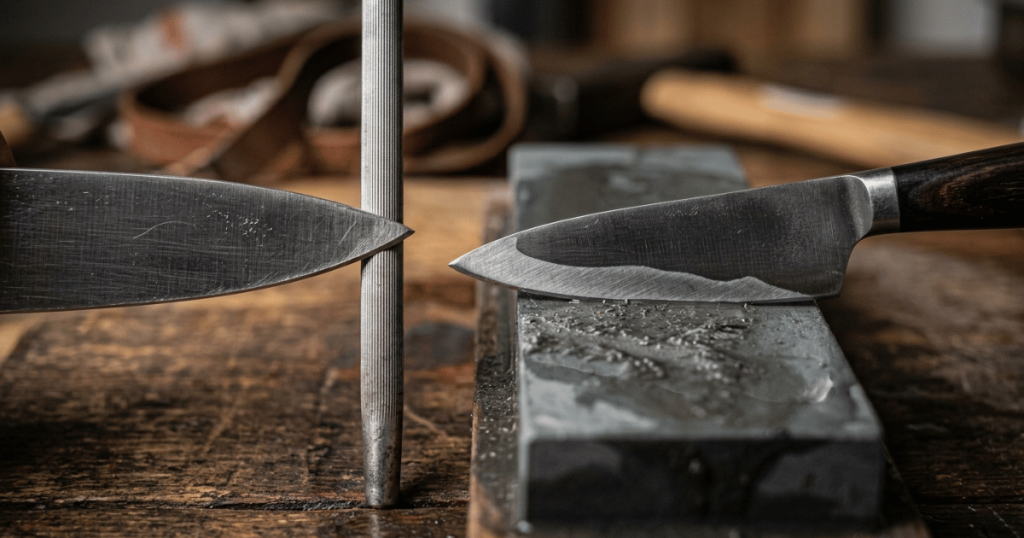
Honing straightens an edge that has bent. No meaningful steel is removed. It is quick, it can be done constantly, and doing it more often than necessary costs you nothing except a few seconds.
Sharpening grinds steel away to create a new edge. It is slower and it consumes the blade. Every sharpening makes the knife slightly smaller, permanently. Doing it more often than necessary is not free.
What each one actually does to the edge is worth reading in full if you have never seen the two set apart, because the physical difference is what sets the two schedules.
Honing: a rhythm, and the rhythm can be generous
Since honing costs nothing, the sensible frequency is often, and the natural trigger is use rather than a calendar. A few passes when you take the knife out, or when you put it away, or both.
Two things worth knowing about that habit:
You cannot really hone too often, but you can hone badly. Wrong angle, too much pressure or a rod that is wrong for the knife will do damage, and doing that more often makes it worse rather than better. The procedure matters more than the frequency.
And honing is not universal. A steel rod is not the right tool for every knife: harder Japanese steels chip where softer Western steels bend, and manufacturers do not agree about whether their own knives should meet a rod at all. Some publish an angle-matched rod for their own product; at least one well-known Japanese retailer tells customers never to use a sharpening steel on a Japanese knife. Both positions are published, and this site is not going to flatten them into one rule. Check what the maker of the knife in your hand says.
Sharpening: five things that set your interval
These are the variables the published averages are averaging over. Read your own kitchen against them and you will know whether you are at the fast end or the slow end.
1. What you cut on
This is the biggest single factor and it is entirely under your control. Wood and soft plastic give under the edge. Glass, stone, ceramic and metal do not, and an edge that meets a surface harder than itself is damaged rather than dulled. A knife used on glass needs sharpening on a completely different schedule from the same knife used on wood.
2. How hard the steel is
Harder steel holds an edge longer and chips more readily. Softer steel rolls rather than chips, which means honing brings it back and it goes longer between actual sharpenings even though it feels dull sooner.
The consequence people find counterintuitive: a softer knife may need honing constantly and sharpening rarely, while a harder knife may need honing seldom and sharpening on a strict schedule. Two knives, two opposite rhythms, and a single published interval covers neither.
3. What you cut
Bone, frozen food, squash skin, citrus peel and anything with grit on it are hard on an edge. Herbs and boneless proteins are not.
Two hours of butchery is a different amount of wear from two hours of prep, and the clock does not know the difference.
4. How you use it
Twisting the blade in a cut, prying, scraping the board with the edge to move food, and lateral force generally are what bend an edge over. Scraping food off a board with the edge rather than the spine is the single most common habit that undoes a fresh sharpening within a week.
5. How it is stored and washed
Loose in a drawer with other steel, or into a dishwasher basket, and the edge meets hard objects while you are not even cooking.
The signal, which replaces the calendar
Here is the actual answer to the question in the title.
Hone the knife. Then test it. If honing brings it back, it was bent and you have fixed it. If honing changes nothing, the edge is worn and it needs sharpening.
That is a four-second diagnostic that is exactly right for your knife, your board and your hands, and it is available every time you cook. Nothing published can beat it, because nothing published can see your kitchen.
The test itself can be the tomato: rest the edge on the skin with no downward pressure and see whether it starts the cut. If the blade slides, the edge is not doing its job whatever the calendar says.
The one thing not to do is push harder. Compensating with pressure is how people cut themselves, and it is also how an already-tired edge gets bent further.
Sharpening less often than you think, on purpose
Worth saying, because the incentive structure of this topic pushes the other way: every sharpening removes steel you never get back. A knife has a finite number of sharpenings in it.
That is an argument for honing diligently and sharpening only when honing has stopped working, and it is also an argument for the method you choose. Some methods remove far more steel per session than others, which means the same interval costs the blade very different amounts depending on what you use. The comparison between whetstone, pull-through and electric is where that trade lives.
The knives you never think about
Three that get missed:
The bread knife. Serrated edges last a long time and then stop, and honing does nothing for them. They are on their own schedule and their own procedure.
The paring knife. Used constantly, small, cheap, and usually the dullest thing in the kitchen because nobody bothers.
The one at the back of the block. If it has not been used in a year it does not need sharpening, and it may need rust attention instead.
The short version
Hone on a rhythm, whenever you use the knife, with the right rod used correctly for that knife. Sharpen when honing stops bringing the edge back, which is a test rather than a date. Your interval depends most on what you cut on, then on how hard the steel is, then on what you cut and how you handle it. Any published number is an average over kitchens that are not yours, and the four-second test in your own hand beats all of them.