A honesuki knife is a Japanese poultry boning knife: a short, stiff blade with a triangular profile and an angled tip, made to separate meat from the bones of chicken and other birds. It works through joints, cartilage and tendons, not through bone. Its heavier relative, the garasuki, is thicker and built for harder butchering work on whole chickens. For a home cook who breaks down a whole chicken regularly, a honesuki is the more useful of the two; the garasuki is a restaurant tool.
The rest of this page explains why the blade is shaped the way it is, how it compares with a Western boning knife, and which steel and edge choices matter.
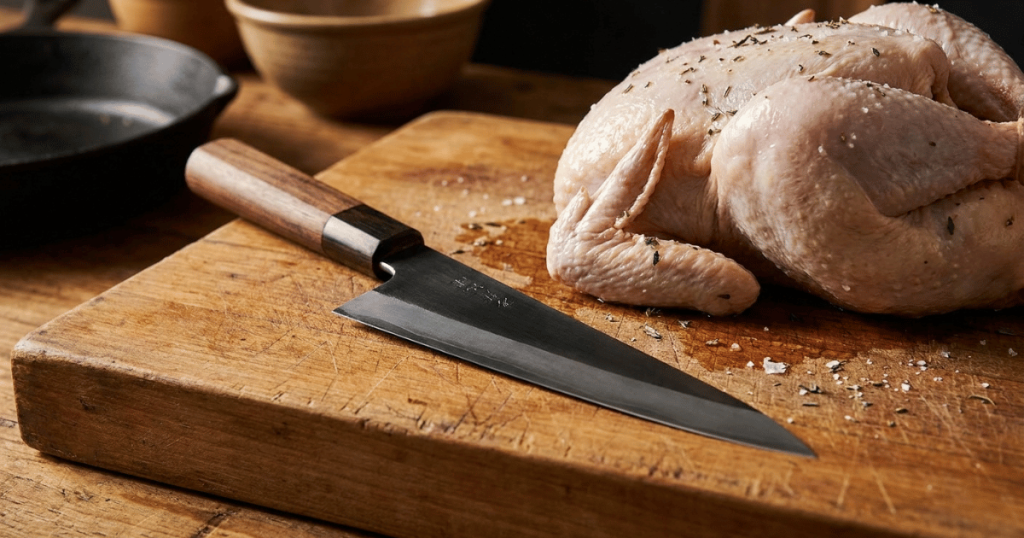
Honesuki knife vs garasuki vs Western boning knife at a glance
| Honesuki | Garasuki | Western boning knife | |
|---|---|---|---|
| Blade shape | Triangular, angled tip | Triangular, larger and thicker | Narrow, often curved, pointed |
| Stiffness | Stiff | Very stiff and heavy | Stiff to flexible, by model |
| Main job | Boning poultry, separating joints | Breaking down whole chickens, heavier work | Boning meat, some poultry and fish |
| Bone | Not for cutting through bone | Heavier work around poultry bones | Not for cutting through bone |
| Traditional bevel | Single or asymmetric | Single or asymmetric | Double |
| Typical length | About 12 to 18 cm (Wikipedia) | Longer and heavier than a honesuki | Varies widely |
The honesuki size range comes from Wikipedia’s entry on Japanese kitchen knives (read September 28, 2026), which describes the hone-suki as “a small triangular knife used to debone chicken” and the gara-suki as “a thicker version of the hone-suki, capable of cutting through chicken bones.”
What Korin says each knife is for
Korin, the New York Japanese knife specialist, describes both on its boning knife style page (read September 28, 2026):
- The honesuki is “used to separate the meat from the bones. It is lighter and thinner than the garasuki and can be used in place of a Western boning knife.”
- The garasuki “is unique to Japan. It originated in specialty chicken restaurants and is commonly used to break down whole chickens. Due to its thickness and weight, it can be used for other jobs requiring heavy work with a short blade.”
Korin also lists a third Japanese boner, the hankotsu, as “a strong and sturdy knife used to cut meat away from the bone, but not for cutting through bones.” It is more often used on larger cuts of meat than on birds.
Notice the difference in wording. The honesuki separates meat from bone. The garasuki is described in terms of weight and heavy work. Neither is a cleaver.
Why the blade is shaped like a triangle
Every feature of the honesuki follows from one job: working close to small bones inside a bird without the blade bending or slipping.
- The tall heel. The blade is taller at the heel than a petty knife. That height gives knuckle clearance when the knife is angled against a carcass, and a larger, firmer surface to hold and steer, which matters when your hands are wet from raw poultry.
- The thick spine near the handle. More metal at the heel means the blade does not twist when you use it to pop a joint or scrape meat off a frame.
- The angled, clipped tip. Like a kiritsuke, the tip sits low with the spine dropping to meet a straight edge. That puts a fine point exactly where it is needed to find the gap in a joint, while the metal behind it stays thick enough to resist bending.
- A short blade. Short means control. You are working inches from your own hand inside a small carcass, and a short blade limits how far the knife can travel if it slips.
Why stiff, not flexible
Western boning knives come in stiff and flexible versions; the flexible ones are popular for fish. The honesuki is always stiff, and the reason is metallurgy and geometry rather than tradition.
How much a blade bends under load depends mostly on its shape, especially thickness, not on how hard the steel is. Hardening changes how much force it takes to permanently bend or break a blade, but a thicker blade of the same steel bends noticeably less than a thinner one. The honesuki’s thick spine and short length are what make it rigid.
Rigidity is what poultry work needs. Separating a thigh from a frame or a wing at the shoulder means pressing the tip into a joint and levering slightly. A flexible blade would bow and wander. A stiff one goes where it is pointed and transmits exactly the force you apply.
The trade-off is that a stiff blade cannot follow a curved surface the way a flexible fish knife can. The honesuki is excellent at joints and poor at skinning a delicate fish fillet.
Single bevel, double bevel and asymmetric grinds
Traditional honesuki are single-bevel or strongly asymmetric: ground mostly on one face. The benefit on poultry is a very keen edge and a flat back that can run close against a bone. The costs are the usual single-bevel ones: the knife is handed, cuts can drift toward the beveled side, and sharpening follows a different method.
Many modern honesuki are sold double-bevel or with a mild asymmetric grind. These suit either hand and sharpen like other Japanese double-bevel knives. For most home cooks, a double-bevel honesuki is the practical choice.
If you do own a single-bevel honesuki, sharpen the front bevel across its face and only lightly remove the burr on the back; our guide to sharpening a single-bevel knife explains why the back must not be ground flat. For a double-bevel model, the approach in how to sharpen Japanese kitchen knives without chipping applies.
Steel choices for a poultry knife
Honesuki are made in carbon steels, stainless steels and clad blades that combine a carbon core with stainless outer layers. For this knife, two properties matter more than peak hardness.
Corrosion resistance. A poultry knife spends its working life wet, in contact with raw meat juices, and is washed often. Carbon steel reacts quickly in those conditions and can rust if not dried at once. Stainless or stainless-clad blades are more forgiving. If you choose carbon steel, our guide to keeping knives from rusting covers what works.
Toughness. The tip and edge of a honesuki meet bone and cartilage constantly. A very hard, thin edge is more prone to chipping when it contacts bone at an angle. A tough steel, or a slightly more obtuse edge, resists that better. Check the maker’s own published specification for the steel and hardness, and treat a listing with no stated steel as an unknown.
Honesuki vs garasuki: which do you need?
- You break down a few whole chickens a month. A honesuki. It handles joints, thighs, wings and breast removal, and it is light enough for the job.
- You break down many birds, or want to split backbones. Look at a garasuki. Its thickness and weight suit heavier work around poultry bones, as Wikipedia and Korin describe. It is larger, heavier and less common outside restaurant kitchens.
- You need to cut through large bones. Neither. Use a cleaver designed for bone. Poultry shears are another route through backbones and are simpler for occasional use.
Honesuki vs Western boning knife: do you need both?
No. Korin’s own description says the honesuki “can be used in place of a Western boning knife.” The honesuki is better at poultry joints because it is stiffer and has a more pointed, controllable tip. A Western boning knife, particularly a flexible one, is better at following curves on fish and on large cuts of meat. Choose the one that matches what you cut most often.
What a honesuki cannot do
- Cut through bone. Forcing it chips or breaks the tip. A chipped honesuki can often be repaired; see our guide on how to fix a chipped knife edge, and when not to try.
- Slice. It is too short and too tall at the heel for long slicing strokes on a roast.
- Replace a fish knife. It lacks flex for delicate fillets, though some cooks use it on smaller fish.
A note on safety and hygiene
Boning poultry is close-quarters work with a sharp point near your hand. Work on a stable board that does not slide, keep your holding hand behind the line the tip is traveling, and cut away from your body. After raw poultry, wash the knife, board and your hands thoroughly with hot, soapy water before touching other food, and dry the knife straight away.
FAQ
What is a honesuki knife used for?
Separating meat from the bones of chicken and other poultry. Its stiff, triangular blade and angled tip work through joints, cartilage and tendons. It is not meant for cutting through bone.
What is the difference between a honesuki and a garasuki?
The garasuki is thicker, heavier and larger, made for heavier work breaking down whole chickens. The honesuki is lighter and thinner, and Korin notes it can stand in for a Western boning knife.
Is a honesuki better than a boning knife?
For poultry joints, its stiffness and pointed tip give more control. For fish and following curved cuts, a flexible Western boning knife suits better.
Can a honesuki cut through chicken bones?
It should not be forced through bone. Use it at the joints. For backbones, use poultry shears, a garasuki or a cleaver designed for bone.
Is a honesuki single bevel?
Traditionally single-bevel or asymmetric. Many modern honesuki are double-bevel, which is easier for most home cooks to use and sharpen.