A full tang knife has one continuous piece of steel running from the tip to the end of the handle, with the handle material fixed to both sides of it. For home cooking, the tang matters less for strength than sellers suggest: everyday cutting rarely loads the blade-to-handle joint hard enough to break a well-made partial tang. What the tang really decides is balance, how the handle is attached, and how that handle eventually fails.
If the handle on your last knife worked loose, the tang was only part of the story. The rest was the handle material, whatever held it to the steel, and the water it met. Below is what each construction does mechanically, why handles come loose, and how to read a knife’s construction before you buy one.
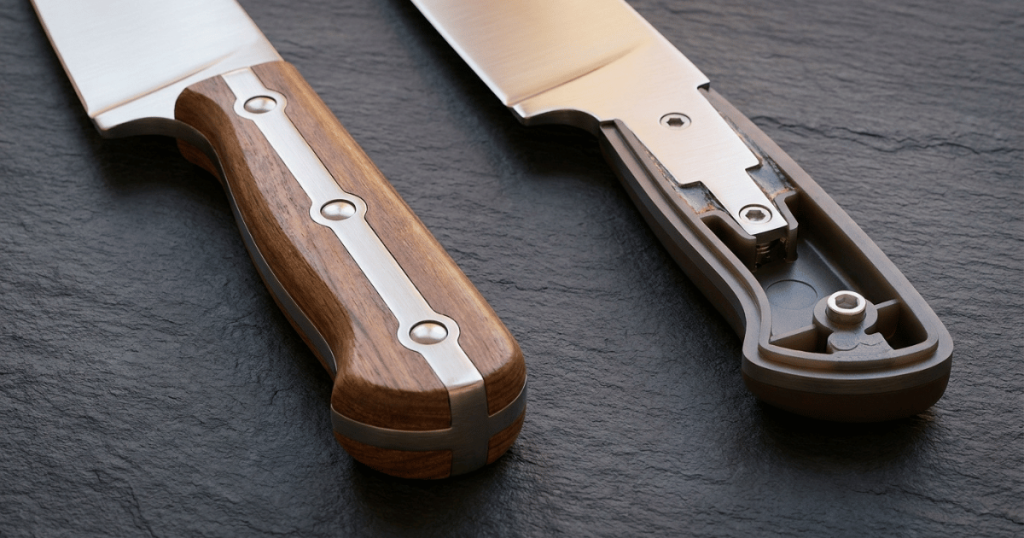
What a Full Tang Knife Is, and the Other Ways Knives Are Built
The tang is the part of the blade that continues into the handle. Wüsthof, the Solingen maker, calls it “the extension of the blade through the handle” on its German Knives page (read September 24, 2026), and notes that “in most German knives, it is common for the blade to extend the entire length of the knife’s handle.” That is a full tang. Every other construction is some version of the steel stopping short, or staying out of sight.
| Construction | How the handle is held | What you see | Balance tendency | How it usually ends |
|---|---|---|---|---|
| Full tang | Two scales riveted or pinned to both faces of a full-length tang | A steel stripe along the top and bottom of the handle, end to end | Toward the hand | Scales shrink, crack or gap at the seam; scales can often be replaced |
| Partial (half) tang | Scales or a slab fixed to a tang that stops partway | Steel along only part of the handle | Further forward than a comparable full tang | The joint loosens where the steel ends |
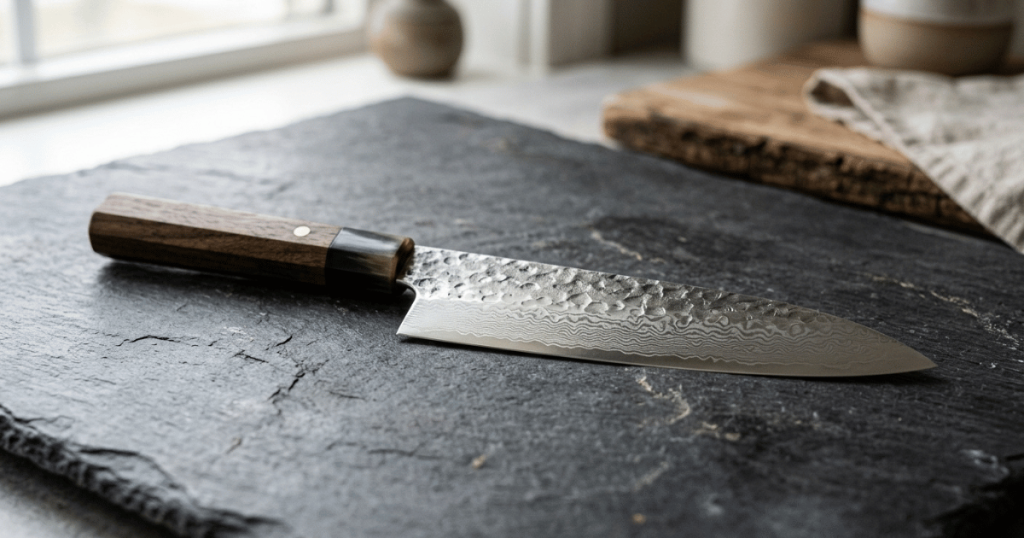
| Hidden tang (wa handle) | A narrow tang set into a one-piece handle, burned in or glued, with a collar called a ferrule | No steel | Toward the blade | Handle turns, rocks or splits; the handle itself is replaceable |
| Encapsulated (molded) | Plastic molded around the tang | No steel; one seamless handle | Depends on the design | Handle cracks or pulls away at the blade; rarely worth repairing |
The hidden tang is not a cost-cutting version of a full tang. It is the traditional Japanese construction. ibuki blade, a Japanese supplier of kitchen-knife blanks, explains in its guide to attaching a tang to a wa handle (published August 28, 2018, read September 24, 2026) that most Japanese kitchen knife makers burn a heated tang into the handle and then hammer the end of the handle. The heat chars the inside of the wood and draws resin out of it, and that resin works as the adhesive. The same guide names the trade-offs: the heat can cause unwanted tempering of the steel or crack the handle, and a tang fixed this way is hard to remove.
Why Full Tang Is Sold as Stronger, and When That Is True
When a knife pushes down through food, your hand supplies the opposing force, and the bending load peaks where the blade enters the handle. In a full tang, steel carries that load all the way into your palm. In a partial tang, the steel stops inside the handle, so the last part of the load path runs through wood or plastic and whatever bonds them to the steel. A narrow tang also has a shoulder where it necks down from the blade, and in metal a sharp change of section is where cracks tend to start.
That difference matters under levering: twisting a blade that has stuck in a winter squash, prying frozen food apart, or forcing the blade sideways through a joint. It matters far less when you slice, where the loads are small and mostly in line with the blade. Gear Patrol’s tang explainer (Tyler Chin, November 13, 2022) warns that a partial tang can snap where the steel ends, and its verdict is “When in doubt, go full tang.” That is sound advice for a cook who levers, and mostly beside the point for one who slices. Wüsthof makes the maker’s case on the page cited above: a full tang “provides durability, stability, and optimal balance for comfortable knife use.”
Why Knife Handles Come Loose
Steel and handle materials disagree about water and heat, and the joint between them is where that disagreement gets settled. Steel does not absorb water. Wood does: it swells as it takes on moisture and shrinks as it dries, and it moves far more across the grain than along it. A wooden scale riveted to a steel tang is trying to change size against a partner that will not. Every wet-and-dry cycle works the rivets, pins and glue that hold the two together. Most handle plastics take up little water, but they expand more with heat than steel does, so hot water works the joint in a similar way.
Once a seam opens, even slightly, water reaches steel that nobody sees or dries. Makers take that seriously. Wüsthof’s German Knives page says its handles “are fixed with stainless steel rivets and enclose something called ‘the sacrificial anode,'” which it describes as “a small aluminum ring fixed to the tang,” patented in the nineties and “inspired by a genius trick from the shipbuilding industry.” The page does not spell out the mechanism. In shipbuilding, the trick is attaching a more reactive metal to the steel so that the reactive metal corrodes instead. Either way, it tells you where a major maker expects trouble: on the steel inside the handle.
Hidden tangs live with the same cycling. The resin bond in a burned-in wa handle, or the glue in a modern one, is loosened by the same wetting and drying, and a handle that starts to turn has lost that bond.
The dishwasher is the harshest version of all this: a long soak in hot water and detergent, then a hot drying cycle. That is why whether knives can go in the dishwasher is a question about the handle as much as the blade.
So the tang type sets the shape of the failure, not whether it happens. A full tang shows a gap you can see or feel along the seam. A hidden tang starts to turn or rock in its handle. A molded handle cracks or pulls away where it meets the blade. A handle that moves is a safety problem, not a cosmetic one: stop using the knife until it has been repaired or replaced.
Balance: What the Extra Steel in the Handle Does
Balance is where the knife’s weight centers. Put more steel in the handle and the balance point moves back toward your hand; take steel out and it moves toward the blade. That is the honest version of the balance claim on full-tang packaging. Traditional wa handles are light, commonly ho wood (Japanese magnolia), so hidden-tang knives tend to feel blade-forward.
Two things complicate it. A thick forged bolster puts a lump of steel right at the junction and can move the balance as much as the tang does. And a thin blade weighs less out front than a thick one. So a full tang knife is not automatically “balanced,” and a hidden-tang knife is not automatically nose-heavy. The only reliable check is the knife in front of you: rest it across one finger where the blade meets the handle and see which way it tips.
Neither result is better. A blade-forward knife feels quick and light; a handle-heavy one feels planted. Which you prefer is taste, and the tang is only one of the things that sets it.
How to Check a Knife’s Tang Before You Buy
Product listings do not always state the tang. The knife itself usually tells you:
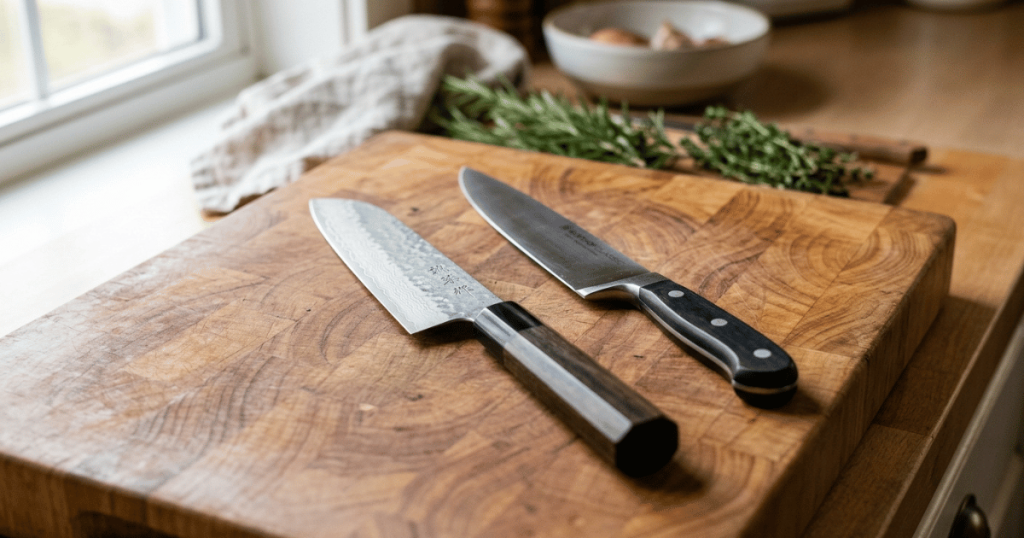
- Look at the top and bottom edges of the handle. A steel stripe running the full length on both edges, between two scales, is a full tang.
- Look for where the stripe stops. Steel that shows for only part of the handle, or only near the bolster, is a partial tang.
- No steel, one piece of wood, a collar at the front: a hidden tang in a wa handle.
- No steel, one seamless piece of molded plastic: an encapsulated tang. Only the maker’s specification tells you how far the steel runs.
- Do not count rivets. Rivets show that scales are fixed to steel. They do not show how far the steel goes.
- Run a fingernail along the seams. On a new knife, a gap or a step between scale and tang is a finishing flaw, and water will find it.
Which Tang Suits Which Cook
| If you… | What actually matters | Construction that suits |
|---|---|---|
| Break down squash and whole birds, and sometimes lever the blade | Steel running unbroken through the joint | Full tang |
| Mostly slice vegetables, fish and boneless meat | A light handle and a blade-forward feel | Hidden tang (wa) or partial tang |
| Want the blade to outlive its handle | A handle that can be replaced | Wa handle, or full tang with scales a repair shop can replace |
| Want a low-cost everyday knife | A sound, seamless molded joint | Encapsulated (molded) handle |
| Put knives in the dishwasher | Nothing in the tang fixes this | None; the handle joint is what suffers |
What a Full Tang Cannot Do
A full tang says nothing about the steel, the heat treatment or the edge. It does not make a knife sharper, hold an edge longer, or resist rust; those come from the steel, its hardness and the blade’s geometry. For the choices that move cutting performance, see our guide to choosing kitchen knives by type, steel and budget.
It also adds weight, which some cooks want and others do not. And it does not stop a wooden scale from moving. A full tang knife left wet in the sink will open its seams like any other, and the habits that protect a handle are the ones in our guide to what ruins kitchen knives.
Finally, plenty of well-made kitchen knives are not full tang at all. Traditional Japanese knives use hidden tangs, which give a lighter handle and one that can be replaced when it wears out. If that is the direction you are leaning, start with our guide to telling real Japanese knives from Japanese-style ones.
Frequently Asked Questions
Is a full tang knife better than a partial tang?
For levering and heavy chopping, a full tang is more forgiving because steel runs through the joint. For slicing and everyday prep, a well-made partial or hidden tang does the job, and the steel, heat treatment and geometry matter more to how the knife cuts.
Are Japanese knives full tang?
Traditional wa-handled Japanese knives are not: they use a hidden tang set into a one-piece wooden handle. Japanese knives with Western-style handles can be built either way, so check the handle edges as described above.
Why does my knife handle feel loose?
The bond between handle and tang has given way, usually after repeated wetting and drying, heat, or dishwasher cycles. Stop using the knife, since a handle that moves can slip in use. Riveted scales can sometimes be replaced and a wa handle can be swapped; a cracked molded handle usually means a new knife.
Does a full tang make a knife heavier?
Yes. More steel sits in the handle, which adds weight and moves the balance point toward your hand. The bolster and the blade’s thickness change the feel as much, so compare knives by how they balance, not by the construction label.
Can a knife be full tang if I cannot see the steel?
Yes. A molded handle can hide a full-length tang, and only the maker’s specification will confirm it. If steel shows along both the top and bottom edges of the handle for its full length, it is a full tang.