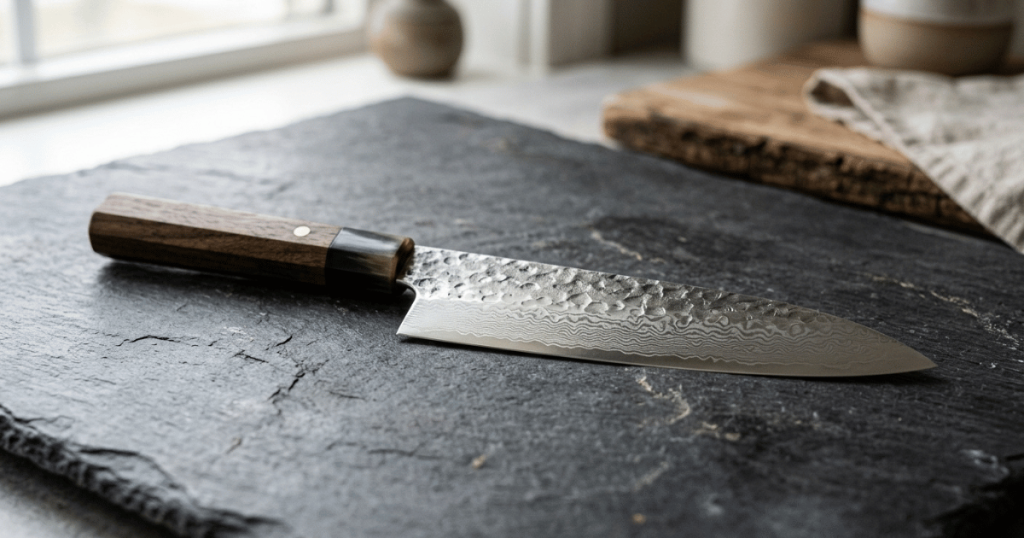
A kiritsuke knife is a long Japanese blade with a nearly flat edge and an angled, clipped tip, built for push cuts and long slicing strokes rather than rocking. The traditional version is single-bevel and combines the jobs of two specialist knives, the yanagiba for fish and the usuba for vegetables. Many kiritsuke sold to home cooks today are double-bevel and work like a flatter, pointier chef’s knife. The bunka is its shorter, taller cousin with the same style of angled tip.
If you rock your knife when you chop, a kiritsuke will fight you. If you push-cut and slice, it may be the most satisfying shape in the drawer.
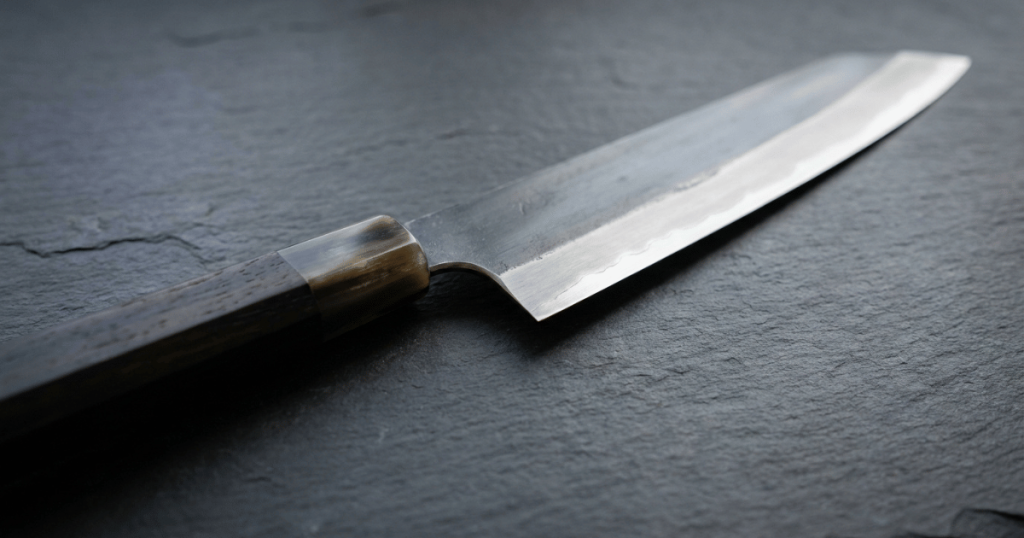
Kiritsuke, bunka and the other hybrid Japanese shapes at a glance
| Kiritsuke | Bunka | Gyuto | Santoku | |
|---|---|---|---|---|
| Edge profile | Very flat, especially at the heel | Fairly flat, some belly | Curved belly toward the tip | Flat with a gentle curve |
| Tip | Angled “reverse tanto” or clipped point | Angled, often shorter | Pointed | Rounded “sheep’s foot” |
| Length | Long | Short, in the santoku range | Short to long | Short |
| Motion it suits | Push cuts, long draw slices | Push cuts, chopping | Rocking and slicing | Push cuts, chopping |
| Traditional bevel | Single | Double | Double | Double |
Wikipedia’s entry on Japanese kitchen knives (read September 28, 2026) gives the traditional kiritsuke a general blade size range of 24 to 30 cm (9 to 12 inches) and describes it as “a large hybrid with the length of yanagi-ba and the blade height and profile of usuba.” It describes the bunka as a variant of the santoku with “a more angular, straight tip” in place of the rounded one.
Where the kiritsuke comes from
In a traditional Japanese kitchen, fish and vegetables have their own knives. The yanagiba is the long, narrow slicer for sashimi. The usuba is the tall, flat, rectangular vegetable knife. Both are single-bevel: ground on one face only, with a flat or slightly hollow back.
The kiritsuke splits the difference. Korin, the New York Japanese knife specialist, describes it in its kiritsuke style guide (read September 28, 2026) as “one of the few multipurpose traditional Japanese blades,” usable “as a yanagi (fish slicer) or an usuba (vegetable knife),” with “a straighter edge than a yanagi for vegetables, and a longer blade than an usuba for slicing fish.” Korin adds that the user “must be highly skilled with traditional Japanese knives” to use the single-edged design properly, and that traditionally the knife was used “only by the executive chefs as a symbol of status and due to its difficulty in use.”
That last point is why the kiritsuke has a reputation it does not entirely deserve in its modern form. The difficulty belongs to the single bevel and the combined job, not to the silhouette.
What the angled tip actually does
The kiritsuke tip is not decoration. Its geometry changes how the front of the knife behaves.
On a gyuto the edge curves up to meet the spine at the point. That curve is what lets the blade rock. On a kiritsuke the edge stays nearly straight almost all the way to the front, and the spine drops sharply down to meet it. The result is a point that sits low, close to the board, on a blade that is still tall behind it.
That gives three practical effects:
- Fine tip work with a long knife. The low point can score fish skin, open a squid, or make precise cuts on the board without lifting your elbow, which a long gyuto tip cannot do as easily.
- Full-length board contact. Because the edge is so flat, more of it touches the board at once. Push cuts through onions or scallions go all the way through without the accordion effect of an edge that curves away from the board.
- No rocking. There is almost no belly to roll on. Try to rock a kiritsuke and the knife pivots on a small point, then slaps down.
The same low, fine tip is also the weak point. A clipped tip is thin and has little metal behind it, so it is the first thing to break if the knife is dropped or used to pry. Our guide on fixing a broken knife tip by reshaping the spine explains why the repair works from the spine rather than the edge.
Single-bevel vs double-bevel kiritsuke
This is the real buying decision, and product listings do not always make it obvious.
A single-bevel kiritsuke is the traditional tool. The asymmetric grind makes very thin, clean slices of fish and extremely thin cuts of vegetables possible, because one face is flat and the blade parts food with little wedging. It also steers: a single-bevel edge tends to drift toward the beveled side in a thick cut, and cutting straight takes practice. It is made for right-handed or left-handed use specifically, and sharpening it means working the bevel and then the back in a different way from a Western knife. Our guide to sharpening a single-bevel knife explains why the back is not simply flat and must not be ground like the front.
A double-bevel kiritsuke, often sold as a “kiritsuke gyuto” or “K-tip gyuto,” has the shape without the single-bevel grind. It is sharpened on both faces, cuts straight, suits either hand, and behaves like a flat-profiled chef’s knife with a pointed front. For a home cook who wants the kiritsuke look and push-cutting feel, this is usually the one to buy.
If a listing does not state the bevel, assume nothing and check with the seller. Words such as single-bevel or kataba, or a choice between right-handed and left-handed versions, point to the traditional grind.
Kiritsuke vs bunka
The bunka, or bunka bocho, borrows the angled tip but sits in a different place in the lineup. Wikipedia translates the name as “cultural kitchen knife” and treats it as a santoku variant.
- Size. A bunka is short and tall, in the same general size range as a santoku. A kiritsuke is long.
- Job. A bunka is an everyday home knife for vegetables, herbs and boneless proteins on a small board. A kiritsuke adds reach for long slices of fish and large vegetables.
- Control. The bunka’s shorter blade is easier to control in a small kitchen. The kiritsuke’s length and flatness need more room and more comfort with a long knife.
- Bevel. Bunka are generally double-bevel. Kiritsuke may be either.
Who should pick which: if your board is small and most of your cutting is vegetables, the bunka is the more practical knife. If you slice fish or roasts, cut long vegetables such as daikon and leeks, and push-cut rather than rock, the kiritsuke gives you reach the bunka cannot.
What a kiritsuke replaces, and what it cannot do
What it can replace:
- A gyuto or chef’s knife, for a cook who push-cuts and slices rather than rocks.
- A santoku or bunka, if you have the board space for a longer blade.
- For a skilled user of the single-bevel version, a yanagiba and usuba in a home kitchen that does not justify both.
What it cannot do well:
- Rocking cuts on herbs or garlic, because there is no belly.
- Heavy work near bone, because the thin tip and hard, thin edge of most Japanese blades are prone to chipping under twisting force. A deba or a Western boning knife handles that.
- Replace a dedicated yanagiba for serious sashimi. A long single-bevel kiritsuke is capable, but a yanagiba is narrower and made for that single job.
Steel and sharpening considerations
Kiritsuke are made in the same families of steel as other Japanese knives: carbon steels, stainless steels, and powder stainless steels. The steel changes how often you sharpen and how the edge behaves; it does not change the shape’s rules. A hard, thin edge rewards push cuts and punishes lateral twisting and contact with bone. For any specific knife, check the steel and hardness in the maker’s own published specification rather than a listing’s marketing copy.
Two sharpening points are specific to this shape:
- Keep the profile flat. Uneven sharpening that takes more metal from the middle creates a slight hollow in the edge, so it no longer meets the board along its length. Work the whole edge evenly on the stone.
- Protect the tip. On the stone, the angled tip is easy to round over. Lift the handle slightly as you work the front section so the bevel angle stays consistent into the point.
A double-bevel kiritsuke sharpens like any other Japanese double-bevel blade; our guide on how to sharpen Japanese kitchen knives without chipping covers angle and pressure. For how the kiritsuke fits among the other Japanese shapes and what separates a Japanese-made knife from a Japanese-style one, see our guide to real vs Japanese-style kitchen knives.
Is a kiritsuke knife right for you?
Buy a double-bevel kiritsuke if you push-cut, have a reasonably large board, and like a long blade with a precise point. Choose a bunka instead if you want the same angled look in a compact everyday knife. Consider a single-bevel kiritsuke only if you already use single-bevel knives and want one blade to cover fish and vegetables. And if you rock-chop, a gyuto or Western chef’s knife will simply suit your hands better, and there is no shame in that.
FAQ
What is a kiritsuke knife used for?
Slicing fish and proteins, push-cutting vegetables, and fine tip work such as scoring. Its flat edge and low, angled tip suit push cuts and long draw slices rather than rocking.
Is a kiritsuke single bevel or double bevel?
Traditionally single-bevel. Many kiritsuke sold for home kitchens are double-bevel, often labeled kiritsuke gyuto or K-tip gyuto. Check the listing for the words single-bevel or kataba, or for a handedness choice.
What is the difference between a kiritsuke and a bunka?
Both have an angled tip. The kiritsuke is long and very flat, suited to slicing and reach. The bunka is shorter and taller, a santoku variant for everyday home prep.
Can a beginner use a kiritsuke?
A double-bevel kiritsuke is manageable for a beginner who push-cuts. The traditional single-bevel version needs practice to cut straight and to sharpen correctly.
Can you rock chop with a kiritsuke?
Not well. The edge has almost no curve, so it cannot roll through a rocking motion. Use push cuts or a gyuto if you prefer to rock.