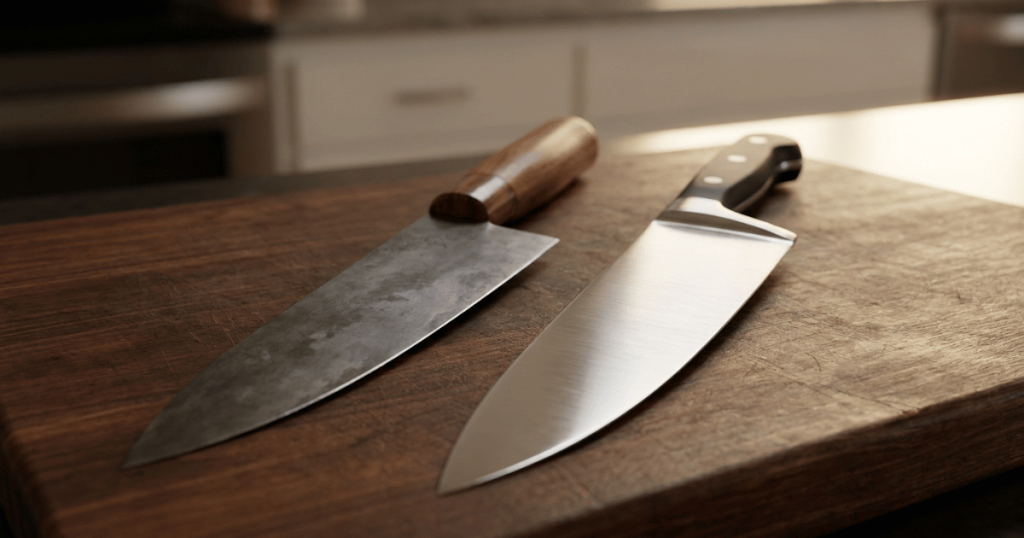
Japanese kitchen knives are generally made from harder steel, ground thinner and sharpened to a more acute angle, so they cut with less effort but chip more easily and do best on a whetstone. German kitchen knives generally use softer, tougher stainless steel on a thicker, heavier, more curved blade, so they tolerate rough use and respond well to a honing steel, but lose their keenness sooner. Neither is better. They are built for different habits.
The catch everyone asks about is the chipping. The rest of this guide shows where that trade-off comes from, using the makers’ own published specifications rather than the loose ranges most comparisons repeat, and ends with a way to choose based on how you actually cook and maintain a knife.
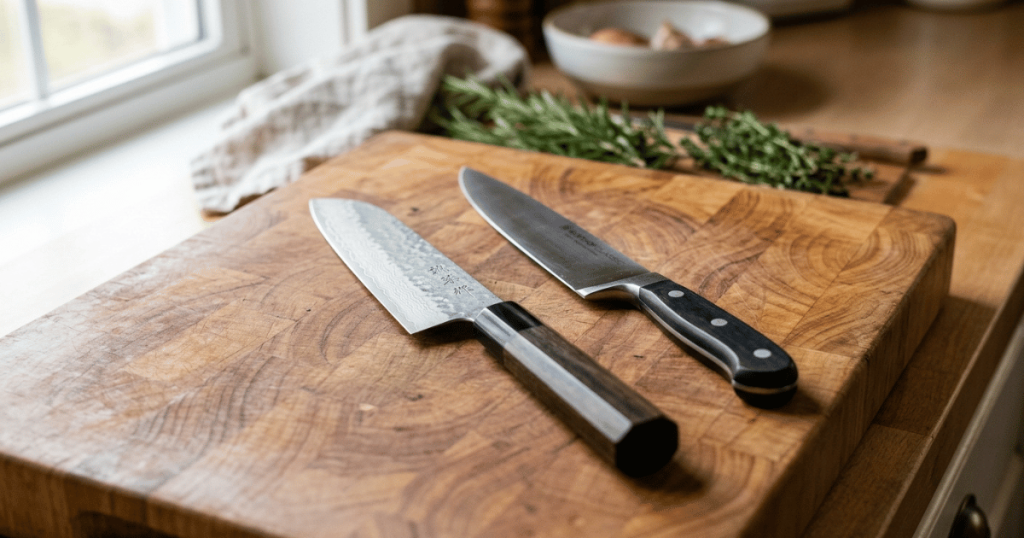
Japanese vs German kitchen knives at a glance
| Japanese style | German style | |
|---|---|---|
| Steel hardness | Harder. Example: MIYABI Birchwood SG2, rated around 63 Rockwell by ZWILLING | Softer. Example: WUSTHOF Classic, 58 HRC; WUSTHOF Gourmet, 56 HRC |
| Edge angle | More acute. MIYABI Birchwood: 9.5 to 12 degrees; Shun Classic: 16 degrees each side | Wider, and set per maker; check your maker’s page |
| Blade | Thin, straight profile (Made In) | Thicker, curved for rocking (Made In) |
| Weight | Lighter (Made In) | Heavier (Made In) |
| Bolster | Often none | Often a full bolster, as on WUSTHOF Classic |
| Everyday upkeep | Whetstone sharpening (Made In) | Routine honing, easier to sharpen (Made In) |
| Weak spot | Chips and broken tips from hard use | Edge rolls and dulls sooner |
Every figure in that table comes from the maker of the knife named. Where a row gives no number, it is because no maker source was read for it, and we would rather leave a cell general than print a range we cannot trace.
“Japanese” and “German” describe a style, not a passport
The labels are shorthand for two design traditions, and the companies themselves cross the line. The MIYABI Birchwood SG2 knives cited above are sold by ZWILLING, a German brand, and described as handcrafted in Seki, Japan. Many Japanese makers sell Western-shaped chef’s knives. Several Western makers sell thin, hard Japanese-style blades.
The spread inside a single tradition is also wide. WUSTHOF publishes 58 HRC for its forged Classic line and 56 HRC for its laser-stamped Gourmet line. Those are two German knives from the same company, two points apart. So what matters when you choose a knife is not the country on the box. It is the hardness, the thickness and the angle of the particular knife, and those numbers belong on the maker’s product page. If a listing does not give them, treat that as information.
Steel and hardness: what the numbers mean
Knife hardness is almost always given on the Rockwell C scale, written HRC. The Rockwell test is defined in ASTM E18, Standard Test Methods for Rockwell Hardness of Metallic Materials. ZwickRoell, which builds hardness testers, describes it as a differential-depth method. A preload sets a reference, the full test force is applied and then removed, and the residual depth of the indent is converted to a hardness number. For the C scale, ZwickRoell describes a diamond cone indenter with a 10 kgf preload and a 150 kgf main load. The shallower the permanent dent, the harder the steel and the higher the number.
Higher hardness means the steel resists being deformed. At the board, that shows up as an edge that stays straight and keen longer. The cost is toughness. Hard steel is less willing to bend before it breaks, so under a twist, an impact, or a bone, it is more likely to chip than to roll. Shun’s FAQ puts the design goal in exactly those terms: its hardness levels let its knives be “thin, hard, and precise without being overly brittle.” Softer steel makes the opposite trade. It rolls instead of chipping, and a honing rod can push a rolled edge back.
A hardness number is not a quality score. It tells you which way a knife will fail and what kind of maintenance it wants.
Geometry: thickness, angle, profile and bolster
Steel sets what an edge can survive. Geometry sets how easily it cuts.
Thickness. Made In describes Japanese knives as having thin, straight blades and German knives as heavier. A thin blade wedges food apart less, which is much of why a Japanese knife feels sharper even at the same edge sharpness. It is also why a thin, hard blade should not be twisted or levered in a cut.
Edge angle. Hard steel can hold a more acute edge without collapsing. ZWILLING hones its MIYABI Birchwood blades to 9.5 to 12 degrees. Shun lists a 16 degree edge on each side for its Classic chef’s knife. The right angle for your knife is the one its maker publishes, and our guide on what angle to sharpen kitchen knives explains how to find it when the maker does not say.
Profile. Made In describes the German blade as curved for rocking and the Japanese blade as straighter. That is a statement about blade shape, and it matters for choosing: a curved belly suits cooks who rock the blade on the board, while a flatter edge suits cooks who push or pull through food.
Bolster. WUSTHOF describes the full bolster on its Classic knives as providing balance and safety, with a finger guard. It adds weight and protects the hand. It also sits at the heel of the edge, and after years of sharpening a full bolster can stand proud of the edge, so some owners have it ground back. Japanese-style blades usually have no full bolster, which keeps them lighter and lets the whole edge be sharpened.
Maintenance: honing rod or whetstone
This is where the choice becomes daily life. Made In says German knives are easier to sharpen and benefit from routine honing, and that Japanese knives should be sharpened on a whetstone.
A softer German edge rolls in use, and a few strokes on a honing rod straighten it. That habit keeps a German knife working between sharpenings, and our guide on how to use a honing steel covers it. Shun’s FAQ also describes honing as straightening a rolled edge without removing material, so honing is not only for German knives. On very hard, thin edges, though, a rough or heavy stroke on a steel rod risks chipping rather than straightening, so use a gentle touch and follow your maker’s advice on rod type.
Harder Japanese edges are most at home on water stones, at the lower angle they were ground to. Our guide on how to sharpen Japanese kitchen knives without chipping walks through that, and our whetstone grit guide explains which stones do which job. Check your maker’s instructions before putting a thin, hard blade through a fixed-angle gadget. Our guide to pull-through sharpeners explains what to keep out of them and why.
What each style will not forgive
Japanese style. Shun asks owners not to use its knives on bones, joints or frozen foods, because they are designed for precision slicing rather than heavy crushing. That same limit applies, in spirit, to most thin, hard blades. Twisting in a squash, prying apart frozen items, scraping the edge sideways across a board, and a drop onto a tile floor are how tips snap and edges chip.
German style. The knife survives almost everything, but the edge gives up sooner. If you never hone, a softer blade will feel dull faster than a harder one, and the extra weight that helps with dense food can be tiring over a long prep session.
Both. Neither style belongs in a dishwasher unless the maker says otherwise. Stainless on either side of the divide resists rust but is not immune to it. Many Japanese knives, and some Western ones, are made in carbon steel, which is a separate decision with its own daily care.
Which suits how you cook
| If this sounds like you | Lean toward | Why |
|---|---|---|
| You break down whole chickens, hack at winter squash, and one knife does everything | German style | Tougher steel and a heavier blade tolerate twisting and impact |
| Most of your prep is vegetables, herbs, fish and boneless meat | Japanese style | A thin, hard, acute edge does precise work with little pressure; Made In says the same about vegetable prep |
| You will hone but you will never own a whetstone | German style | A softer edge comes back on a rod |
| You enjoy sharpening, or will pay a sharpener who uses stones | Either; Japanese rewards it most | The lower angle and hard steel are the payoff of stone work |
| Other people in the house use your knives, including roughly | German style | It tolerates mistakes that chip a harder blade |
| You prefer a light knife and long prep sessions | Japanese style | Made In notes Japanese knives tend to be lighter |
Plenty of home cooks settle on one of each: a tougher knife for the heavy jobs and a thin, hard one for precise work. That is often a better answer than forcing one knife to do both.
Where the question stops being useful
Once you know the trade-off, the country label adds little. Two knives worth comparing are two specific knives: read the hardness, the edge angle and the steel on each maker’s page, hold them if you can, and ask what each maker says it should not be used for. That last line often tells you more about a knife than the marketing above it.
Frequently asked questions
Are Japanese knives sharper than German knives?
They are usually ground thinner and to a more acute angle from harder steel, so they tend to feel sharper and stay keen longer. The trade-off is that they are more likely to chip under impact or twisting. A well-sharpened German knife is still very sharp, and it is more forgiving.
What is the difference in hardness between Japanese and German knives?
It varies by knife, so read the maker’s figure. As published examples, WUSTHOF lists 58 HRC for its Classic line and 56 HRC for its Gourmet line, while ZWILLING rates its MIYABI Birchwood SG2 at around 63 Rockwell. Hardness is measured on the Rockwell C scale under ASTM E18.
Do Japanese knives chip more easily?
Generally, yes. Harder steel and a thinner, more acute edge resist rolling but are less tough, so impact and twisting are more likely to chip them. Shun, for example, asks owners not to use its knives on bones, joints or frozen food.
Can you use a honing steel on a Japanese knife?
Honing straightens a rolled edge, and Shun describes it as part of maintaining its knives. On very hard, thin edges, use a light touch and follow the maker’s guidance on the rod, because heavy strokes can chip rather than straighten.