In the ceramic knives vs steel choice, ceramic wins on hardness, weight and rust: its zirconia blade is harder than any steel, so the edge wears slowly on soft food, and it does not rust. Steel wins on toughness: it bends where ceramic chips or snaps, so it handles bones, frozen food, hard squash and hard cheese, and you can hone and sharpen it at home. Ceramic suits careful slicing of produce and boneless protein; steel suits everything, so ceramic works best as a second knife.
Both halves of that answer come from a single trade-off that runs through all materials, and ceramic sits at the far end of it: hardness against toughness. Once you see it, you can predict exactly what a ceramic knife will and will not survive, and why “never needs sharpening” is only half true.
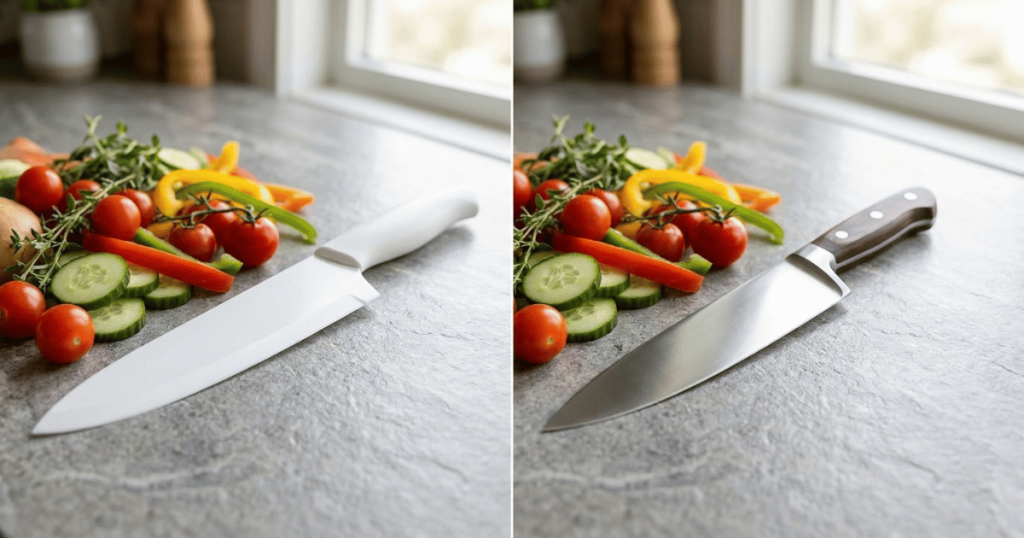
What a Ceramic Kitchen Knife Is Made Of
It is not the ceramic of a coffee mug. Kyocera, which makes both industrial ceramics and ceramic kitchen knives, says on its ceramic knife FAQ (read September 24, 2026) that its blades are made of “an advanced, high-tech ceramic called zirconium oxide (also called zirconia).” Zirconia powder is formed into a blank and fired at high temperature until the particles fuse into a dense solid. The result is hard enough that, in Kyocera’s words, “Ceramic is harder than all metals.”
Density matters more in a ceramic than in steel, for a reason covered below: cracks in ceramics start at flaws such as pores. Kyocera’s FAQ says its Premier series blades go through an extra hot isostatic pressing step at “1500° C and a pressure of up to 2,000 bar” (about 2,730°F and 29,000 psi), which it describes as creating “a tighter weave between the ceramic molecules.” Kyocera’s zirconia material page adds that the material is used “for industrial cutters, scissors, and kitchen knives, contributing to a longer life for such products.”
Hardness vs Toughness: The Core of Ceramic Knives vs Steel
Hardness is resistance to being scratched or dented. Toughness, as Kyocera defines it, “is measured by its resistance to fracturing.” A material can have plenty of one and little of the other, and these two knives sit on opposite sides of that line.
On hardness, ceramic wins clearly. Kyocera’s FAQ states that “zirconium oxide has a hardness of 8.2 Mohs (vs. steel at 5-6 Mohs and diamond at 10 Mohs).” The Mohs scale is a scratch ranking: a harder material scratches a softer one. It tells you that zirconia shrugs off the fine abrasion that slowly wears a steel edge. It says nothing about what happens when a thin edge meets a bone.
On toughness, steel wins, and the ceramic maker says so itself. Kyocera’s Fine Ceramics World page on toughness (read September 24, 2026) states: “Typically, ceramics are characterized by hardness as well as a lack of toughness.” The same page notes that “partially-stabilized zirconia, used for products such as scissors and knives, offers significant fracture-toughness improvements.” Tough for a ceramic is not the same as tough.
The reason lies in how each material handles stress at the edge. In steel, atoms can slip past one another along planes in the crystal, so an overloaded edge bends or rolls instead of breaking. In a ceramic, the bonds do not allow that slip at room temperature. The stress has nowhere to go, so it gathers at the tip of the smallest flaw, a pore or a scratch, and a crack runs. Partially stabilized zirconia fights back with a clever trick: grains near a growing crack change crystal structure and expand slightly, squeezing the crack. That slows the crack. It does not let the edge bend.
| Situation | Zirconia ceramic edge | Steel edge |
|---|---|---|
| Slicing soft food | Wears very slowly | Wears, and rolls slightly over time |
| Hits a bone or frozen food | Chips | Dents or rolls; very hard steels can chip |
| Twisted or levered | Chips or snaps | Flexes, then springs back or bends |
| Dropped on the tip | Chips or breaks | Bends or chips |
| Honing | Does nothing | Straightens a rolled edge |
| Sharpening | Diamond abrasives only | Any suitable stone |
What “Never Needs Sharpening” Really Means
The claim is half true. A ceramic edge resists abrasion, so it stays keen through a long run of soft-food slicing. What it never does is roll. A steel edge dulls partly by folding over microscopically, and a few strokes on a honing steel stand it back up; our explainer on honing versus sharpening covers what each does to a steel edge. A ceramic edge dulls a different way: by losing tiny pieces along its length. A missing piece cannot be straightened back into place.
So when a ceramic knife finally goes dull, it needs a real sharpening, and only diamond abrasives cut zirconia well. Kyocera’s FAQ tells owners they “can use a home sharpener with a diamond wheel,” or send knives to its authorized service, EVERSHARP, which it says “offers an outstanding sharpening and repair service removing any chips and sharpening the knife back to its factory edge.” Our guide to sharpening ceramic knives explains why an ordinary whetstone barely touches the blade.
With steel, the same job is a whetstone on the counter, and a small chip can be ground out at home; our guide to fixing a chipped knife walks through it. That is the quiet cost of ceramic: it asks for sharpening less often, but when it does, the job is harder or goes in the mail.
Where Ceramic Wins
Edge life on soft food. A harder, abrasion-resistant edge wears slowly on the foods Kyocera’s care guidelines list as intended use: “All fruits, vegetables, and leafy herbs,” “Boneless meats and fresh fish.”
Rust. Zirconia is already an oxide, and there is no iron in it to rust. Steel is different. Stainless steel resists rust but can still spot when left wet, and carbon steel rusts readily; our guide to keeping knives from rusting covers the steel side of that problem.
Reactivity. Kyocera says its blades “don’t transfer any metallic taste or react with acidic foods.” The contrast is sharpest with carbon steel, which reacts with acids and darkens as it does.
Weight. Zirconia is less dense than steel, so a ceramic blade of the same size weighs less in the hand.
Where Ceramic Breaks
Kyocera’s own care guidelines are the clearest statement of ceramic’s limits, and they read like a list of everything that loads an edge sideways or hits it hard. The maker says: “Do not use on frozen items, bones, or heavy-rind produce,” and “Avoid slicing through large blocks of hard cheese.” It rules out prying with the blade and smashing food with its side, and warns that glass, marble, tile or stone surfaces “can cause the edge to micro-chip.” Its own summary is short: “Ceramic is prized for its hardness, but it does not flex.”
Drops are the other risk, and Kyocera’s FAQ is candid about them: “Any knife, whether stainless steel or ceramic, will potentially break if dropped on a hard surface at a certain angle.” The difference is what happens short of breaking. A steel tip can bend and be straightened, or chip and be reground. A ceramic tip has no bending to fall back on.
One safety point follows from all of this. A chip from a ceramic edge is a small, hard, sharp fragment. If an edge chips mid-cut, check the food and discard anything you are unsure about.
Everyday Care: The One Rule That Flips
Day to day, the two are looked after in much the same way, and both makers recommend washing by hand. Kyocera’s FAQ puts it this way: “Hand washing recommended. High-quality knives can deteriorate over time in dishwashers.”
The difference is cleaning chemistry. Kyocera’s care guidelines say a ceramic blade “can be safely sanitized with a mild bleach solution if needed,” and suggest baking soda for stubborn surface stains. Steel is the opposite on that point. Shun’s care guidance for its steel knives says: “Do not use soaps with citrus extracts or bleach; they can promote rust.” The chemistry explains it: zirconia has no iron for bleach to attack, while steel does. So a ceramic blade tolerates a cleaning step that would harm a steel one, and a light-colored ceramic blade may still need the occasional scrub to lift surface stains.
Which Should You Buy?
| If you… | Better choice | Why |
|---|---|---|
| Want one knife for everything | Steel | Handles bones, squash, frozen food and hard cheese; hones and sharpens at home |
| Slice a lot of produce and want long gaps between sharpenings | Ceramic, as a second knife | A hard edge wears slowly on soft food |
| Cook often with acidic food and dislike rust spots | Ceramic or stainless steel | Ceramic cannot rust; stainless resists; carbon steel reacts |
| Share a kitchen where knives get dropped or knocked around the sink | Steel | Ceramic has no margin for impacts |
| Sharpen your own knives on stones | Steel | Ceramic needs diamond or a mail-in service |
Most cooks end up in the same place: a steel knife as the main tool, and a ceramic knife, if any, as a specialist for the work it does well.
Frequently Asked Questions
Are ceramic knives better than steel knives?
Neither is better overall. Ceramic is harder, lighter and does not rust, so its edge wears slowly on soft food. Steel is tougher, handles hard food, and can be honed and sharpened at home. For most cooks, steel is the main knife and ceramic is a specialist.
Do ceramic knives ever need sharpening?
Yes. They wear slowly on soft food, but they do dull, mostly by losing tiny chips from the edge. Then they need diamond abrasives or the maker’s service; Kyocera points owners to a diamond-wheel sharpener or to EVERSHARP.
Can I use a honing steel or a whetstone on a ceramic knife?
A honing steel does nothing, because it straightens a rolled steel edge and a ceramic edge does not roll. An ordinary whetstone is too soft to cut zirconia well; diamond abrasives are what work.
Why did my ceramic knife chip?
Something loaded the edge sideways or hit it hard: a bone, frozen food, a hard rind, a twist, a hard surface, or a drop. Ceramic is hard but lacks toughness, so it chips where steel would bend.
Do ceramic knives react with acidic food?
Not according to Kyocera, which says its blades “don’t transfer any metallic taste or react with acidic foods.” Carbon steel does react with acids, which is why it darkens; stainless steel reacts far less.