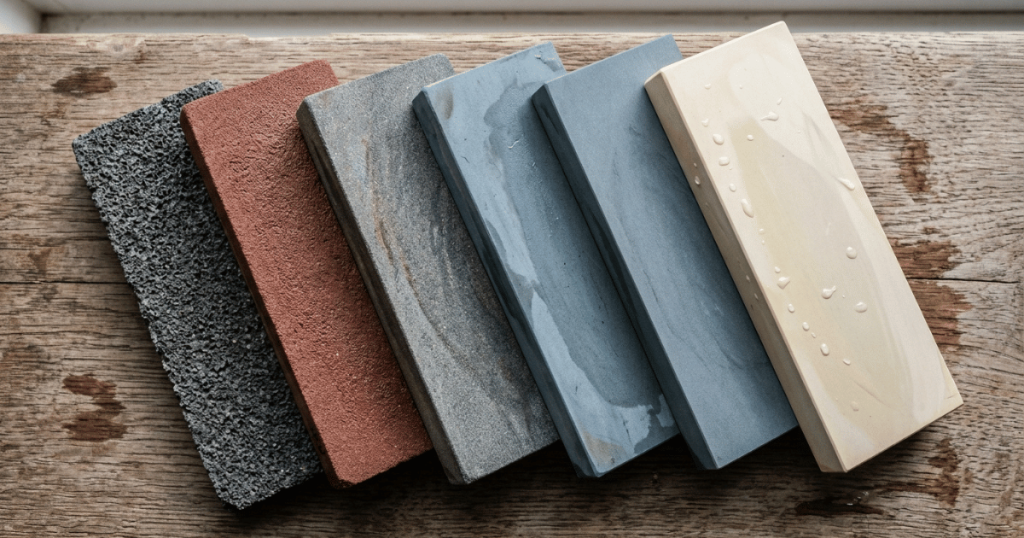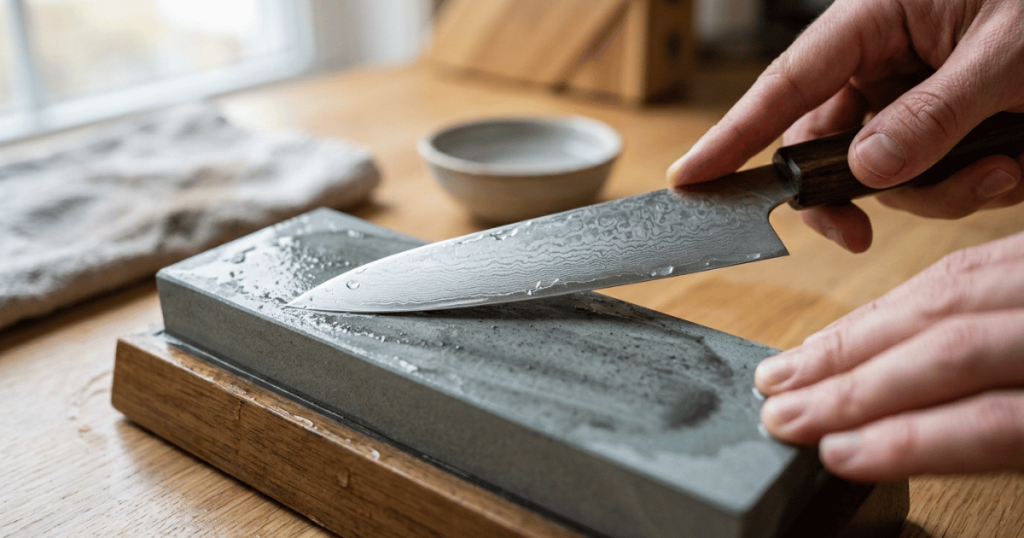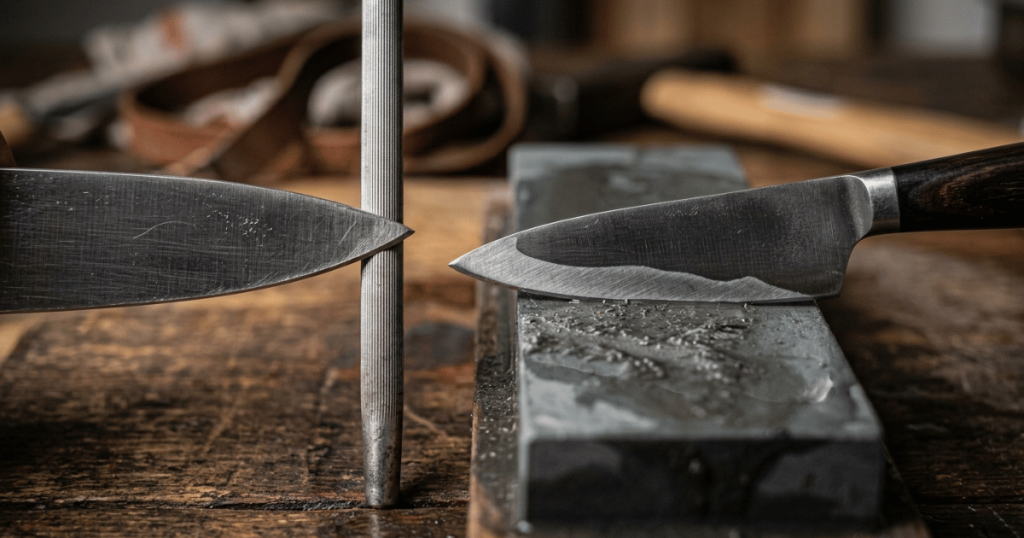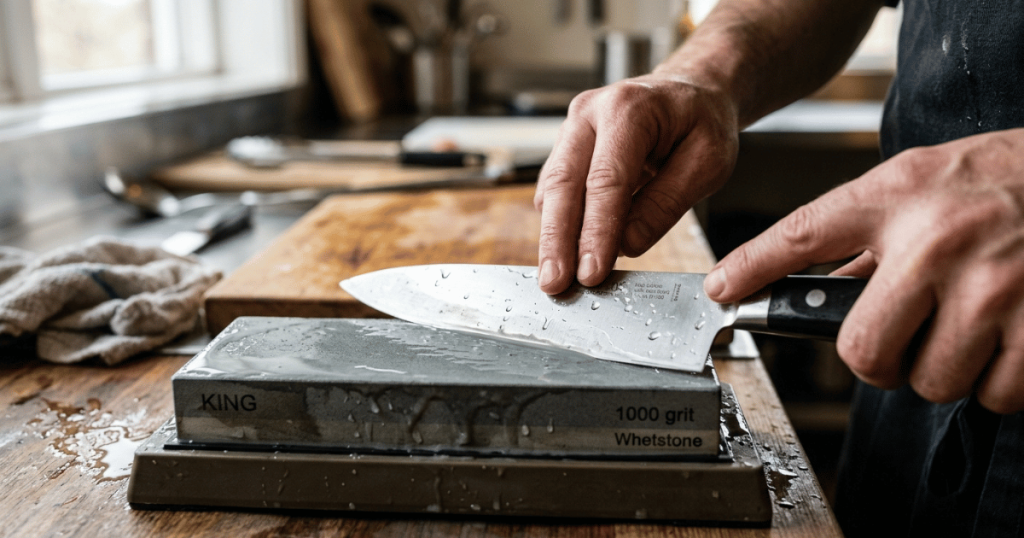
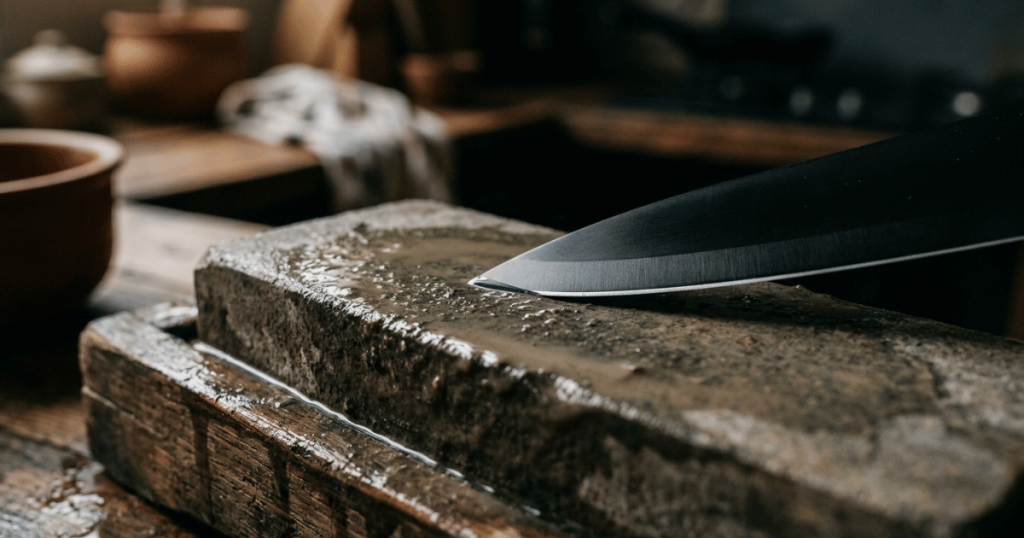
Your stone is not doing nothing because you are doing it wrong. It is doing nothing because the blade is harder than the abrasive in the stone.
Abrasion is one material scratching another, and it only works one way round. A ceramic kitchen blade, usually zirconium oxide, is harder than the abrasive particles in a common water stone, so the stone slides across it and gives up. No amount of pressure, patience or angle changes that.
What ceramic blades are, and what follows
A ceramic blade is a fired ceramic rather than a metal. That gives it three properties that between them explain everything about owning one.
It is very hard. Which is why it holds an edge for a long time, and why almost nothing will sharpen it.
It is brittle. Hard materials resist deformation and fracture instead. A steel edge that meets a bone bends over. A ceramic edge chips or snaps. There is no bending stage.
It does not corrode. The genuine upside, and the reason ceramic knives found a niche in the first place.
The practical rule that follows from the second point: ceramic knives are for soft work. Vegetables, fruit, boneless proteins. Not bone, not frozen food, not hard squash, and never prying or twisting. Lateral force is what breaks them.
The only abrasive that works
Diamond. That is the list.
Diamond is harder than the ceramic, so it cuts. Anything softer polishes at best.
Which means the options for sharpening a ceramic blade at home come down to:
- A diamond plate or diamond stone. Diamond abrasive bonded to a flat backing.
- A diamond-wheeled electric sharpener specifically rated for ceramic. Rated for ceramic by its own maker, not assumed.
- A diamond rod or file, for small touch-ups.
And what does not work, whatever it costs: ordinary water stones, oil stones, ceramic honing rods, steel honing rods, carbide pull-through slots, and any electric sharpener not specifically rated for ceramic. A carbide slot on a brittle blade is not merely ineffective, it is a way to snap the tip off.
This is also a reminder that grit numbers do not travel between systems: diamond products are usually rated on a different scale from water stones, so a diamond number and a water-stone number are not comparable. A grit number is a name inside a standard rather than a measurement, and that article sets out why.
Before you sharpen: should you?
Three questions, and for many people the answer to this section is that sharpening is not the right move.
1. Is it chipped, or is it dull? Look down the edge under a light. A chipped ceramic blade is a different problem, and chips in ceramic are not the small cosmetic events they are in steel: they indicate the blade has taken a shock, and material may be weakened beyond the visible damage.
2. Does the maker offer sharpening? Several ceramic knife manufacturers run factory sharpening or replacement programs, precisely because home sharpening of ceramic is difficult and the equipment is specialized. Check the maker’s own page before you buy a diamond plate. On a knife of modest value, the factory route is frequently cheaper and better than the equipment.
3. What is the knife worth against the plate? A diamond plate costs real money. If you own one ceramic knife and it is inexpensive, the arithmetic favors the factory program or replacement.
If you are going to do it yourself
Understand the risk first: ceramic can break during sharpening. Pressure, a catch, an edge dropped against the plate at the wrong moment. This is not a scare line, it is the reason to work with light hands and low expectations.
1. Support the plate and support yourself. Plate on a non-slip mat or in a holder, flat, at a comfortable height. Nothing sliding.
2. Find the existing angle. Ceramic knives are often ground more shallowly than Western steel knives and the angle differs by maker. Color the bevel with a permanent marker, take two light strokes, and look at where the marker went. Adjust until it comes off evenly across the bevel.
3. Very light pressure. Lighter than you think. The weight of the blade and little more. Pressure is what breaks brittle material, and diamond cuts without needing force.
4. Slow, smooth strokes, full length, alternating sides with equal counts. Dominant hand on the handle, other hand’s fingertips on the flat of the blade well behind the edge, never in front of it.
5. No sudden changes of direction and no snatching. Steady is the whole technique.
6. Check often and stop early. Look at the edge under a light, and test on paper: slice a hanging sheet downward and away from you. Stop the first time it cuts cleanly. Extra strokes on a brittle blade buy nothing and risk something.
7. Expect no burr the way you would on steel. Ceramic does not form a ductile burr; it tends to break away in tiny fragments. Which means the burr signal you rely on for a steel knife is not available here, and observation of the edge replaces it.
8. Wipe the blade and the plate afterward, spine to edge, never along the edge. Ceramic dust is not something to handle casually or breathe; work with the plate wet if the plate’s maker permits it, and wipe rather than blow.
What to do about chips
Small chips: can sometimes be worked out with a diamond plate the way a chip is worked out of steel, which means grinding the edge back to the depth of the chip. On ceramic that is slow, and the removal is unforgiving.
Anything larger, or a chip near the tip: stop. The maker’s program or replacement. Attempting a large repair on a brittle blade with hand pressure is the most likely way to end up with two pieces.
A snapped tip on a ceramic knife is usually the end of that knife. Reprofiling a broken ceramic point by hand is not realistic.
Living with a ceramic knife instead
The most useful thing about ceramic is that it does not need sharpening often. So the practical strategy for most owners is to make the factory edge last.
- Soft cutting board only. Wood or soft plastic. Never glass, stone or ceramic surfaces.
- No bone, no frozen food, no hard squash, no crab shells.
- No twisting, no prying, no scraping the board with the edge.
- Stored so it cannot knock against anything. A guard, a block or a magnetic strip, not loose in a drawer.
- Do not drop it. A ceramic knife dropped on a hard floor frequently does not survive, and catching a falling knife is worse than letting it land.
- Dishwasher only if the maker says so, and even then, the risk is the knocking rather than the water.
Where this sits against your other knives
A ceramic knife is a specialist, not a general-purpose knife, and the honest framing is that it does one narrow set of jobs well and is fragile everywhere else. The comparison of sharpening methods lists it as an exclusion for almost every tool, and the method pillar covers which tool goes with which steel for everything else in the drawer.
Where you stop
- No pull-through, no carbide slot, no steel rod, no ceramic rod, no water stone.
- No electric sharpener unless its own maker rates it for ceramic.
- No powered grinder of any kind.
- Light pressure, always. Force breaks brittle material.
- Never run a finger along the edge to test it. Across, or use paper.
- Stop at any chip, catch or crack, and go to the maker.
- Do not breathe or blow ceramic dust. Wipe, and keep the work wet if the plate allows.
The short version
Your whetstone does nothing because the blade is harder than the stone’s abrasive. Diamond is the only abrasive that cuts ceramic, so the options are a diamond plate, a diamond rod, or an electric sharpener its maker rates for ceramic. Before buying any of them, check whether your knife’s manufacturer sharpens or replaces, because for most owners that is the cheaper and safer route. If you do it yourself, find the angle with a marker, use the lightest pressure you can manage, alternate equal strokes, and stop the first time it cuts paper. And treat the knife as a soft-work specialist, because a ceramic edge chips where a steel edge would only bend.