Honing straightens an edge that has bent over. Sharpening grinds metal off the blade until a new edge exists. Honing takes seconds, removes little or nothing, and can be done constantly. Sharpening takes real time, removes steel you never get back, and is needed only a few times a year for most home cooks. The rule that follows is short: hone on a rhythm, sharpen on a signal, and treat the day the rod stops helping as the signal rather than as a reason to hone harder.
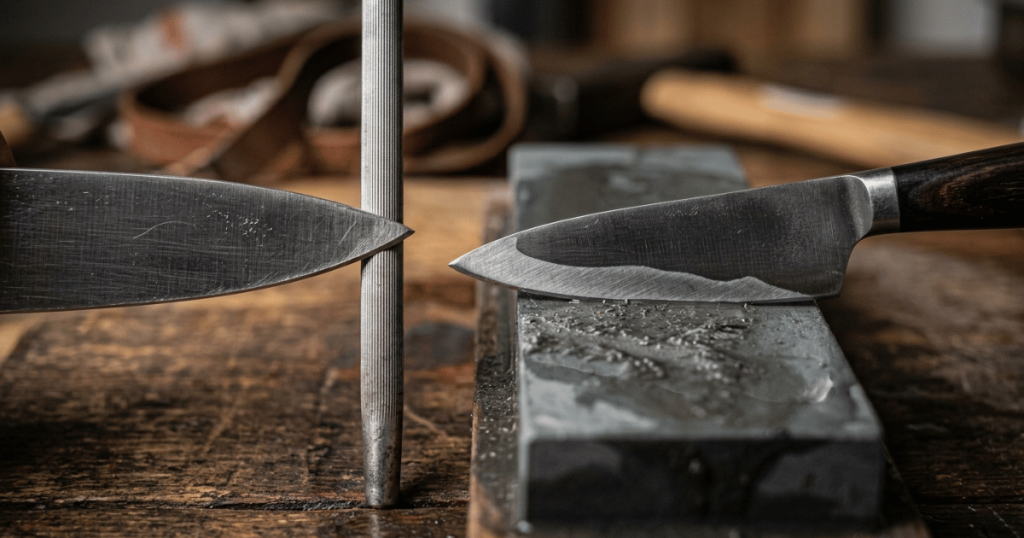
Two different failures, two different fixes
“Dull” describes one feeling and two entirely separate things happening to the steel.
| What happened | What it feels like | What fixes it | What will not |
|---|---|---|---|
| The apex rolled. The very edge bent to one side under load. All the steel is still there, pointing the wrong way. | Sharp last week, suddenly skidding this week. Cuts fine in one section and not another. | A honing rod. Seconds of work. | Nothing else is needed, and a stone session is wasted effort. |
| The apex wore away. Abrasion against the board and the food took the point off. There is no thin edge left, just a rounded shoulder. | Gradually worse over months. Honing helps less each time, then not at all. | Sharpening: a stone, a machine, or a service. | The rod. There is nothing left to straighten. |
Almost every honing versus sharpening explanation stops at that distinction. It is correct and it is not enough, because the question people actually arrive with is the one underneath it.
Why the rod stops working after a few months
Honing only works while there is still an apex to move. Every time you use the knife, two things happen at once: some of the edge bends, and some of it abrades away. The rod addresses the first and cannot touch the second. So each session restores slightly less than the one before, because the underlying apex is thinner and more rounded than it was. Eventually you are running a rod along an edge with nothing left to align, and the knife stops responding.
The makers describe the endpoint rather than the mechanism, and they are clear about it. Zwilling: “if the cutting edge can no longer be renewed by honing, it must be reground to bring on a new edge.” Victorinox says sharpening is needed far less often than honing and only “when honing no longer helps.” Both are saying the same thing. The rod failing is not a malfunction, it is the scheduled arrival of the other job.
There is a second reason worth ruling out. Some tools sold as steels are abrasives. Wüsthof separates them: a honing steel re-aligns the edge, while a sharpening steel “will actually grind away material from the knife, allowing it to reset the edge.” An owner who has used a diamond rod for two years has been sharpening, not honing, and the knife has been losing metal the whole time. Check what your rod is made of before you blame the blade.
The makers do not fully agree on what honing does
Most pages on this subject present one tidy explanation. The published explanations actually differ, and reading them together tells you more than any one of them.
Wüsthof describes a honing steel as re-aligning “the microscopic teeth in the blade.” Victorinox describes honing as realigning “the blade’s edge, which can bend slightly with use.” Shun describes it as maintaining an edge “by realigning it when it begins to roll.” Teeth or a rolled apex: two different pictures of something nobody in a kitchen can see. What matters is what all three agree on, which is that the rod moves existing metal rather than creating a new edge. Nobody who sells honing steels claims otherwise, and that is the most useful fact on this page. A tool built to reposition steel cannot replace steel that is gone.
What each one costs you
| Honing | Sharpening | |
|---|---|---|
| What it does | Straightens a rolled apex | Grinds a new apex |
| Metal removed | Little to none, depending on the rod | Real metal, permanently |
| Time | Seconds, at the board | Minutes per knife once practiced, an evening the first time |
| Skill | Low. Angle drift is forgiving | Higher. Angle drift shows up in the result |
| How often | Often. Shun notes that some cooks hone weekly and others daily | Rarely. When honing no longer restores the edge |
| Cost of getting it wrong | A scratched blade face, a wasted minute | A reground bevel, a shorter blade, or a chipped edge |
The asymmetry in that last row is why the two jobs are not interchangeable. Honing is close to free. Sharpening is a withdrawal from a finite account, because a knife only has so much steel and every session spends some of it. That is the real argument for honing often: not that it makes the knife sharper, but that it delays the thing which shortens the knife’s life.
One word, three tools
Much of the confusion here is vocabulary rather than technique. The word “steel” is doing three jobs.
- Honing steel. A smooth or lightly grooved steel rod. Realigns, removes almost nothing. This is the one in most knife blocks.
- Sharpening steel. Wüsthof’s own term for a rod that grinds material away. Same shape, different job.
- Ceramic or diamond rod. An abrasive on a rod. These sharpen, gently in fine ceramic and not at all gently in diamond.
Before deciding whether your knife needs honing or sharpening, work out which of those is in your drawer. People who say a rod ruined their knife are usually describing the third kind, used with a heavy hand at a guessed angle.
Which one do you need right now
| Symptom | Most likely | Do this |
|---|---|---|
| Was cutting well a week ago, now slides off a tomato skin | Rolled apex | Hone. Test on paper afterward |
| Honing works but only for a day or two | The apex is thinning | Sharpen soon. Keep honing in the meantime |
| Honing does nothing at all | The apex is worn away | Sharpen. More rod work is wasted time |
| Cuts well in the middle, poorly at the tip | Uneven wear, or honing that never reached the tip | Hone heel to tip properly, then sharpen if that fails |
| Visible chip, bent blade, or broken tip | Damage, not dullness | Neither. This is repair or a professional regrind |
| Serrated bread knife feels dull | Usually technique or a very fresh loaf | Not the rod. Zwilling’s instruction is “don’t ever hone serrated knives” |
The schedule that actually works
Hone on a rhythm you will not have to remember: before a cooking session, or after, or whenever the knife comes out for something that matters. The makers’ own advice sits in that range. Victorinox suggests honing before or after each cooking session. Wüsthof says a steel should be used regularly, even after each use. Shun leaves it to how often the knife is used.
Sharpen on a signal rather than a calendar, and the signal is the one above: honing stops restoring the bite. Someone who hones consistently will hit that a small number of times a year. Someone who never hones will hit it far sooner, because steel that could have been straightened gets fatigued and breaks off instead. That is the whole relationship between the two jobs. Honing is not a substitute for sharpening, it is what buys you time between sharpenings.
What neither of them fixes
Both jobs assume an intact edge on a straight blade. A chip is missing steel, and closing it means grinding the entire edge back behind the deepest point of the damage, which is a repair with a real cost in blade height. A bent blade, a snapped tip, or a knife ground out of shape is the same category. Ceramic sits outside both, since it does not roll and ordinary abrasives do not touch it. And a serrated edge is its own procedure, worked scallop by scallop, never on a rod and never on a flat stone.
Frequently asked questions
Is honing the same as sharpening?
No. Honing realigns an edge that has bent over and removes little or no metal. Sharpening removes metal to create a new edge. Victorinox describes the difference in exactly those terms, and no maker of honing steels claims the rod can replace sharpening.
Can I only ever hone and never sharpen?
No. Honing delays sharpening, it does not remove the need for it. Once the apex has worn away rather than rolled, there is nothing for the rod to straighten, and Zwilling’s own guidance says the edge has to be reground at that point.
Does honing damage a knife?
A smooth honing steel used lightly at the knife’s own angle takes off very little. The risks come from the other cases: a diamond or heavily grooved rod used with force, a rod used on a hard Japanese edge it was not specified for, or a rod used on a serrated or coated blade, which Zwilling excludes outright.
How do I know if my rod is a honing steel or a sharpener?
Look at the surface and the label. A smooth or lightly ridged steel rod is a honing steel. A ceramic or diamond rod is an abrasive, and makers generally sell those as sharpeners. Wüsthof separates the two by name in its own guidance, which is a good reminder that the shape tells you nothing.
How often should I sharpen if I hone regularly?
There is no honest universal number, because it depends on the steel, the board, the food and how much you cook. The reliable answer is behavioral rather than numeric: sharpen when honing stops bringing the edge back. For most home cooks who hone consistently, that lands a handful of times a year.