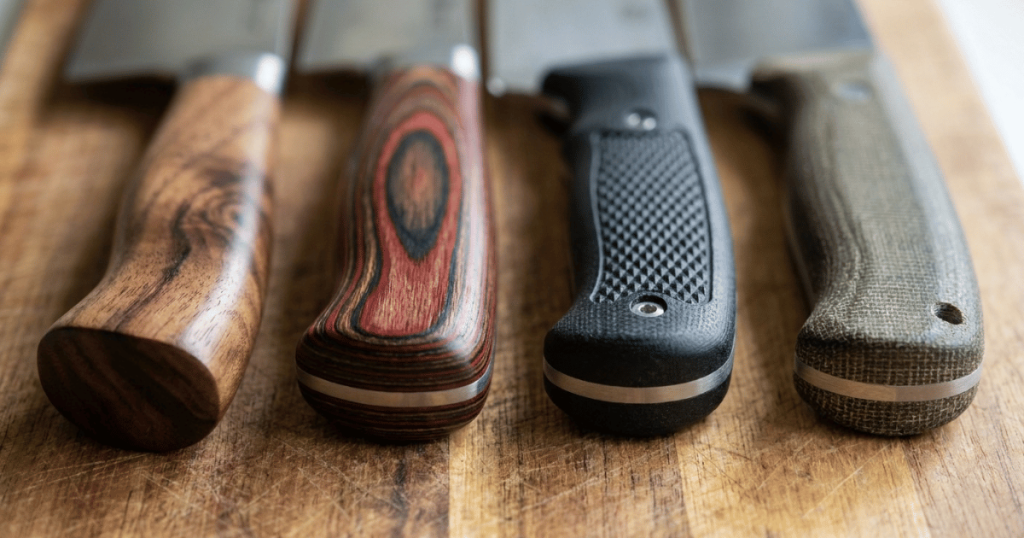
Knife handle materials differ most in how they deal with water, and that decides how long a handle lasts. Bare wood absorbs water, so it swells, shrinks and can crack. Pakkawood is hardwood impregnated with resin: moisture resistant, but still wood. Micarta (cotton fabric or paper in phenolic resin) and G-10 (glass cloth in epoxy) are fiber composites that hold their shape far better than wood. Molded plastics such as polypropylene and TPE take up very little water; makers such as Victorinox rate some of them dishwasher safe.
If a knife just went through the dishwasher by mistake, that order is also your first answer: molded plastic is the most likely to shrug it off, bare wood is the most at risk, and the composites sit in between. But the material is only half of it. The other half is the joint that holds the handle to the blade.
Why Water Decides How Long a Handle Lasts
Wood is a bundle of hollow cellulose fibers. The walls of those fibers take up water and swell, then give it up and shrink. The movement is small along the grain and much larger across it. Steel does not move with water at all. So every time a wooden handle is soaked and then dries, it changes size against a tang, rivets and glue that stay put, and the stress collects at the joints and at any small crack already there.
Resin changes the picture. Fill wood’s pores with resin, or build a handle from fabric, paper or glass cloth locked in cured resin, and water has far less room to go. Shun, which makes Pakkawood-handled knives, is candid about the limit on its Use and Care page (read September 24, 2026): “Although the wood has been stabilized, it is natural wood and, like all wood, will tend to shrink in very arid environments and swell in very humid environments.” Glass fiber and molded plastic sit at the far end of the scale, taking up very little water at all.
Heat adds a second stress. Hot water drives moisture into wood faster, and a heated drying cycle pulls it out fast. For a material that moves with water, that is a hard combination.
Knife Handle Materials Compared
| Material | What it is | Response to water | Dishwasher | Feel | Upkeep |
|---|---|---|---|---|---|
| Bare wood | Natural wood, unfinished or lightly oiled | Absorbs; swells and shrinks | No | Warm, dry grip | Dry at once; oil now and then |
| Pakkawood | Hardwood impregnated with resin | Resists, but still moves a little | Shun advises hand washing | Smooth, polished | Hand wash and dry |
| Micarta | Cotton canvas, linen or paper layers in phenolic resin | Low; cotton and paper can take up some moisture | Follow the knife maker | Smooth or textured | Minimal |
| G-10 | Glass fiber cloth in epoxy resin | Very low; glass does not absorb water | Follow the knife maker | Smooth or textured | Minimal |
| Polypropylene, POM, TPE | Molded plastics | Very low | Some are rated safe | Firm to rubbery | Minimal |
Bare Wood
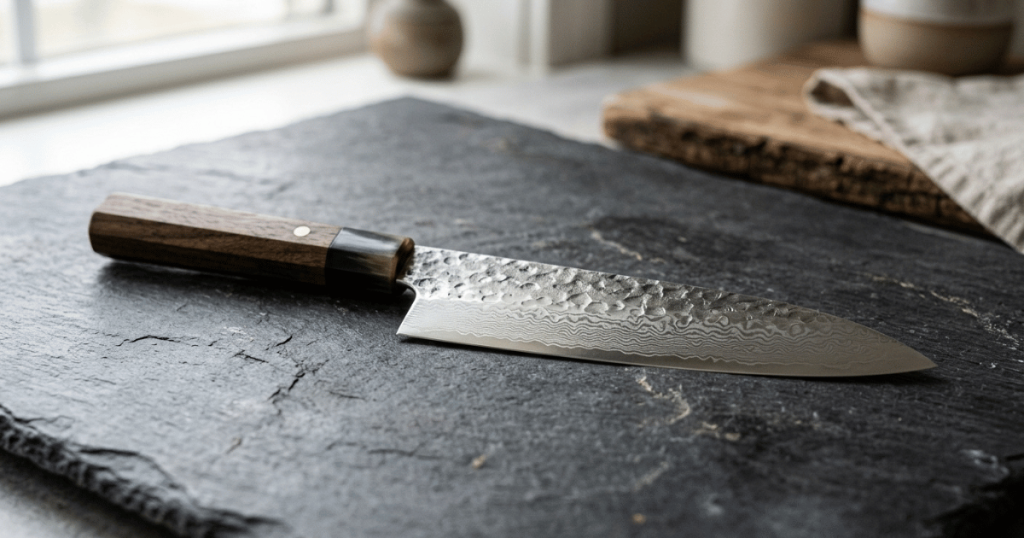
“Bare wood” here means natural wood with little or no sealing finish. It is the traditional choice for Japanese wa handles, which are commonly made of ho wood (Japanese magnolia): light, soft and easy to shape. Harder woods such as walnut, rosewood and ebony appear on Japanese and Western knives alike. Shun uses Tagayasan, a dark wood it describes as “known as ‘iron sword wood’ for its incredible durability.”
Wood’s case is real: it is warm in the hand, grips well when dry, looks better with age, and on a wa-handled knife the whole handle can be replaced when it wears out. If that tradition appeals, our guide to telling real Japanese knives from Japanese-style ones shows what to look for.
The cost is attention. Bare wood has to be dried right after washing and oiled now and then, and it stains, darkens and eventually checks if it spends time wet. It is the right handle for a cook who will do that, and the wrong one for a kitchen where knives sit in the sink.
Pakkawood and Stabilized Wood
Shun’s handle materials page describes Pakkawood as “genuine hardwood impregnated with resin” and says “the resin makes it moisture resistant, strong, and durable.” It is polished to a gloss, looks and feels like wood, and resists water far better than bare wood. Stabilized wood, common on custom handles, is the same idea applied to a single piece of natural wood: resin driven into its pores and cured.
The limit is the one Shun states on its care page: resin-filled wood is still wood, so it still shrinks and swells a little with humidity. That is why Shun advises hand washing its Pakkawood-handled knives and drying them straight away. Pakkawood is the right choice if you want the look of wood with far less upkeep. It is not a way to make wood dishwasher-proof.
Micarta
Micarta is the laminate brand of Norplex-Micarta, and the name is often used loosely for similar materials. Norplex-Micarta’s grade directory describes its canvas grade as made “with a cotton fabric and phenolic resin,” its linen grade as a “fine weave (less than 4 ounce/square yard) cotton fabric commonly called linen, combined with phenolic resin,” and also lists paper-based phenolic grades. The layers are soaked in resin, stacked, pressed and cured into a solid that does not melt again.
The fibers still matter. Cotton and paper can take up some moisture where they are exposed at the surface, and the laminate maker sells versions with “lower moisture absorption” and “improved moisture resistance,” which tells you the base cotton grades are not immune. Even so, Micarta holds its shape far better than wood and needs little care. Canvas grades have a coarser weave than linen grades, and the weave can show on a finished handle.
G-10
G-10 is the glass-fiber cousin of Micarta. Norplex-Micarta’s explainer, What is G-10 (dated September 13, 2018, read September 24, 2026), defines it as “continuous filament fiberglass cloth (plain weave, e-glass)” in a “non-brominated (not flame retardant) epoxy resin system,” supplied as a fully cured composite.
Glass does not absorb water and cured epoxy takes up very little, so G-10 barely responds to a wet kitchen. It is hard and stiff, and makers can leave it smooth or cut a texture into it. One detail matters for heat: the same explainer notes that the NEMA standard behind the G-10 name “does not have a minimum Tg requirement,” Tg being the temperature at which the epoxy starts to soften. The name alone does not tell you how much heat a particular handle is built for.
Polypropylene, POM and TPE
Molded plastic handles come in three common types. Polypropylene is a rigid, low-cost plastic. POM, also called acetal, is harder and denser and is used for riveted scales on some Western knives. TPE, thermoplastic elastomer, is soft and rubbery and is chosen for grip.
Victorinox’s own specification for its Fibrox Chef’s Knife Extra Wide, 8 in (5.2063.20) lists the handle as “Thermoplastic elastomers (TPE),” marks the knife “Dishwasher safe: Yes,” and describes an “ergonomic, non-slip handle for control.” A handle molded around the tang has no seam running along its length for water to work into, which is much of why this group copes with water so well.
The trade-offs are looks and repair. Plastic handles read as utilitarian, they cannot be refinished or re-scaled, and a plastic handle left against a hot pan can deform.
Which Handle Survives a Dishwasher Accident?
Ranked by how each material responds to hot water and a heated dry:
- Molded plastic. Some knives in this group, such as Victorinox’s Fibrox, are rated dishwasher safe by their maker, which means they were designed for it.
- G-10. The material is unaffected by water. The risk is the joint to the blade and how much heat that particular handle was built for.
- Micarta. Little effect. Cotton and paper grades can take up some moisture at the surface.
- Pakkawood. Resists water, but it is still wood, which is why its maker advises hand washing.
- Bare wood. The most at risk: soaked in hot water, then dried fast.
After an accidental cycle, dry the knife by hand right away and let any wooden handle finish drying at room temperature, away from heat. Then check it. Look for a gap along the seams, feel for any movement in the handle, look along the grain for cracks, and check the blade and bolster for rust spots; our guide to removing rust from kitchen knives covers any you find. Oil bare wood once it is fully dry. If the handle moves at all, stop using the knife until it has been repaired.
As for making it a habit, our explainer on whether knives belong in the dishwasher looks at the blade side of the question as well.
The Handle Material Is Only Half the Story
A handle fails where it meets the steel: at the seam between scale and tang, at the rivets or pins, at the glue line, or at the collar of a wa handle. A G-10 scale on a badly sealed seam can still let water reach the tang, while a well-fitted wooden handle that is always dried can serve for years. When you compare knives, look at the joint as closely as the material: tight seams with no step, and no gap where handle meets bolster or blade. The habits that protect any handle, whatever it is made of, are in our guide to what ruins kitchen knives.
Frequently Asked Questions
What is the most durable knife handle material?
Against water, G-10 and molded plastics are the least affected, because glass fiber and plastics take up very little water. Against knocks, G-10 and Micarta are both hard composites. Durability also depends on the joint: a well-made handle that is kept dry can outlast a poorly sealed one of any material.
Is Pakkawood real wood?
Yes. Shun describes it as “genuine hardwood impregnated with resin.” The resin makes it moisture resistant, but Shun’s care guidance notes that stabilized wood still shrinks and swells a little with humidity.
What is the difference between G-10 and Micarta?
Both are layers of fiber locked in cured resin. G-10 uses glass fiber cloth in epoxy; Micarta uses cotton canvas, linen or paper in phenolic resin. Glass does not absorb water, so G-10 is less affected by moisture, while cotton and paper can take up a little.
Can wooden knife handles go in the dishwasher?
No. Hot water and a heated drying cycle make wood swell and then shrink quickly, which opens seams and cracks handles. Wash by hand and dry right away, as makers such as Shun advise.
Are plastic knife handles dishwasher safe?
Some are, and the maker’s specification is the place to check, because the rating covers the whole knife, not only the handle. Victorinox, for example, rates its TPE-handled Fibrox Chef’s Knife Extra Wide dishwasher safe.