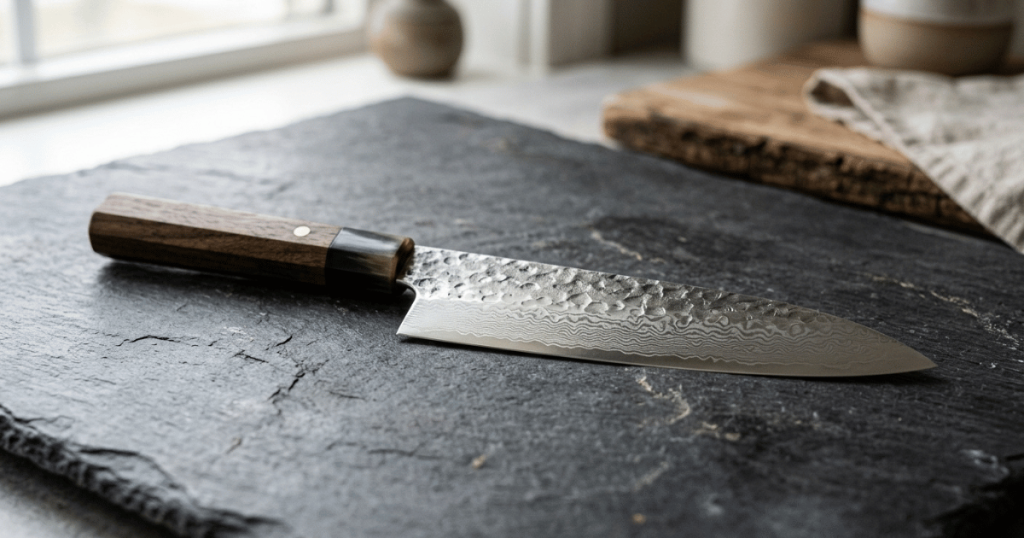
Damascus kitchen knives get their wavy pattern one of two ways: genuine layered steel that has been forge-welded and folded, then acid-etched so the layers show, or a pattern applied to the surface of a single ordinary steel. Either way, the pattern itself does not decide how the knife cuts. That job belongs to a separate piece of steel, usually a single core steel hidden under or between the decorative layers, and how that core steel behaves depends on its own composition and hardness, not on how many wavy lines are etched into the cladding around it. Before you pay a premium for the look, it helps to know which question you are actually answering: is the layering real, and separately, what is the core steel and what does its own published spec say.
Start with how the layering is actually done, because that is the part most buying guides get vague about.
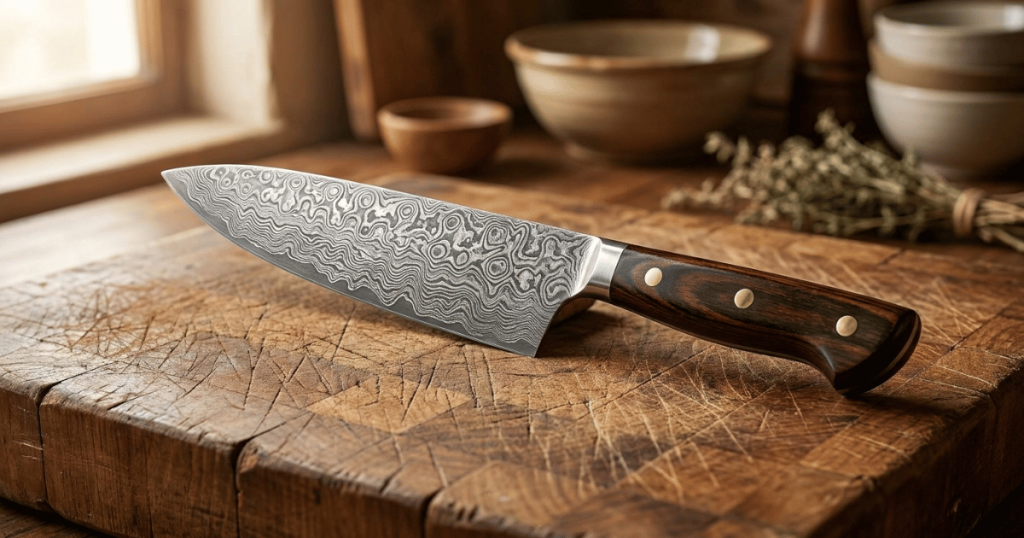
How Real Pattern-Welded Damascus Is Actually Made
What is sold today as “damascus” on a kitchen knife is pattern-welded steel, a modern forging technique, not the same process as the historical crucible steel once called Damascus steel, which used a different metallurgical method that is no longer produced the same way. A modern maker stacks two or more different steel alloys into a billet, heats it, and hammer-welds the layers together. The billet is then folded back on itself and welded again, repeatedly, building up alternating bands of the different steels.
Once the layered billet has the number of bands the maker wants, it is drawn out into a blade shape. The wavy pattern only becomes visible afterward, when the finished blade is treated with a mild acid. The acid etches the different alloys at slightly different rates, so one steel darkens or recedes more than the other, and the contrast between them is what you actually see as the “damascus” pattern.
That etching step is a normal, expected part of authentic production, not a sign of fakery on its own. The real question is not whether a blade was etched, since genuine layered damascus is always etched to reveal its pattern, but whether there is layered steel underneath the etch at all.
What the Pattern Shows You, and What It Does Not
On most production damascus kitchen knives, the layered, patterned steel is not what forms the cutting edge. It is a decorative outer cladding, forge-welded around a separate core steel that runs down the center of the blade and does the actual cutting. The cladding layers are usually a softer, easier-to-etch stainless alloy chosen for contrast and corrosion resistance, while the core is a harder, wear-resistant steel chosen and heat-treated specifically for edge performance. Look closely at the bevel near the cutting edge on a knife built this way and you can often see a visible line where the patterned cladding stops and the core steel takes over, exactly where the edge is ground.
This construction is not a shortcut or a lesser version of “true” damascus. It is simply how a maker gets a decorative, forge-welded pattern and a specific, controllable cutting performance in the same blade, without depending on the cladding steel to also hold an edge. But it does mean the pattern and the performance are answered by two different specs, and a buyer who only asks about the pattern has not asked about the part of the knife that actually cuts.
Why the Core Steel, Not the Pattern, Decides How the Knife Cuts
A common core steel in damascus-clad Japanese-style kitchen knives is VG-10, a stainless steel developed by Takefu Special Steel in Japan. Metallurgist Larrin Thomas, writing on Knife Steel Nerds (read 2026-09-18), documents VG-10’s composition at roughly 1% carbon and 15% chromium, and reports measuring it at approximately 60.7 HRC under a specific heat treatment he tested. Separately, the steel composition and hardness reference site zknives.com (read 2026-09-18) lists VG-10’s typical hardness as 60 to 61 HRC, noting that some makers push it as high as 62 HRC.
Those figures describe VG-10 itself, not any specific damascus-clad knife, since an individual maker’s heat treatment still decides where a given blade lands inside that range. But the pattern applies pressure in the wrong direction here: two knives can carry visually similar damascus cladding while running entirely different core steels underneath, at entirely different hardness levels, with entirely different edge behavior. A harder core in the low 60s HRC range holds a sharpened edge through more cutting sessions before it needs attention, and it is also less tolerant of a sudden lateral shock or an inconsistent sharpening angle, a trade-off covered in more depth in the site’s sharpening angle guide. None of that trade-off shows up in how many wavy layers are etched into the cladding around it.
Real Layered Steel vs. a Surface-Applied Pattern
A genuinely forge-welded pattern runs through the metal, so it shows up on every exposed surface of the blade where steel was actually layered, not just on the two flat faces near the edge. Checking the spine and the tang, where a decorative surface treatment is less likely to have been applied evenly, is a reasonable first look. A pattern that stops abruptly at the edges of the flat faces, or looks unnaturally regular and repeating rather than organic, is worth asking the seller about directly rather than assuming.
The distinction that actually matters is whether layered steel exists beneath the surface at all. A surface-applied pattern sits on top of a single ordinary steel and, if ground or sanded away in one spot, does not reappear, because there was never a second alloy underneath to expose. Genuine forge-welded layers are part of the blade’s structure, so resharpening or light abrasion near the edge does not erase the underlying construction, even if it dulls the visible contrast until the blade is re-etched. If you cannot verify construction directly, ask the seller to name the core steel and cite a published spec for it. A seller who can only describe the pattern, and not the steel doing the cutting, has not told you the part of the answer that affects how the knife performs.
What to Actually Check Before Buying Damascus Kitchen Knives
Ask for the name of the core steel, not just the word “damascus.” A listing that only counts layers, such as advertising a high layer count as the main selling point, is marketing a cosmetic number, not a performance one; layer count affects the pattern’s visual complexity, not edge retention or toughness. Once you know the core steel’s name, look for the maker’s own published composition and hardness figures, the way VG-10’s figures above come from a metallurgist’s testing and a steel-reference site rather than a marketing page. If a listing cannot name its core steel at all, treat the pattern as decoration only and price the knife accordingly.
Fit that core steel’s likely hardness range against how you actually treat a knife day to day. A harder core, in the low-to-mid 60s HRC range some VG-10 blades reach, rewards a careful, consistent sharpening habit and less tolerance for the blade meeting bone or a hard surface. A knife built around a softer core sacrifices some edge life for a wider margin of error. That trade-off, and how to tell when an edge actually needs attention rather than sharpening on a fixed schedule, is covered in the site’s guide to how often to sharpen kitchen knives.
Living With the Pattern: Sharpening and Care Do Not Change
Sharpening a damascus-clad kitchen knife works the same as sharpening any knife built around that core steel, because the bevel that meets the whetstone sits at the edge, where the core steel is exposed, not on the decorative cladding further up the blade. The cladding’s presence does not change the angle or the technique; it only changes what you see on the flats above the bevel. If the edge chips rather than rolls, which is more likely on a harder core steel under lateral stress, the site’s guide to fixing a chipped knife edge, and when not to try covers how to assess the damage before reaching for a stone.
Day-to-day care is also unchanged by the pattern. Hand washing, prompt drying and avoiding a full sink protect the cladding’s contrast and the core steel’s edge for the same reasons they protect any stainless kitchen knife, covered in the site’s guide to how to take care of kitchen knives: what ruins them. Harsh abrasive cleaners can dull the visible etched contrast over years of use, but a re-etch restores it without affecting the core steel’s edge or hardness underneath.
Frequently Asked Questions
Is a damascus kitchen knife better than a plain stainless knife?
Not automatically. The pattern is a cladding and finishing choice, not a performance spec. Two damascus-clad knives can run completely different core steels at different hardness levels, so “better” depends on the named core steel’s own published spec, not on the presence of a pattern.
Does the number of layers in a damascus blade matter for cutting performance?
No, not for edge retention or toughness. Layer count changes how complex and fine the visible pattern looks. The core steel that forms the actual cutting edge is a separate piece of metal, chosen and heat-treated on its own terms.
Can a damascus pattern be fake?
Yes, in the sense that a pattern can be applied to the surface of a single ordinary steel with no layered construction underneath. The acid-etching step itself is normal on genuine damascus too; the real question is whether layered steel exists beneath the surface at all, which is easiest to ask the seller to confirm by naming the core steel.
Do damascus knives need different sharpening?
No. The edge bevel sits on the core steel, not the decorative cladding, so sharpening follows whatever angle and routine suit that core steel, the same as any other kitchen knife built from it.
Does the damascus pattern wear off over time?
The visible contrast can dull with heavy cleaning or abrasion and can be restored with a re-etch, but this affects only the surface appearance. It does not remove the underlying layered structure on a genuinely forge-welded blade, and it does not change the core steel’s hardness.