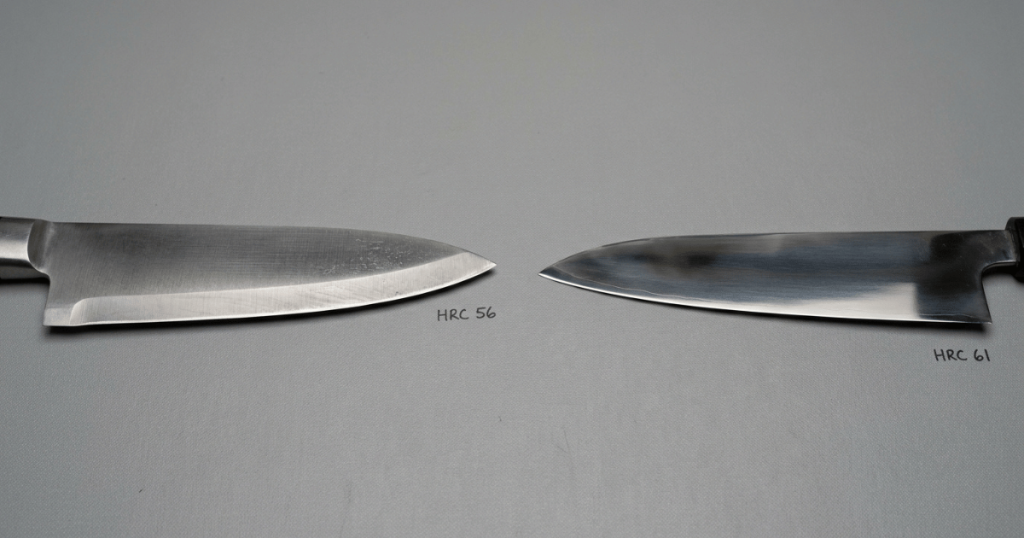
Knife hardness HRC is a Rockwell C-scale number that tells you how much a diamond tip resists sinking into a blade’s steel under a fixed load, and manufacturers use it as shorthand for how a knife will behave. A higher number, such as HRC 61, means a harder edge that holds its sharpness through more cutting board before it needs attention. A lower number, such as HRC 56, means a softer edge that gives up some edge life in exchange for resisting chips and taking a touch-up faster. Neither number is “better” on its own. Each is a trade-off, and the trade-off is set in the metal before the knife ever reaches a store shelf.
Before any buying advice, it helps to see what the number actually measures and why it moves the way it does.
What Knife Hardness HRC Actually Measures
The Rockwell C test presses a diamond cone into the steel’s surface under a set load, then measures how deep the resulting dent is. A shallow dent means the steel resisted the indenter well, which the scale reports as a higher number. A deeper dent means the steel gave way more easily, reported as a lower number. The test is destructive at a microscopic scale but repeatable, which is why it became the standard way cutlery makers communicate hardness instead of a vaguer word like “hard” or “soft.” When a maker states a figure, such as 58 HRC, that number describes the finished, heat-treated blade, not the raw steel alloy before treatment.
The number by itself does not explain why two knives at different HRC levels feel so different in use. That comes down to what hardness does to the steel’s internal structure.
Why Harder Steel Trades Away Toughness
Hardness and toughness pull in opposite directions inside the same piece of steel. Raising hardness generally means a finer, more rigid internal structure that resists the diamond indenter, and that same rigidity resists a blade edge rolling over under normal cutting pressure, which is what keeps an edge sharp longer. But rigidity that resists bending also resists absorbing a sudden shock. A tougher, softer structure can flex slightly and spring back when it hits something unexpected, such as a bone shard or the edge of a ceramic plate. A harder, more rigid structure is less able to flex, so instead of rolling or bending, it is more likely to chip. This is not a manufacturing flaw in either direction. It is the same physical property showing up as an advantage in one situation and a liability in another.
Heat treatment is how a maker decides where on that spectrum a given knife will sit, and two real, published figures make the trade-off concrete.
Two Real, Sourced HRC Numbers: 58 vs 60.7
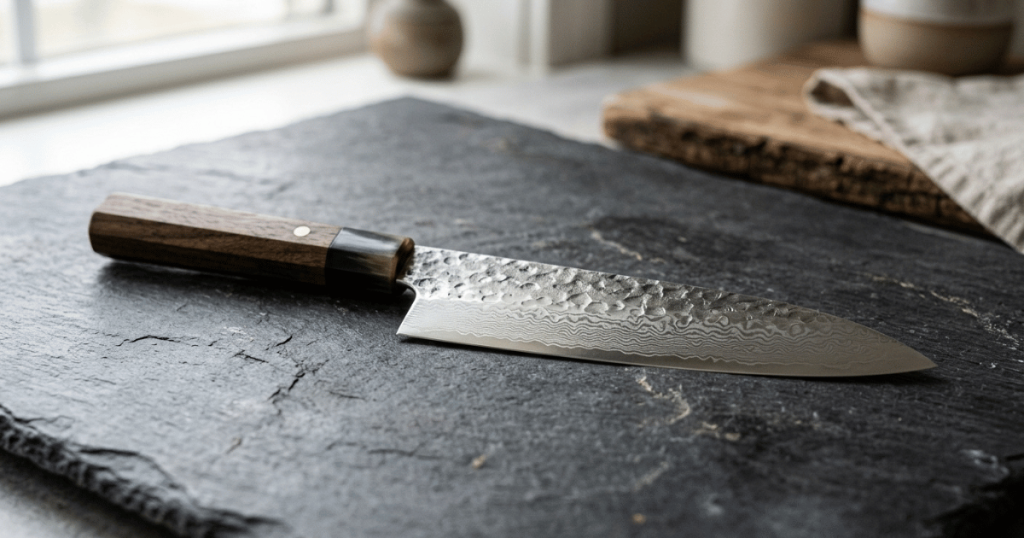
Wusthof states on its own Classic series product page (read 2026-09-18) that the line’s blades are “precision forged from a single piece of Wusthof steel hardened to 58 Rockwell.” That is a manufacturer’s own published spec for a Western-style, softer-tempered kitchen knife, and it sits inside the range most general guides describe as easy to maintain and resistant to chipping. On the harder end, metallurgist Larrin Thomas, writing on Knife Steel Nerds (read 2026-09-18), reports VG-10, a stainless steel designed by Takefu Special Steel in Japan and widely used in Japanese-style kitchen knives, reaching approximately 60.7 HRC under a specific heat treatment he tested and documented, with toughness measured separately at roughly 5.8 ft-lbs in subsize unnotched Charpy testing.
| Source | Blade / steel | Published HRC | What it trades for |
|---|---|---|---|
| Wusthof (manufacturer spec) | Classic series, Western-style forged blade | 58 Rockwell | Easier resharpening, more resistance to chipping under hard use |
| Larrin Thomas / Knife Steel Nerds (metallurgist testing) | VG-10, Japanese stainless steel | about 60.7 HRC | Longer edge life between sharpenings, less tolerance for lateral force |
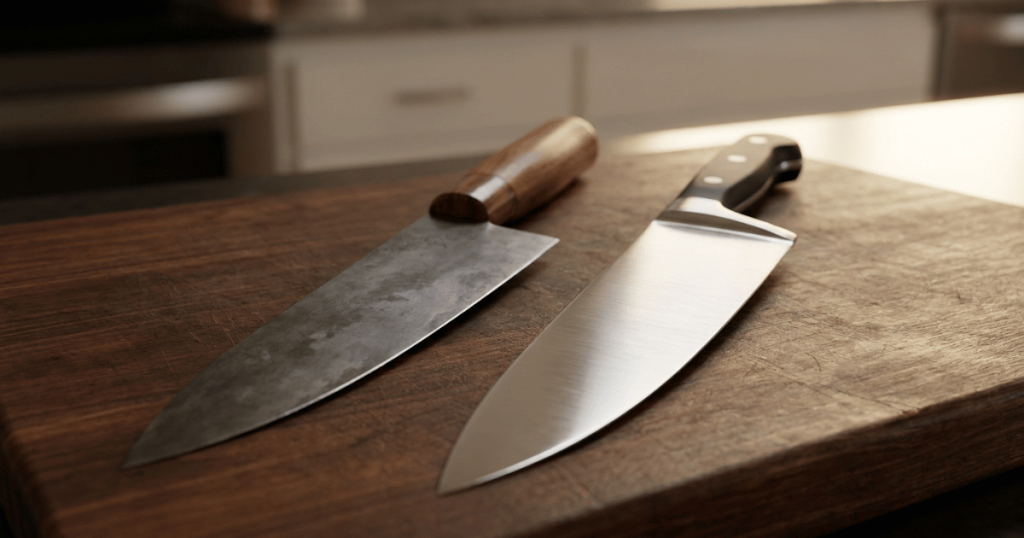
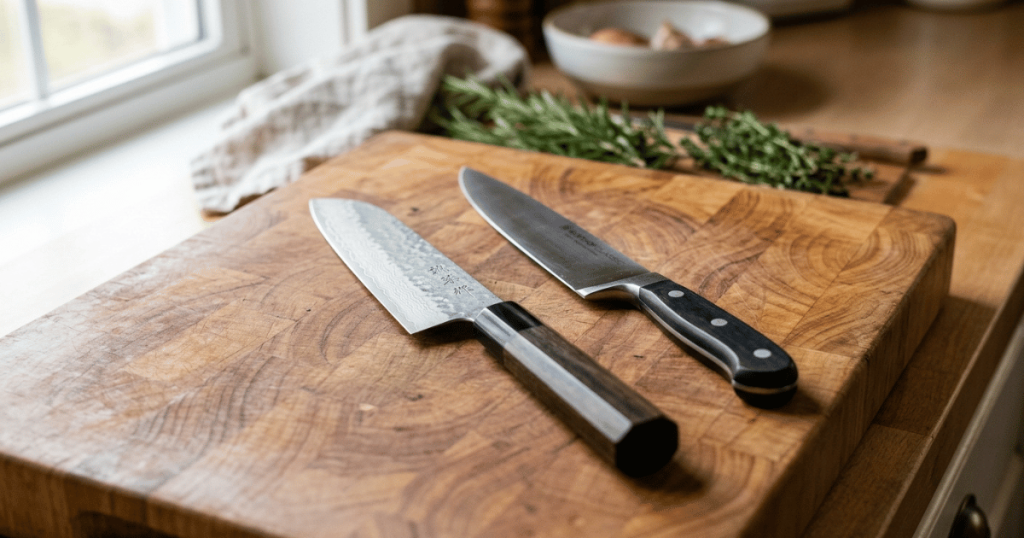
These two figures illustrate the trade-off; they are not a rule that every Japanese knife tests harder than every Western knife. Individual makers set their own heat treatment inside a steel’s possible range, so a Western maker can choose to run a blade harder and a Japanese maker can choose to run one softer for a specific line. What stays fixed is the metallurgical relationship between hardness and toughness described above. A sourced hardness number reliably tells you which side of that trade-off a blade sits on, but only a maker’s own published spec, not a country of origin or a marketing phrase, tells you where any single knife actually landed.
Neither figure above is a claim about which specific knife is “the best.” They are two documented data points from two different kinds of source, a maker’s own spec sheet and an independent metallurgist’s lab test, showing that the gap the working title asks about (56 versus 61) is a real, sourced range rather than a marketing invention.
What Changes Near the Higher End of the Range
A blade hardened toward 60 HRC and above holds a sharpened edge through more cutting sessions before it needs a full sharpening, which is exactly why the signal to sharpen should come from the edge itself rather than a fixed calendar date, a point covered in the site’s guide to how often to sharpen kitchen knives. That same hardness also narrows the margin for sharpening error. A steel in this range is less forgiving of an inconsistent angle, so it is worth reading the sharpening angle guide before setting or resetting an edge on a harder knife, rather than treating angle the same way you would on a softer, more forgiving blade.
Harder edges also fail differently under impact. Instead of the small roll or fold a softer edge takes from hitting bone or a plate, a harder edge is more likely to lose a small piece outright. That failure mode, and what to do about it, is the subject of the site’s guide to fixing a chipped knife edge, and when not to try, which is worth reading before you own a knife in the harder end of this range.
What Changes Near the Lower End of the Range
A blade in the mid-50s to high-50s HRC range, the zone Wusthof’s own spec sits in, gives up some edge-holding time in exchange for a wider margin of error. It tolerates a slightly inconsistent sharpening angle better, resists chipping against harder foods and awkward cutting board contact, and generally responds well to a quick touch-up rather than a full resharpening session. This is not a lesser knife; it is a different bet, one that favors resilience and low-maintenance use over maximum edge life between sessions.
Whichever end of the range a knife sits in, the daily habits that protect it do not change much. Prompt drying, a stable cutting surface and correct storage matter for a 58 HRC blade and a 61 HRC blade alike, and both benefit from the basics covered in the site’s guide to how to take care of kitchen knives: what ruins them.
Matching Hardness to How You Actually Cook
The right HRC for a given cook depends on two honest questions rather than a search for the single highest number. First, how carefully do you actually handle a blade in daily use, including cutting board choice, storage and the occasional bone or frozen edge it might meet? Second, how often are you realistically willing to sharpen, and how comfortable are you holding a consistent angle while you do it? A cook who sharpens rarely and occasionally works around bone is generally better served by a blade nearer the Wusthof-style 58 HRC figure. A cook who sharpens often, handles a blade carefully and wants the edge to last as long as possible between sessions is the better match for a harder, VG-10-range blade near 60 to 61 HRC. Neither answer is universally correct, and no single named knife earns the label “best” on hardness alone without naming which of these two priorities it is being judged against and citing the maker’s own spec for that specific knife.
Frequently Asked Questions
What is a good HRC for a kitchen knife?
There is no single correct number. A manufacturer’s own published spec, such as Wusthof’s 58 Rockwell for its Classic line, sits at a lower-maintenance point on the range, while metallurgist-tested Japanese steels such as VG-10 near 60.7 HRC sit at a higher-edge-life point. The right choice depends on how often you are willing to sharpen and how carefully you handle the blade.
Does a higher HRC always mean a better knife?
No. A higher HRC generally means longer edge retention but less tolerance for lateral force and sharpening-angle error, so it is a trade-off rather than a simple upgrade. A knife’s suitability depends on how it will be used, not on maximizing one number.
Why do Japanese knives often have a higher HRC than German or Western knives?
Japanese-style knives commonly use harder stainless steels, such as VG-10, run near their manufacturer’s designed hardness, while many Western-style forged knives, such as Wusthof’s Classic line at a published 58 Rockwell, are heat-treated softer on purpose to prioritize resilience and easier home maintenance over maximum edge life. This is a general pattern from named examples, not a rule that applies to every knife from either tradition.
Can a knife’s HRC change over time?
The steel’s hardness itself does not change with normal kitchen use. What can change is the condition of the edge: repeated sharpening removes metal, and improper sharpening or storage can introduce damage, but neither of these alters the Rockwell hardness of the steel underneath.
Where can I find the actual HRC of a knife I am considering?
Check the maker’s own product page or spec sheet first, the way Wusthof publishes 58 Rockwell for its Classic series. If the maker does not state a figure, look up the named steel’s published range from the steel manufacturer’s datasheet or an independent metallurgy source rather than relying on a vague marketing phrase.