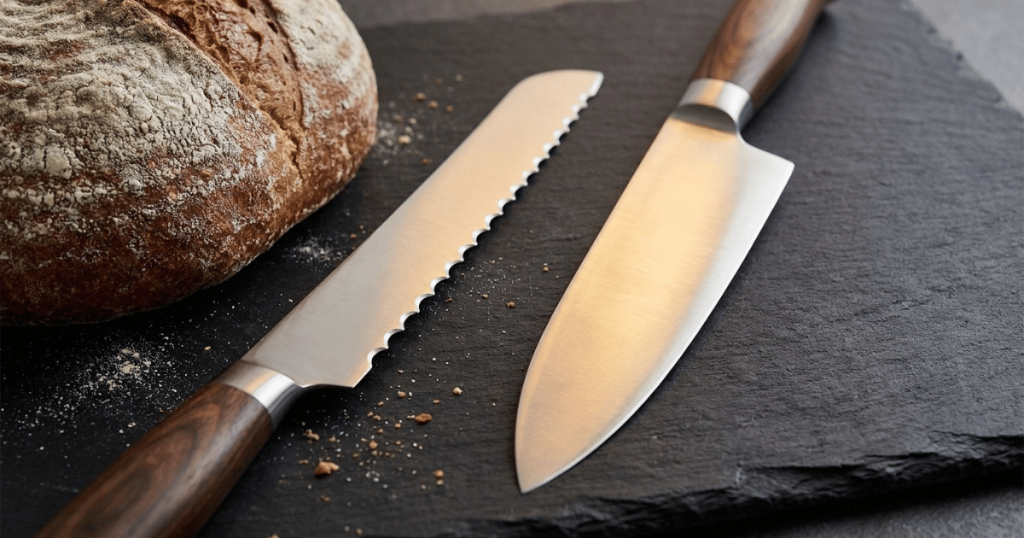
Serrated vs non serrated knives comes down to how the edge meets food. A serrated edge has teeth whose points concentrate pressure, so they bite into crusty bread, tomato skin and citrus rind without crushing what is underneath, and they keep cutting long after a straight edge would feel dull. A non serrated (straight or plain) edge cuts more cleanly and precisely, and it is much easier to sharpen. Most home kitchens are best served by one of each: a straight-edge chef’s knife plus a serrated bread knife.
That is the practical answer to “do I need both?” The rest of this page explains why the two edges behave differently, what measured edge-wear data shows, and which edge suits which food.
What Makes an Edge Serrated
A straight edge is one continuous cutting line. Along its whole length, the edge touches food at the same time and cuts by pressure and slicing.
A serrated edge is a row of teeth, points with scalloped hollows (often called gullets) between them. Most kitchen serrated knives are ground on one side only, with the scallops cut into that face and the other face left flat. The teeth touch food first, and only at their points.
That difference in contact is the whole story. Joe Talmadge, in his long-standing essay Serrated vs. Plain on the A.G. Russell Knives blog (dated December 1998, read September 25, 2026), puts the mechanism precisely: “The high points on the serrations will touch the material first, and this gives those points higher pressure per area than if the same pressure was applied to a plain blade; this allows the serration to puncture more easily.”
In kitchen terms: the same hand pressure spread over a few tooth points instead of a whole edge is enough to break through a hard crust or a slick skin, before the blade has squashed the soft food beneath it.
Serrated vs Non Serrated Knives: What the Edge Data Shows
The most useful measured comparison comes from metallurgist Larrin Thomas, who publishes Knife Steel Nerds. In Which Steel Has the Best Edge Retention? Part 2 (published November 26, 2018, read September 25, 2026), he compares a plain edge and a serrated edge in the same steel on a CATRA machine, a standardized test that measures how much abrasive test card a blade cuts over repeated strokes.
His findings, in his words:
- “The initial cutting ability of a serrated edge is significantly lower than a plain edge but after a sufficient number of cuts the serrated edge keeps going while the plain edge has dulled.”
- “There is a crossover in cutting ability at about 18 cuts, while the total cardstock cut crossed over at about 47 cuts.”
- “After the 60 cut standard test the plain edge cut 732 mm TCC and the serrated edge got 837 TCC,” where TCC is total card cut.
- The serrated “edge wears much more slowly than plain edges; the CATRA test is often performed with 200 cuts rather than the standard 60 because the edge wear is so much slower.”
He adds a fair caveat: the plain edge was sharpened at 26 degrees and the serrated at 22, so “it is not a perfect 1:1 comparison.” He also notes that serrated edges “are typically at lower edge angles to improve their cutting ability relative to plain edges.”
Two limits to keep in mind. The test cuts abrasive card, not bread or tomatoes, so treat it as evidence of how each edge wears, not as a score for any kitchen task. And it measures one edge in one steel.
What it does show is the shape of the trade: a straight edge is the better cutter when both are fresh, and a serrated edge holds on to useful cutting much longer. The teeth’s points do the work, and the recessed scallops are protected from wear, which is why a bread knife can feel serviceable for years while a chef’s knife needs regular attention.
Why a Straight Edge Cuts Cleaner
A fresh straight edge meets food along one continuous line, so it parts food cleanly instead of in a row of small bites. That matters wherever the cut surface is the result: thin slices of fish, fine herbs that bruise if torn, onions, and cooked meat you want to keep neat.
Talmadge also names the failure mode of teeth on soft material: “With softer materials, the serrations will sometimes catch and unwind the material rather than cut.” In the kitchen, that shows up as ragged, torn surfaces on soft, fibrous foods.
And a straight edge can be pushed straight down, which is what much everyday prep uses. As Talmadge notes, “the more push cuts are used, the more necessary it is for the plain edge to have a ‘razor polished’ edge.” That is the other side of the trade: a straight edge only cuts cleanly while it is genuinely sharp, and you will notice the difference as it dulls. Our guide on how to tell if a knife is sharp gives quick tests.
Which Edge for Which Food
The deciding property is not the food’s name but its structure. Teeth win where a hard or slick outside sits over a soft inside. A straight edge wins where the food is uniform, or where the cut surface needs to be clean.
| Food | Better edge | Why |
|---|---|---|
| Crusty bread, baguette, sourdough | Serrated | Hard crust over a soft crumb; points break the crust without crushing |
| Soft sandwich bread, brioche | Serrated | Soft and squashable; teeth avoid pressing it flat |
| Tomatoes, plums, peaches | Either: serrated, or a very sharp straight edge | Slick skin over soft flesh; a dull straight edge slides and crushes |
| Citrus and melon rind | Serrated for the rind; straight for the flesh | Tough outer layer, then soft interior |
| Layer cakes, sponge | Serrated | Soft and crumbly; the teeth cut without compressing |
| Onions, carrots, herbs, garlic | Straight | Uniform texture; clean cuts, easy push cutting |
| Raw fish, boneless meat | Straight | Clean surfaces; teeth tear soft fibers |
| Cooked steak at the table | Either | Straight cuts cleaner when sharp; serrated stays usable longer between sharpenings |
For steak knives specifically, the edge data explains the long-running argument. A sharp straight edge gives the cleaner cut. Serrated steak knives trade some of that cleanness for an edge that stays usable longer with little upkeep. Which is right depends on whether you will keep a set of straight edges sharp.
Sharpening and Upkeep
This is where the practical cost of serrations shows up. Talmadge is blunt: “The coarse plain edge is much easier to sharpen than the serrated edge.”
A straight edge can be honed between sharpenings to straighten a rolled edge, then sharpened on stones or a guided sharpener when honing no longer helps. Our guide to honing vs sharpening explains which one your knife needs.
A serrated edge is sharpened one scallop at a time, with a tapered rod on the ground side, and only a light pass on the flat back to remove the burr. It needs sharpening far less often, but each session takes more care. The method is in our guide to sharpening a serrated bread knife one tooth at a time. Keep serrated knives out of sharpeners designed for straight edges; our guide to pull-through sharpeners covers what to keep out of them.
Do You Need Both?
For most home cooks, yes, and only two. A straight-edge chef’s knife or santoku handles the large majority of prep: vegetables, herbs, meat, fish. A serrated bread knife covers crusty bread, cakes, and the tomatoes and rinds that a straight edge only handles well when very sharp.
A few cases change the answer:
- You rarely sharpen. A serrated utility knife will stay usable longer, but expect rougher cuts on soft food.
- You keep your straight edges very sharp. You may reach for the serrated knife only for bread.
- You bake a lot. A longer serrated bread knife earns its place over a short serrated utility knife.
What no one needs is a block of serrated knives in place of a straight chef’s knife. The data shows why: a straight edge starts out as the better cutter, and with regular care it can stay that way.
Frequently Asked Questions
Are serrated knives sharper than non serrated knives?
Not when both are fresh. In Knife Steel Nerds’ CATRA comparison, the plain edge had “significantly” better initial cutting ability. The serrated edge overtook it after repeated cuts because it wears much more slowly.
Why do serrated knives stay sharp longer?
Only the tooth points meet the food and the cutting surface, and the scallops between them are protected. Knife Steel Nerds reports the serrated edge “wears much more slowly than plain edges,” so it keeps cutting after a plain edge has dulled.
Is a serrated knife better for tomatoes?
It is easier. The teeth bite through the slick skin without crushing the flesh. A very sharp straight edge does the job just as well; a dull one slides and squashes.
Can you sharpen a serrated knife?
Yes, one scallop at a time with a tapered rod, working the ground side and deburring the flat back lightly. It takes longer than sharpening a straight edge, but it is needed far less often.
Should steak knives be serrated or non serrated?
A sharp straight edge cuts more cleanly. Serrated steak knives stay usable with less maintenance. Choose straight if you will sharpen them, serrated if you will not.