A pull-through sharpener has an angle built into its slots, and it will impose that angle on whatever you pull through it. That single fact explains why the tool is fast, why it is popular, and why the people who dislike it are also right.
It is not a bad tool. It is a tool with a fixed opinion, and the question is whether your knife shares it.
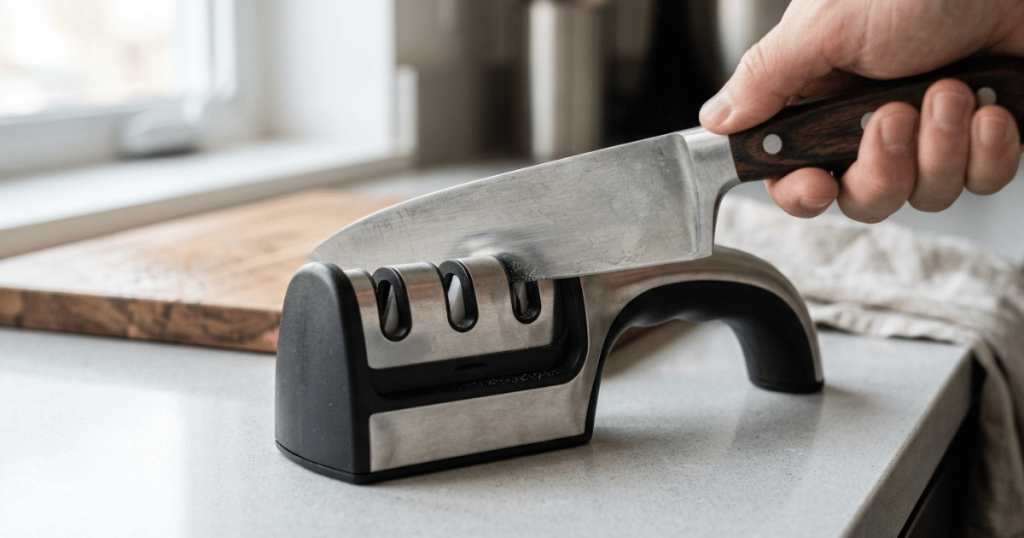
What is actually happening in the slot
Inside a pull-through are two abrasive elements, usually carbide plates or ceramic rods, held in a V at a set angle. You draw the blade through and both sides of the edge are worked at once.
Three consequences follow directly, and every honest discussion of this tool is a discussion of these three.
1. The angle is the manufacturer’s, not your knife’s. If your blade’s existing bevel is shallower than the slot, the sharpener grinds the shoulders of the bevel until the edge matches the slot. It is reshaping the knife, not maintaining it. Finding the angle your knife already has takes about a minute with a marker, and it is the check that tells you whether this tool is appropriate at all.
2. Carbide slots remove a lot of steel very fast. That is why they work in seconds. The carbide slot on most two-stage sharpeners is a coarse cutting stage, and its job is to take metal off. Repeated use over years takes a visible amount of blade with it.
3. Both sides are worked simultaneously and equally. Which is exactly wrong for any knife that is not ground the same on both sides.
Four kinds of knife that must not go in one
This is the important list.
Single-bevel Japanese knives. Yanagiba, deba, usuba and their relatives are ground on one side only, with a flat or hollowed back. A tool that works both sides equally destroys that geometry in one pass, and it cannot be undone at home. If the back of your blade is flat rather than beveled, stop.
Hard Japanese double-bevel knives. Harder steel chips where softer steel bends, and a carbide slot applies exactly the kind of aggressive, uncontrolled load that produces chipping. Most also carry a shallower factory angle than a typical pull-through slot, so the tool would be regrinding them even if the steel tolerated it. The right procedure for those knives is a different one.
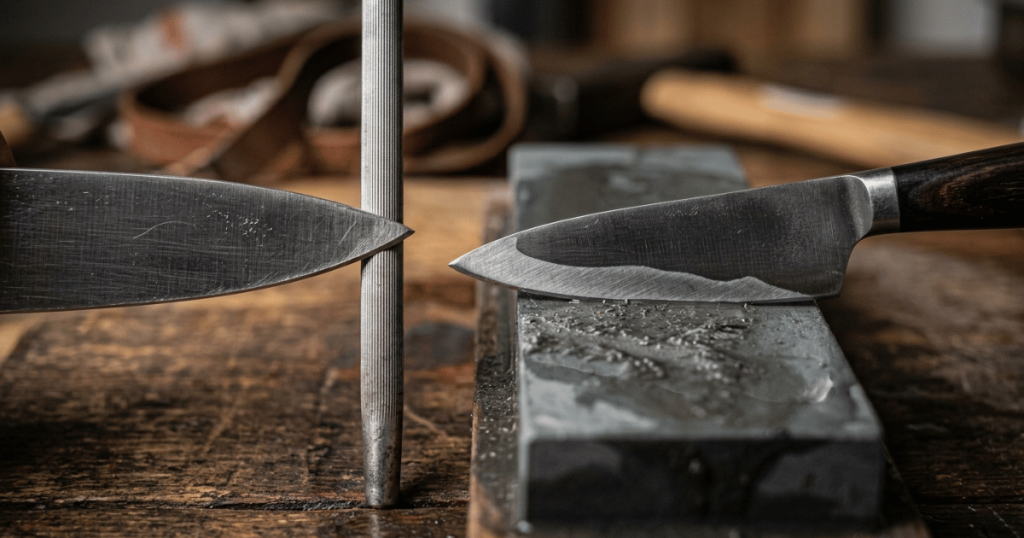
Serrated knives. A pull-through works on a straight edge. Pulling a serrated blade through one flattens the points of the scallops and does nothing to the recesses that actually cut. Serrations are sharpened one tooth at a time, from one side, with a tapered rod.
Ceramic knives. A carbide or steel-based abrasive will not touch ceramic, and forcing a brittle blade into a V is a good way to break it.
And one more, less absolute: any knife you care about a great deal. Not because the tool will destroy it, but because you cannot control what it does, and a knife worth learning a stone for is worth learning a stone for.
What it is genuinely good for
Being fair to the tool, because the internet mostly is not.
Softer Western kitchen knives at a conventional angle. The everyday chef’s knife, the utility knife, the paring knife. If the slot angle and the blade angle are close, a pull-through maintains them adequately.
Knives you would otherwise not sharpen at all. This is the real argument in its favor and it is a strong one. A knife maintained badly is safer than a knife not maintained at all, because dull knives are what cause kitchen injuries. A household that will use a pull-through and would never use a stone is better off with the pull-through.
Situations where speed is the point. Twenty seconds before dinner, rather than twenty minutes at a sink.
Using one properly
Six steps, and the details matter more than they look.
1. Put it on a stable surface and hold it down. Most have a rubber base or a handle. Your free hand goes on the body of the sharpener, well away from the slots, and it stays there for every stroke. Never hold the sharpener in the air, and never hold it in the hand the blade is moving toward.
2. Set the blade in at the heel. Seat the part of the edge nearest the handle into the slot, with the blade vertical and the spine straight up. Not tilted. The slot sets the angle; your job is only to keep the blade upright so the slot can.
3. Pull straight toward you, heel to tip, in one smooth motion. The blade travels along its own length as it comes out. Keep the speed even and the pressure light: the weight of the knife plus a little is enough, and pushing down harder does not sharpen faster, it just removes more steel.
4. Count your passes and keep them equal. Whatever number you settle on, do the same each time. Uneven passes produce an uneven edge, and there is no way to correct for it inside a fixed slot.
5. Use the stages in the right order and do not overuse the coarse one. On a two-stage tool, the coarse slot is for a genuinely dull edge and the fine slot is for finishing and for routine touch-ups. The single most common mistake is running every knife through the coarse slot every time, which grinds a knife away over a few years. Most maintenance should be the fine stage only.
6. Test, then stop. Slice hanging paper away from yourself, or rest the edge on a tomato skin with no pressure. When it starts the cut, you are done. There is no benefit in extra passes and there is a permanent cost.
Cleaning up afterward
Wipe the blade. A pull-through leaves fine steel particles on the edge. Wipe with a damp cloth, moving from spine to edge, never along the edge.
Empty the sharpener. Filings accumulate in the body. Many models come apart for this. A clogged slot works worse and holds moisture against the abrasive.
Look down the edge under a light. Bright spots are chips or flats that survived. If they are still there after your usual passes, the tool is not going to fix them and forcing it will only remove more steel from everywhere else.
When to stop using it and change method
Three signals:
It stops bringing the knife back. A blade that has been reshaped by a slot many times has a thickened shoulder behind the edge, and no amount of slot work fixes that. It needs a stone or a professional.
You can see how much narrower the blade has become. Compare it to a knife of the same model that has not been through one. That difference is steel that is gone.
You bought a better knife. The tool that was correct for a softer knife may be the wrong tool for the new one. Which method suits which knife is the decision to redo at that point, and the pillar on this site walks through all of them.
Where you stop
- Never run a finger along the edge to check it. Across, or use paper.
- Never hold a pull-through in your hand while pulling a knife through it. On the surface, held down, every time.
- Never pull a blade backward through a slot. One direction, heel to tip, toward you.
- Never use one on a single-bevel, serrated or ceramic knife, and think hard before using one on a hard Japanese knife.
- Stop if you see or feel a chip appear. Continuing will make it larger.
The short version
A pull-through imposes its own angle on your knife, which is fine if the angles match and is a reshaping job if they do not. Check your bevel with a marker before you use one. Keep single-bevel, serrated and ceramic knives out of it entirely, and be cautious with hard Japanese steel. Hold the tool down, keep the blade vertical, pull heel to tip toward you with light pressure, count equal passes, stay out of the coarse slot for routine work, and stop the moment it cuts paper.