The main paring knife uses are small, precise jobs, many of them done in the hand rather than on the board: peeling and trimming fruit and vegetables, coring, hulling strawberries, removing blemishes and seeds, deveining shrimp, scoring, and cutting small items like garlic or shallots. A paring knife has a short blade, usually a few inches long, and the shape of its tip decides which of those jobs it does best. A spear point does general work, a bird’s beak peels round food, and a sheep’s foot slices on the board.
That tip shape is why many knife blocks hold two or three small knives that look almost alike. This guide explains what each shape is for, which sizes exist, and which small knife you can skip.
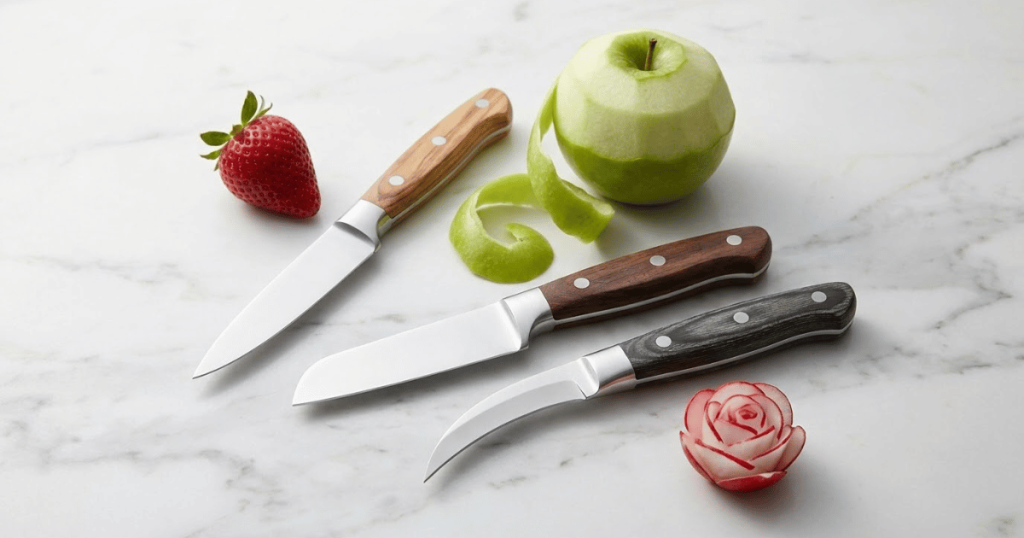
Paring knife uses at a glance
| Job | Where it happens | Best tip shape |
|---|---|---|
| Peeling apples, potatoes, citrus | In the hand | Bird’s beak or spear point |
| Hulling strawberries, coring tomatoes | In the hand | Spear point or bird’s beak |
| Removing blemishes, eyes and seeds | In the hand | Bird’s beak |
| Deveining shrimp, scoring | Board or hand | Spear point |
| Mincing a garlic clove or shallot | On the board | Spear point or sheep’s foot |
| Thin slices of small produce | On the board | Sheep’s foot |
| Tomato skin, citrus rind | Board or hand | Serrated paring knife |
The pattern is simple. Anything that needs a point goes to a spear point. Anything round that needs peeling favors a curve. Anything flat on the board favors a straight edge.
What size paring knife do you need?
WebstaurantStore’s guide to types of kitchen knives (read September 27, 2026) gives paring knife blades as “between 2 1/4″ and 4 1/2″,” with straight or serrated edges, and puts the bird’s beak (tourné) knife at “a short 2 1/4″ to 3″ blade that curves downward.”
The length you want depends on where you use it. For in-hand work, a shorter blade keeps the edge close to your fingers, which is what gives you control over a peel. For on-the-board work, a longer paring knife reaches across a lemon or an onion half without the handle hitting the board. That is why many home cooks settle on something in the middle of the range for a single paring knife, and add a shorter curved one only if they peel a lot.
If a paring knife starts to feel short for what you are cutting, that job probably belongs to a utility knife or a chef’s knife instead. The in-between knives are a separate question with their own trade-offs.
The four paring knife shapes
Spear point
The spine and edge curve toward a centered point. This is the classic paring knife, and it covers the widest range of paring knife uses: coring, scoring, hulling, deveining and small board work. If you own only one small knife, this is the shape to own.
Bird’s beak
The edge curves inward, like a hook or a beak, so it wraps around round food. That makes it good at peeling, taking out blemishes and eyes, and working around the curve of an apple or potato. It is also the knife traditionally used for tourné, the French cut that turns vegetables into small, barrel-shaped pieces.
Victorinox’s Swiss Classic Shaping Knife page (read September 27, 2026) describes its bird’s beak model as designed for “decorative cuts, peeling and precision work.” The product name calls it a 2 inch knife, while the specification lists a 2.4 inch blade, a reminder to read the spec table and not the title.
Sheep’s foot
A straight edge with a rounded, blunt spine dropping down to meet it. With no sharp point and a flat edge, it behaves like a very small santoku or nakiri: it slices and minces on the board with the whole edge in contact. It is the weakest of the four for in-hand work and the best for small, straight slices.
Serrated
A small serrated edge grips slippery skins, which is why serrated paring knives are often sold for tomatoes and citrus. The trade-off is that serrations tear rather than slice cleanly, and they are harder to sharpen at home.
Why do I have three small knives?
Because each tip shape wins a different job, and knife sets fill slots. A typical block may include a spear point paring knife, a bird’s beak and sometimes a serrated paring knife or a longer utility knife. They overlap more than they differ.
Here is a practical way to decide which to keep:
- Keep the spear point. It does most paring knife uses well enough.
- Keep the bird’s beak only if you peel round produce often and find the spear point awkward for it.
- Keep the sheep’s foot only if you do a lot of small, flat slicing and dislike a sharp point near your fingers.
- Keep the serrated paring knife only if tomatoes and citrus are a daily job and your straight knives are not kept sharp. A sharp straight edge will usually handle a tomato skin.
The honest answer for most kitchens is one spear point paring knife, kept sharp, and a chef’s knife for everything bigger.
The steel and edge question
Paring knives are often the cheapest knife in a set, and many are thin, stamped blades. That is not necessarily a problem. A paring knife rarely meets bone or heavy impact, so it does not need great toughness. What it needs is a keen edge near the tip, because most in-hand cuts use the last inch of the blade.
That tip section is also where a paring knife dulls first. When a small knife is dull, you press harder, and a hard push on a knife held against your thumb is how the blade slips. Keep the edge sharp and the pressure low. Our guide on how to tell if a knife is sharp gives four quick tests that work on a short blade.
Hardness follows the same rules as bigger knives. A harder paring knife holds its edge longer but chips more readily if it is pried against a pit or a bone. A softer one rolls and can be brought back with a honing rod. Check the maker’s stated steel and hardness, and sharpen to the maker’s angle, just as you would for a chef’s knife.
Sharpening the different paring knife shapes
Spear point and sheep’s foot. These sharpen like any straight-edged knife. The short length means fewer strokes, but the principle is the same as in our guide on how to sharpen kitchen knives.
Bird’s beak. The inward curve is the hard part. A concave edge only touches the flat face of a stone at its two ends, so the middle of the curve never gets sharpened on a flat stone. A round or tapered rod, or the rounded edge of a stone, reaches into the curve. Go slowly, keep a consistent angle, and follow the curve.
Serrated. Serrated paring knives are sharpened one scallop at a time with a thin tapered rod, the same method we describe in how to sharpen a serrated knife. Many owners simply replace an inexpensive serrated paring knife instead.
Care that matters more on a small knife
Small knives go missing in sink water and get tossed in drawers, and both are hard on an edge. Victorinox lists its Swiss Classic Shaping Knife as dishwasher safe, but safe for the handle is not the same as kind to the edge. Our guide to putting knives in the dishwasher explains what happens to an edge in a dishwasher and why hand washing is still the safer habit for any knife you want to stay sharp.
FAQ
What is a paring knife used for?
A paring knife is used for small, precise jobs: peeling, trimming, coring, hulling strawberries, removing seeds and blemishes, deveining shrimp, scoring and cutting small items like garlic. Many of these jobs are done in the hand rather than on a board.
What size paring knife is best?
Paring knife blades range from about 2 1/4 to 4 1/2 inches, according to WebstaurantStore. A shorter blade gives more control for in-hand peeling; a longer one reaches across larger produce on the board. A middle length is a sensible single choice.
What is a bird’s beak knife used for?
A bird’s beak, or tourné, knife has an inward-curving blade for peeling round produce, removing blemishes and making decorative or tourné cuts. It is a specialist knife; a spear point paring knife covers most of the same work.
Do I need a serrated paring knife?
Usually not. It grips tomato skins and citrus well, but a sharp straight paring knife does the same job and slices more cleanly. A serrated paring knife is most useful if your straight knives are often dull.
Can you sharpen a bird’s beak paring knife?
Yes, but not on the flat face of a stone alone, because the curved edge only touches a flat surface at its ends. Use a round or tapered rod, or the rounded edge of a stone, to reach the middle of the curve.