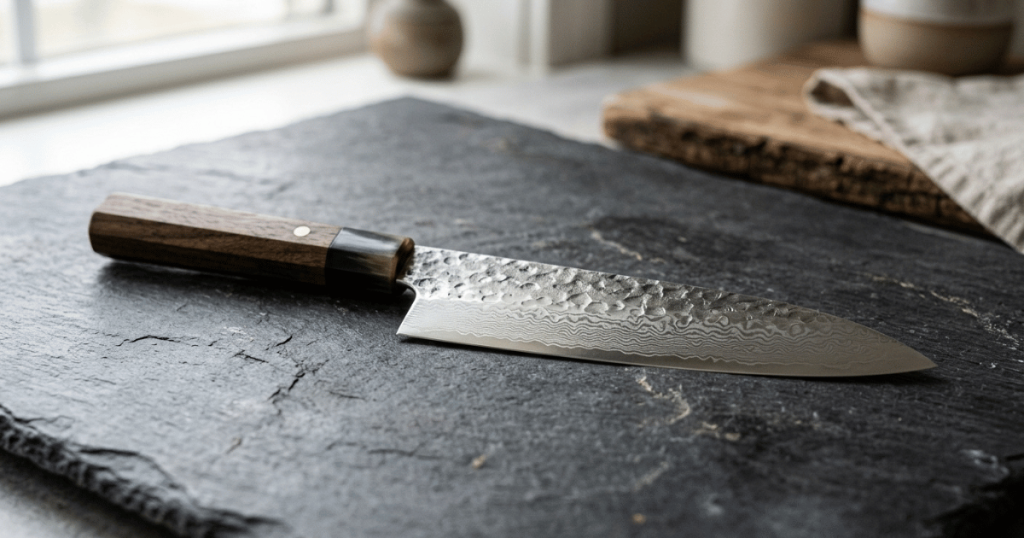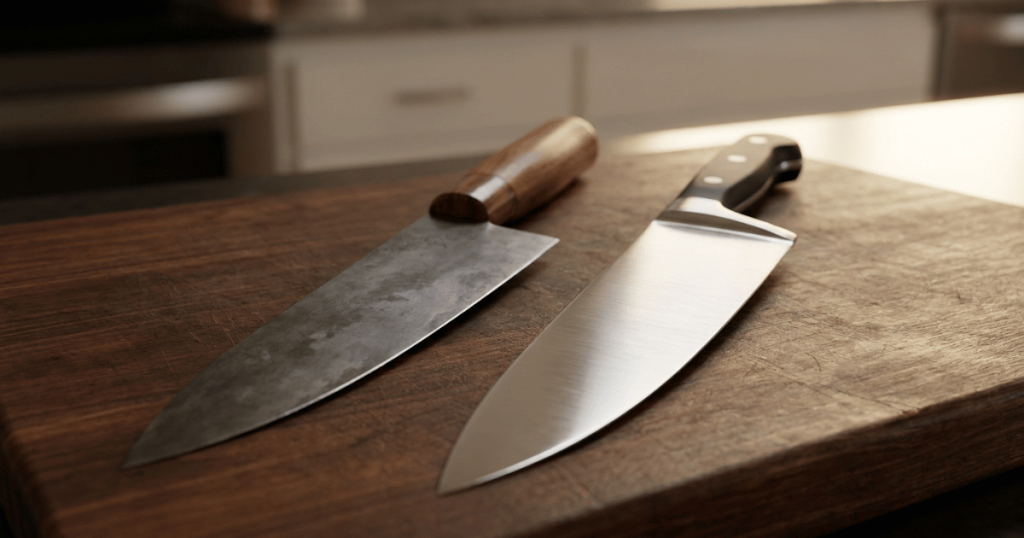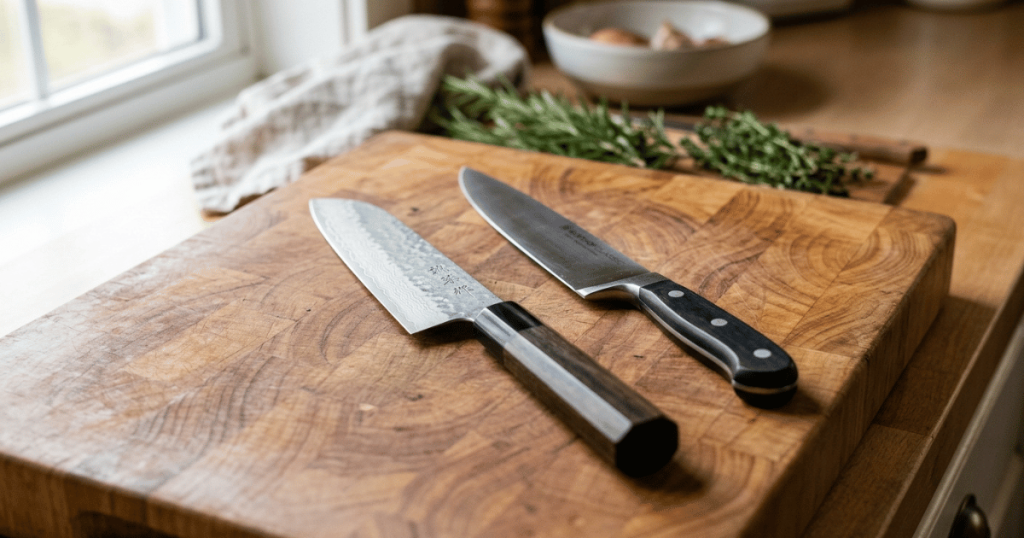
In the gyuto vs chef knife question, the short answer is that a gyuto is a chef’s knife. It is the Japanese form of the Western chef’s knife, built for the same all-purpose job: vegetables, boneless meat, herbs and general board work. What changes is the build. A typical gyuto is thinner, lighter and made from harder steel, with a somewhat flatter profile. A typical Western chef’s knife is heavier, often has a bolster, and uses softer, tougher steel. The word “typical” is doing a lot of work there, and the spec sheet matters more than the name.
So yes, “gyuto” is close to Japanese for chef’s knife. But two knives with those two names can differ in hardness, weight and edge angle in ways that change how they cut and how you care for them. This guide compares real maker specifications and shows which differences are reliable and which are only assumptions.
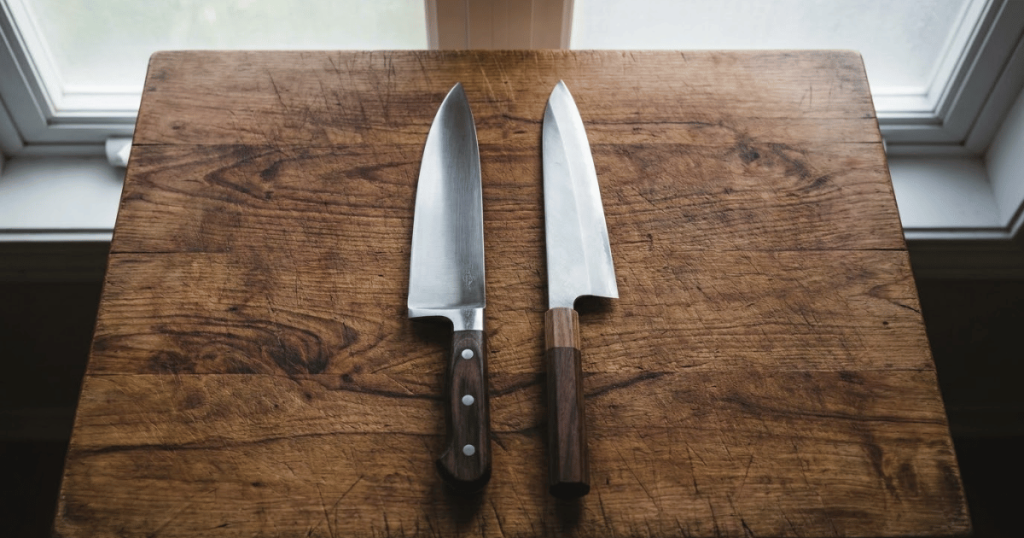
Where the gyuto came from
Japanese knife makers and retailers commonly trace the gyuto to the Meiji era (1868 to 1912), when Western cooking and beef became part of Japanese kitchens. The name is usually translated as “cow sword” or, more usefully, “beef knife.” The traditional Japanese kit of the time was built around fish and vegetables, with specialist shapes such as the yanagiba, deba and nakiri. The gyuto borrowed the European outline, a curved belly, a pointed tip and a double bevel, and Japanese makers applied their own steels and grinds to it.
That history is the whole comparison in miniature. The shape was imported. The metallurgy and the grind were not. Everything useful in the gyuto vs chef knife decision comes from those two variables, not from the outline.
Gyuto vs chef knife: the spec sheet comparison
Here are three real knives from two makers, with figures taken from each maker’s own product page (all read September 27, 2026).
| Spec | WÜSTHOF Classic 8″ Chef’s Knife | Shun Classic 8″ Chef’s Knife | Shun Classic 8″ Western Cook’s Knife |
|---|---|---|---|
| Made in | Solingen, Germany | Seki City, Japan | Shun Classic line |
| Steel | Forged stainless steel | VG-MAX core, Damascus cladding | VG-MAX core |
| Hardness | 58 HRC | Not stated on the product page | Not stated on the product page |
| Edge angle | 14 degrees per side | 16 degrees per side | 22 degrees per side |
| Construction | Forged, full bolster, full tang | Thinner blade, full composite tang | Thinner blade, stronger edge |
| Weight | Not stated on the product page | 6.7 oz (190 g) | Not stated on the product page |
The WÜSTHOF figures come from WÜSTHOF’s Classic 8″ Chef’s Knife page. The Shun figures come from Shun’s Classic 8″ Chef’s Knife page and its Classic 8″ Western Cook’s Knife page. Shun’s own description of the Classic chef’s knife says its “thinner blades” make it “lighter and less tiring to use than comparable European-style Chef’s knives.”
Look at the edge angle row. The German knife is ground to a more acute angle than the Japanese one. That runs against the usual rule of thumb, and it is the most useful thing on this page: nationality does not set the angle. The maker does.
What reliably differs: hardness and thinness
Hardness
WÜSTHOF lists its Classic chef’s knife at 58 HRC. Japanese knives are commonly made from harder steels. As one example with a published figure, Takefu Special Steel’s datasheet for VG10, a widely used Japanese knife steel, gives a hardness of HRC 60 or more with 1.00% carbon and 15% chromium.
Two or more points on the Rockwell C scale change behavior at the edge. Softer steel is tougher: overload it and the thin apex tends to bend or roll to one side rather than break. Harder steel resists that rolling, so a fine edge stays keen longer, but when it is overloaded it is more likely to chip. Neither is better in the abstract. A softer edge forgives bone contact, twisting and careless storage. A harder edge rewards careful use with longer sharpness.
Thinness and weight
Shun’s figure of 6.7 oz for its 8 inch chef’s knife, together with its own statement that the blade is thinner than European-style knives, reflects the general pattern: gyuto-style knives are ground thinner behind the edge. Less steel behind the apex means less wedging in dense food, so a carrot splits less and an onion slices with less force. The cost is the same as with hardness: less material supporting the edge when it meets something hard.
What does not reliably differ
Edge angle
As the table shows, a German maker can grind a more acute edge than a Japanese one, and a single Japanese maker can offer both 16 and 22 degree knives in the same line. Shun describes its 22 degree Western Cook’s knife as a “less-acute edge” that “provides additional strength” for heavier foods like winter squash. That is the angle trade stated plainly by a maker: lower angles cut more easily, higher angles hold up better.
Profile
A gyuto is often described as flatter toward the heel than a Western chef’s knife, which suits push and pull cuts. But profiles vary widely by maker, and Shun itself says the curved belly of its Classic chef’s knife can be “gently ‘rocked’ through fresh herbs.” If you rock-chop, look at the actual edge profile of the knife in front of you, not the category name.
Length
Both come in similar lengths. The 8 inch size (Shun lists its Classic chef’s knife at 203 mm) is common in both families, and both are sold longer and shorter.
Which should you buy?
| If you… | Lean toward | Why |
|---|---|---|
| Want the most forgiving all-purpose knife | Western chef’s knife | Softer, tougher steel and more mass behind the edge |
| Want a lighter knife that stays sharp longer between sharpenings | Gyuto | Thinner blade, commonly harder steel |
| Cut a lot of hard squash, or use the knife hard | Western chef’s knife, or a more obtuse edge | More support behind the edge |
| Mostly slice vegetables and boneless protein | Gyuto | Thin grind reduces wedging |
| Use a honing steel as your main maintenance | Western chef’s knife | A softer edge realigns with a steel |
| Sharpen on whetstones and like doing it | Either, and a gyuto rewards it | Hard steel takes and keeps a fine edge |
If you cannot decide, decide by how you treat knives, not by which cuisine you cook. Someone who drops knives in the sink and cuts through chicken joints will be happier with a Western chef’s knife. Someone who wipes and dries the knife after each use and never twists it in food will get more out of a gyuto. Our overview of how to choose kitchen knives by type, steel and budget covers the wider decision.
What nobody selling gyutos will tell you
The label “gyuto” says nothing certain about the steel, the hardness or the angle. Nothing stops a knife made anywhere, from any steel, being sold under that name, and a Japanese maker can sell a softer, heavier knife in the same outline. Our guide to Japanese kitchen knives, real vs Japanese-style goes further into what the origin claim does and does not guarantee.
The honest way to compare is to read four numbers from the maker, not the retailer: the steel name, the stated hardness, the stated edge angle and the weight. If a maker does not publish them, that is information too.
How the choice changes your maintenance
Honing
A honing steel works by pushing a rolled edge back into line. That suits a 58 HRC Western edge, which tends to roll. A harder gyuto edge is less likely to roll and more likely to chip, and a coarse grooved steel can chip a hard, thin edge. Our guide on how to use a honing steel covers the angle, the pressure and when a smooth or ceramic rod is the better choice.
Sharpening angle
Sharpen each knife to its maker’s stated angle. Sharpening a 16 degree Japanese edge at a wider Western angle slowly thickens it and throws away what you paid for; sharpening a softer Western knife too acute leaves an edge that rolls quickly. See what angle to sharpen kitchen knives to find yours.
FAQ
Is a gyuto the same as a chef’s knife?
In role, yes. A gyuto is the Japanese form of the Western chef’s knife and does the same all-purpose job. It is usually thinner, lighter and made from harder steel, but those are tendencies, so check the maker’s specifications.
Is a gyuto sharper than a chef’s knife?
Not automatically. Sharpness depends on the edge angle and the grind. WÜSTHOF grinds its Classic chef’s knife at 14 degrees per side, while Shun grinds its Classic chef’s knife at 16 degrees per side, according to each maker’s product page.
Is a gyuto harder to maintain?
A harder, thinner gyuto edge chips more easily than it rolls, so it needs gentler use and suits whetstones better than a coarse honing steel. A softer Western chef’s knife is more forgiving of rough use and quick touch-ups.
What size gyuto should I buy?
Around 8 inches is a common all-purpose size in both gyuto and Western chef’s knives. Choose shorter for a small workspace and longer if you often slice large produce or roasts.
Can a left-handed cook use a gyuto?
Most gyutos are double bevel, sharpened on both sides, so they work in either hand. Check the maker’s description, because some Japanese knives are ground asymmetrically.