This bread knife guide starts with the most common complaint: the knife squashes the loaf. That usually comes down to three things. The blade is too short for the loaf, so every stroke is a short saw that drags the crumb; the serrations are too fine or too worn to bite through the crust; or the cook is pressing down instead of letting the teeth cut. The fix at purchase is a blade clearly longer than your widest loaf, with deep, well-defined serrations. A good bread knife breaks the crust at a few points and then slices, rather than crushing.
The rest of this guide explains why serrations work, which pattern suits which bread, how long a bread knife should be, and what the steel and sharpening questions look like for a serrated edge.
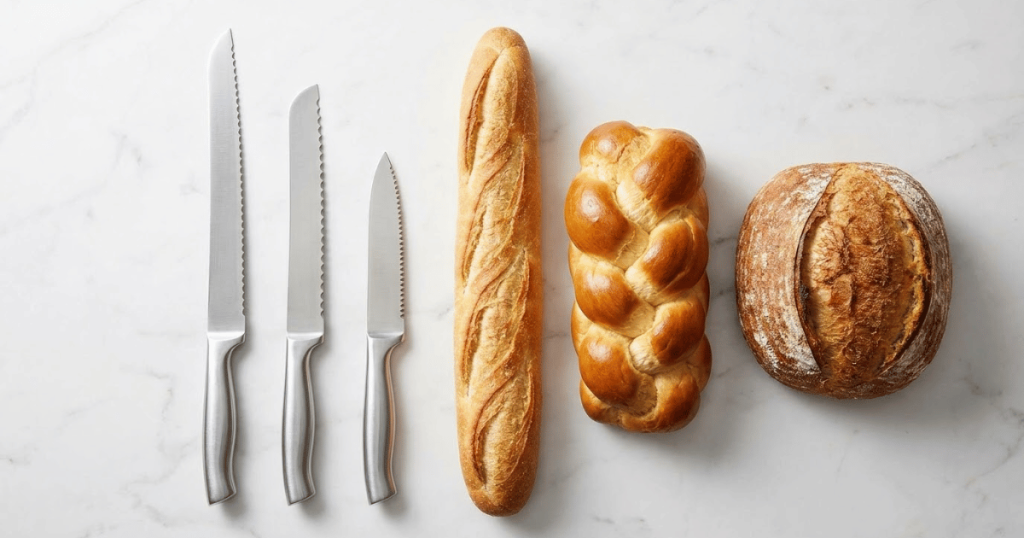
Why a serrated edge cuts crust without crushing crumb
A straight edge meets food along one continuous line. A serrated edge meets it only at the tips of the teeth. Wikipedia’s entry on serration explains the mechanism: with fewer points of contact, “the applied pressure at each point of contact is greater,” and the points meet the material at a sharper angle, producing “many small splits in the surface” that add up to a cut.
That is exactly what a crusty loaf needs. The crust is hard and brittle; the crumb beneath it is soft and compressible. A straight edge that is not very sharp has to push hard to break the crust, and that push flattens the crumb before the crust gives way. Teeth concentrate the force on a few points, so the crust splits under light pressure and the crumb is left alone.
Shun’s article on serration (read September 27, 2026) puts the same idea in a maker’s terms: “The pointed teeth of a serrated blade concentrate pressure at tiny contact points, enabling the blade to ‘bite’ into food with minimal effort.”
Bread knife guide to serration patterns
Not all serrations are alike, and the pattern changes how the knife behaves. Shun’s article names five types:
| Pattern | What it looks like | How it behaves on bread |
|---|---|---|
| Low-frequency | Fewer, deeper scallops | Bites crust aggressively, cuts fast |
| High-frequency | Smaller, tighter teeth | More points of contact, finer cut, less bite per tooth |
| Scalloped | Rounded, wave-like teeth | Glides rather than tears, cleaner cut face |
| Push-pull | Teeth leaning in alternating directions | Designed to work on both directions of the stroke |
| Combination | Serrated tip, smooth section in the middle | Partly bread knife, partly slicer |
Two of these are the ones you meet most often when shopping.
Scalloped (wavy) serrations have rounded arches with points between them. Shun describes scalloped teeth as ones that “glide instead of tear.” Wikipedia notes that bread knives typically carry wider scalloped serrations, which cut “through a firmer or tougher outer crust or skin without crushing the softer and more delicate inner crumb.” This is the most versatile pattern for a home kitchen that bakes or buys a mix of breads.
Pointed serrations look more like a saw. They grab a hard crust more readily, which suits very crusty loaves, but they can leave a rougher face and more crumbs, and on soft enriched bread they are more likely to tear.
The practical rule: deeper and wider teeth bite; shallow, fine teeth squash. A steak knife’s fine serrations on a loaf of sourdough is the classic example of the second.
Why length matters more than people expect
WebstaurantStore’s guide to kitchen knife types (read September 27, 2026) gives bread knife blades a range of “5” to 14″, with 8″ to 10″ being the most popular size range.”
The reason length matters is stroke geometry. A serrated knife cuts by sliding: each tooth splits a little crust as it passes. If the blade is shorter than the loaf, each stroke can only travel a short distance before you reverse it, so you end up sawing back and forth in place. Every reversal is a moment when the blade stops sliding and starts pressing, and pressing is what compresses the crumb. A blade longer than the loaf lets a single long stroke do most of the cutting.
A simple way to choose: measure the widest bread you regularly cut and buy a blade comfortably longer than that. For a household that buys sandwich loaves and baguettes, the popular middle of the range is enough. For large round country loaves, go longer.
Offset handles and other features
Some bread knives have an offset handle, set higher than the blade. WebstaurantStore notes that the offset is designed to “prevent the user’s knuckles from hitting the cutting board,” which helps when you finish the cut at the bottom of a loaf. Shun, for example, lists an 8.25 inch Classic offset bread knife and a 9 inch Premier bread knife in its serration article. Offset or not, check the blade length against your largest loaf before you buy.
Other things worth reading on a spec sheet:
- Blade stiffness. A stiff blade tracks straight through a tall loaf; a flexible one can wander.
- Tooth depth and spacing. Deeper, wider teeth for crusty bread; a finer scallop if you also slice tomatoes or cake.
- Steel and handle. The steel matters less than on a straight knife, for the reason below.
The steel question: why bread knives stay sharp longer
A serrated edge dulls more slowly than a straight one, and the reason is contact. Shun explains that “only the raised teeth make contact with cutting surfaces, so there’s less wear and tear overall,” and Wikipedia notes that serrated blades “tend to stay sharper longer than similar straight edges.” The recessed part of each scallop rarely touches the board at all, so it keeps its edge even after the tooth tips have rounded.
That changes the steel choice. On a chef’s knife, hard steel buys you a longer-lasting fine edge. On a bread knife, the geometry already does much of that work, and a very hard steel adds brittleness to thin teeth that will eventually be sharpened by hand. A tough, moderately hard stainless steel is a sensible default for a bread knife. Spend your money on tooth pattern, length and stiffness first.
When a bread knife gets dull, and what to do
Bread knives do dull. The tips of the teeth round over, and eventually they stop breaking the crust cleanly, which sends you back to pressing and squashing. If your bread knife tears loaves it used to slice, the teeth are the first suspect. Our guide on how to tell if a knife is sharp includes tests you can adapt to a serrated edge.
Sharpening a serrated edge is different from sharpening a straight one. Wikipedia notes serrated edges “can be difficult to sharpen using a whetstone or rotary sharpener intended for straight edges but can be sharpened with ceramic or diamond coated rods.” Our step-by-step guide on how to sharpen a serrated bread knife, one tooth at a time covers the method.
Not every sharpening service will take them either. Shun states that it “does not sharpen serrated knives through its sharpening service due to their complex geometry.” If you would rather hand the job off, ask before you send the knife; our guide to professional knife sharpening, mail-in vs local lists the questions worth asking a sharpener.
Should you buy an expensive bread knife?
For most kitchens, a bread knife is the least demanding knife to buy well. Because the serrations protect the edge, a modestly priced knife with the right length, deep scallops and a stiff blade will usually serve better than an expensive one that is too short or too finely toothed.
Put your money into a bread knife only if you cut a lot of very crusty or very large loaves, where length, tooth depth and stiffness all become more noticeable. Otherwise, match the length to your bread, choose scalloped serrations for versatility, and spend the difference on the straight-edged knives that need better steel.
FAQ
What should I look for in a bread knife?
Look for a blade longer than your widest loaf, deep and well-defined serrations, and a stiff blade that tracks straight. Scalloped serrations suit most home kitchens; pointed serrations suit very crusty bread.
How long should a bread knife be?
Bread knives range from about 5 to 14 inches, with 8 to 10 inches the most popular range, according to WebstaurantStore. Choose a blade comfortably longer than the widest loaf you usually cut.
Why does my bread knife squash the bread?
Usually because the blade is too short for the loaf, the serrations are too fine or worn, or too much downward pressure is being used. A longer blade with deep, sharp teeth lets long strokes do the cutting instead of pressure.
Scalloped or pointed serrations: which is better?
Scalloped serrations are more versatile and leave a cleaner cut face on most breads. Pointed serrations grab very hard crusts more readily but can tear soft bread and leave more crumbs.
Can you sharpen a bread knife?
Yes. Serrated edges are sharpened with a thin ceramic or diamond-coated rod, one scallop at a time, rather than on a flat whetstone. Some sharpening services do not accept serrated knives, so ask first.