How many kitchen knives do you need? For most home cooks, three: a chef’s knife, a paring knife and a serrated bread knife. The chef’s knife handles most chopping, slicing and mincing. The paring knife handles small work held in the hand. The bread knife handles crusts and soft-skinned food that a smooth edge squashes. Each one does a job the other two do badly, and that is the test for any knife beyond them: add a fourth only when you can name a task you cook often that these three fail at.
The rest of this page explains why one knife cannot cover everything, what each of the three is really for, which additions earn a place and which ones a big set adds for the piece count.
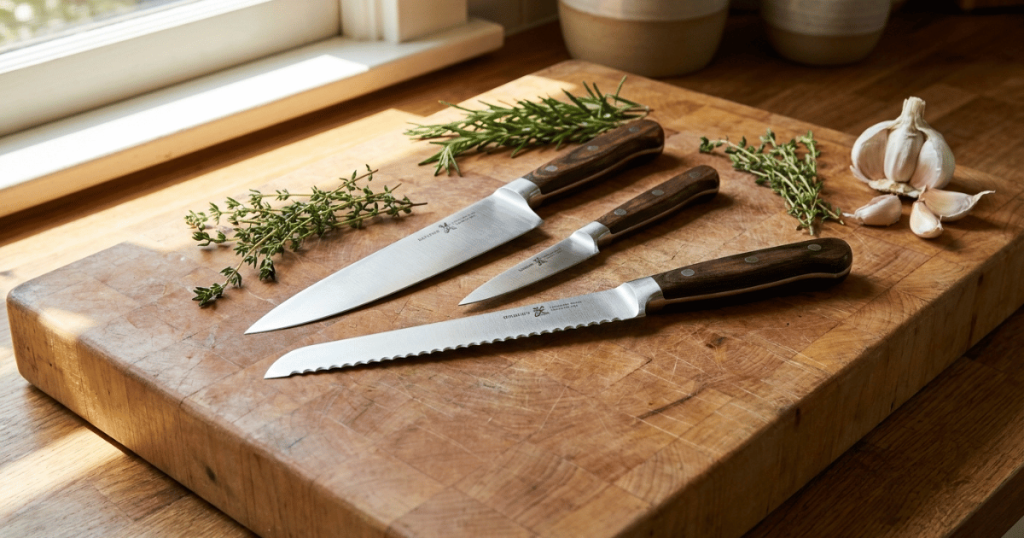
The short answer: three knives, each covering a failure of the others
The useful way to think about a knife collection is not “one knife per task” but “one knife per failure.” A chef’s knife can technically peel an apple. It does it badly, because of its length and height, not because it is dull. A new knife earns a place when it fixes something the existing ones physically cannot do well.
| Knife | What it does best | What it does badly | The physical reason |
|---|---|---|---|
| Chef’s knife | Chopping, slicing, mincing on a board | Small work in the hand, hard crusts, bone | Long, tall blade with a thin edge built for board work |
| Paring knife | Peeling, trimming, coring, in-hand cuts | Anything large, board chopping | Short blade gives control but no length or knuckle clearance |
| Bread knife | Crusty bread, tomatoes, soft-skinned fruit | Fine dicing, precise cuts | Serrations pierce a surface but leave a rougher cut |
Most of the cooking in a typical home kitchen falls into the “does best” column of those three rows. That is why the same three appear on nearly every serious list of essentials.
Why one knife cannot do everything: the metallurgy
The limit on how many jobs one knife can do starts at the edge itself. A kitchen knife cuts well because its edge is thin, and a thin edge places demands on the steel that pull in opposite directions.
Larrin Thomas, the metallurgist who writes Knife Steel Nerds, puts it plainly in How to Pick the Best Steel for Every Knife (read October 2, 2026): “Knives with thin edges require high ‘edge stability’ which is a combination of high hardness to avoid rolling and high toughness to avoid chipping.” In his article What is Edge Stability? (also read October 2, 2026) he names the catch: “Higher hardness is required to avoid edge rolling but higher hardness also reduces toughness which increases the possibility of edge chipping.”
That trade-off is why a chef’s knife should not be used on bone or frozen food. Its thin, hard edge is optimized for food that offers little resistance. Hitting bone asks the edge for toughness it was not designed around, and the usual result is a chip or a rolled section. A knife built for that job is a different shape and a different compromise, which is exactly why it is a separate knife.
The chef’s knife: the one that does most of the work
The chef’s knife is the center of the collection because its shape suits the widest range of board work. A long edge lets you slice in one stroke. A tall heel keeps your knuckles off the board. A gently curved belly lets the blade rock for mincing herbs and garlic.
Because it does most of the cutting, it is also the knife whose steel and grind matter most. This is where a harder, finer-grained steel pays off, and also where the chipping risk described above is highest if the knife is misused. Western chef’s knives and Japanese gyuto both fill this slot. A santoku can fill it instead if you prefer a shorter, flatter blade, but it replaces the chef’s knife rather than adding to it.
If you are only going to spend real money on one knife, spend it here. Our guide to the best kitchen knives by type, steel and budget explains what to look for in the steel and construction of this main knife.
The paring knife: control in the hand
A paring knife exists because some jobs happen off the board. Peeling an apple, hulling strawberries, cutting the eyes out of a potato, scoring a sausage or segmenting citrus all need the blade to move a short distance with a lot of control.
A long chef’s knife is wrong for this. Its length works against you, and its height means you cannot hold it close to the edge. The paring knife’s short blade puts the edge near your fingers, so small movements translate directly into small cuts.
The trade-off is that it is poor on the board. It has almost no knuckle clearance and too little length for slicing anything wide. That is fine. It is not meant to replace the chef’s knife, only to cover what the chef’s knife cannot do.
Paring knives come in several tip shapes, including the curved bird’s beak used for peeling round produce. One general-purpose paring knife is enough for most kitchens.
The bread knife: why serrations are not a gimmick here
A smooth edge cuts by concentrating force along a very fine line. On a hard crust, that line skates before it bites, and by the time it breaks through, you have pressed down hard enough to crush the soft crumb underneath.
Serrations change the geometry. The points of the teeth concentrate force on a tiny area, so they pierce the crust with little downward pressure, and the sawing stroke does the rest. The same effect helps with tomatoes, peaches and other soft fruit with a slippery skin, where a smooth edge that has lost a little of its keenness tends to slide.
The bread knife also tends to need the least frequent attention, because the recessed parts of each scallop do much of the cutting and are protected from the board. When it does need work, it needs a different method: each serration is sharpened individually. Our guide to sharpening a serrated bread knife one tooth at a time covers the process.
How many kitchen knives do you need if you cook more than most?
Three is the baseline, not the ceiling. A fourth or fifth knife makes sense when your cooking regularly includes a task the core three fail at. The useful question is not “what knives exist?” but “what do I cut every week that my current knives do badly?”
- You break down whole chickens or bone out meat. A stiff boning knife, or a Japanese honesuki for poultry, works close to bone without risking your chef’s knife.
- You carve large roasts or a holiday turkey. A long, narrow slicing or carving knife makes long, even slices in one stroke with less drag than a tall chef’s knife.
- You fillet fish. A flexible fillet knife follows the curve of the bones in a way a stiff blade cannot.
- You need to cut through bone. A heavy cleaver built for bone, with a thicker, tougher edge. This is the job the edge stability trade-off says your chef’s knife should never do.
- You want a lighter in-between knife. A utility or petty knife sits between paring and chef’s knife sizes. Useful for some cooks, redundant for many.
If none of these describes your weekly cooking, three is enough.
What the big knife set adds to the count
Large knife sets are built around a piece count, and the count is not the same as the number of distinct jobs. When you look at a big set, check what fills it.
- Steak knives. Sets often include several. These are table knives, not prep knives.
- A honing rod and kitchen shears. Both are useful tools, but they are counted as pieces.
- Duplicates by size. Two or three utility or paring knives of slightly different lengths do overlapping jobs.
- Specialty blades. A tomato knife or a cheese knife may be included whether or not it matches how you cook.
None of this makes a set a bad purchase. It means a large set may give you three knives you use daily plus several you rarely touch, at the steel quality the set price allows.
Every knife is an edge you have to maintain
The hidden cost of more knives is maintenance. Every knife you own is an edge that dulls with use and needs honing and eventually sharpening. Three knives used often and kept sharp are more useful than ten used occasionally and rarely sharpened.
Honing realigns a slightly rolled edge between sharpenings; sharpening removes steel to form a new edge. If the difference is unclear, our explainer on honing vs sharpening covers what each does to the edge. How often each knife needs it depends on how you use it, not on a calendar; see how often to sharpen kitchen knives for the signals to watch for.
This is another argument for starting small. A collection you can keep sharp is more useful than a larger collection that is mostly dull.
How to build up from three
Start with the chef’s knife and make it the best one you can comfortably afford, since it does the most work. Add a paring knife and a serrated bread knife. Then cook for a few weeks and notice which tasks feel awkward. If the same awkward task comes up repeatedly, that tells you which fourth knife to look at. If nothing comes up, you are done.
Buying this way avoids paying for blades you do not use, and it lets you match each addition to a real job rather than to a slot.
FAQ
How many kitchen knives does a home cook need?
Most home cooks need three: a chef’s knife, a paring knife and a serrated bread knife. Add more only for tasks you do often that these three handle badly, such as boning meat, filleting fish or carving roasts.
Can I get by with just one knife?
Yes, if you mostly chop vegetables and slice boneless meat. A chef’s knife covers most board work. You will miss a paring knife for in-hand work and a serrated knife for crusty bread and tomatoes.
Is a knife set better than buying knives one at a time?
Not necessarily. Sets add steak knives, a honing rod, shears and duplicate sizes to the piece count. Buying individually lets you put more of your budget into the chef’s knife you use most.
Should a santoku be one of my three knives?
It can replace the chef’s knife if you prefer a shorter, flatter blade for slicing and dicing. It is an alternative to the chef’s knife rather than an addition to it.
Why shouldn’t I use my chef’s knife on bones?
A chef’s knife has a thin, hard edge designed for low-resistance food. Bone and frozen food can chip or roll that edge. Use a boning knife to work around bone and a cleaver built for bone to cut through it.