What is a nakiri knife? It is a Japanese vegetable knife with a thin, rectangular blade and a straight, flat edge sharpened on both sides. The name means “knife for cutting greens.” Because the whole edge meets the board at once, a nakiri cuts vegetables cleanly with a straight down or push stroke instead of a rocking one. It looks like a small cleaver, but it is much thinner and is not built for bone, frozen food or heavy chopping. Think of it as a vegetable specialist that sits beside a chef’s knife, not in place of one.
That last point is the one most product pages skip. The rest of this guide covers what the shape is doing, what it replaces, what it cannot do, and how the steel and the flat edge change the way you sharpen it.
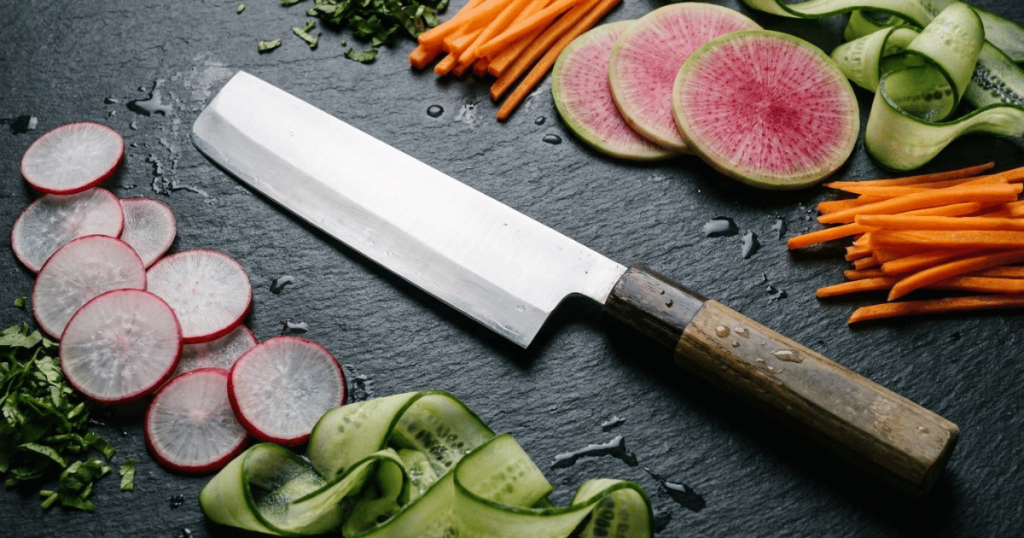
What is a nakiri knife, feature by feature
| Feature | What a nakiri has | Why it matters |
|---|---|---|
| Name | Nakiri bocho, “knife for cutting greens” | Tells you the job: vegetables |
| Typical length | 15 to 20 cm (about 6 to 8 in), per Wikipedia | Short enough for control, long enough for a cabbage half |
| Edge | Straight and flat along its length | Full contact with the board on every cut |
| Bevel | Double bevel, sharpened on both sides | Works for right- and left-handed cooks |
| Tip | Squared (Tokyo style) or a rounded drop (Osaka style) | No sharp point for piercing or tip work |
| Blade | Tall and thin | Room for knuckle clearance; less wedging in dense produce |
The length and bevel details come from Wikipedia’s Nakiri bocho entry (read September 27, 2026), which also notes that the Tokyo style has a squared tip “giving a cleaver-like appearance,” while knives from Osaka tend to carry a sheep’s foot drop tip. Makers vary within that range: Shun’s nakiri collection page (read September 27, 2026) lists blades of 5.5, 6 and 6.5 inches across its lines.
Why a flat edge changes how the knife cuts
Most Western chef’s knives have a curved belly. That curve lets the blade roll forward on the board, which is why a chef’s knife rocks. A nakiri has almost no curve, so it cannot roll. What it gains instead is contact: when the edge comes down, it meets the board along its entire length at the same moment.
That matters for one specific failure. When a curved edge chops straight down through a scallion or a thin carrot, only part of the edge reaches the board, and the last fiber of the slice can stay attached. The result is a row of slices that lift together, still joined at the bottom. A flat edge severs the whole slice in one stroke.
Wikipedia describes the nakiri as “suitable for cutting all the way to the cutting board without the need for a horizontal pull or push.” Shun’s page puts it the same way from the maker’s side: “The blade’s straight edge makes push cuts easy and ensures complete contact with the cutting board.” The motion follows the geometry. You chop straight down, or push the blade forward and down, and you do not rock.
It looks like a cleaver. It is not one.
The rectangular outline is where the confusion starts. A meat cleaver is heavy and thick behind the edge on purpose: its mass does the work of splitting joints and small bones, and the thick wedge behind the edge supports it against impact. A nakiri is the opposite. Wikipedia notes that these knives are “much thinner” than a deba, the heavy Japanese fish knife, and that the thin blade “does not help with cutting small bones in fish or meat.”
The reason is mechanical. A thin blade ground to a fine edge has very little steel directly behind the apex. That is exactly why it glides through a dense sweet potato with less wedging and cracking: there is less metal forcing the food apart. It is also why a hard strike on bone concentrates force on a narrow strip of steel that has nothing behind it, which is how edges chip.
The Chinese vegetable cleaver is another rectangular knife that people confuse with both, and it is a separate tool with its own trade-offs. The outline alone tells you very little; the thickness behind the edge tells you what the knife can survive.
Nakiri vs usuba: the other Japanese vegetable knife
The usuba is the traditional professional vegetable knife in Japan, and it looks similar at a glance. The difference is the grind. According to Wikipedia, the usuba uses a single-bevel edge (kataba) and is heavier than a nakiri, while the nakiri is double-beveled (ryoba).
A single-bevel edge is ground on one face only, with a slightly hollow back. It can be made extremely keen and is designed for the very thin sheet cuts of classical Japanese cooking, but it is handed (a right-handed usuba does not suit a left-handed cook) and it takes a specific sharpening routine to keep the back true. If you are considering one, read our guide to sharpening a single-bevel knife first, because the back of that blade is not simply flat.
For most home cooks, the double-bevel nakiri is the practical choice: it sharpens like any other double-bevel knife and works in either hand.
What a nakiri replaces, and what it does not
| Job | Does a nakiri do it well? | Better tool, if not |
|---|---|---|
| Slicing onions, carrots, celery, leeks | Yes, this is the core job | |
| Shredding cabbage and greens | Yes, the tall flat blade suits it | |
| Thin, even slices of cucumber or zucchini | Yes | |
| Mincing herbs by rocking | No, the flat edge will not roll | Chef’s knife |
| Boneless meat and fish | It can, but it is not what the shape is for | Chef’s knife or gyuto |
| Anything with bone | No | Heavier knife made for it |
| Piercing, scoring, coring | No, there is no point | Paring knife |
| Crusty bread | No | Bread knife |
| Frozen food | No | Let it thaw |
In short, a nakiri replaces the vegetable portion of what a chef’s knife does. It does not replace the chef’s knife. Owners who buy one as their only knife soon find the jobs in the right-hand column.
What a nakiri cannot do, and why
Bones and frozen blocks. As above, a thin edge has little support. Impact loads it in a way it was not ground for.
Twisting in hard squash. Dense winter squash tempts you to lever the blade sideways when it sticks. Sideways force on a thin, hard edge is a common way to snap off a corner or chip the edge. Shun makes the same point indirectly about its own chef’s knives: its Classic line uses a 16 degree edge, and it sells a Western Cook’s knife with a 22 degree edge specifically for “tougher tasks like winter squash.” A more acute edge is keener and less robust.
Tip work. A squared or rounded tip has no point, so hulling, scoring and coring go to a small pointed knife.
Rock chopping. If your habit is to keep the tip on the board and rock through herbs, a nakiri will fight you. That is not a flaw in the knife; it is the profile doing what it was designed to do.
The steel question: hard, thin, and sometimes reactive
Many nakiri are made from hard Japanese steels, and the hardness explains both the appeal and the care. Takefu Special Steel’s VG10 datasheet (read September 27, 2026) lists VG10 at 1.00% carbon, 15% chromium, 1% molybdenum, 1.5% cobalt and 0.25% vanadium, with hardness of HRC 60 or more. Takefu says the chromium, molybdenum and cobalt strengthen the matrix for “high hardness” and “a long-lasting sharp edge,” and that the steel has “excellent corrosion resistance.”
High hardness means the fine edge resists rolling over and keeps its keenness longer between sharpenings. The trade is toughness: harder steel tends to chip rather than bend when it is overloaded. On a thin vegetable knife, that is a fair trade, as long as you keep it away from the jobs above.
Some nakiri are made from plain carbon steel instead of stainless. Carbon steel can take a very fine edge, but without enough chromium it will rust and stain if it is left wet, and acidic foods can darken it. If yours is carbon steel, our guide on how to keep knives from rusting covers the routine.
Sharpening a nakiri: keep the flat edge flat
A nakiri’s defining feature is also its sharpening risk. A flat edge only stays flat if the stone you sharpen it on is flat. Stones wear hollow in the middle with use, a shape called dishing. Sharpen a straight edge on a dished stone and you slowly grind a curve into it, and a curved nakiri loses the full-contact cut that made it worth buying. Check your stone and follow our guide to flattening a whetstone before you start.
The second rule is angle and pressure. A thin, hard Japanese edge is sharpened at a lower angle than a typical Western knife, and it rewards light pressure and a whetstone over aggressive tools. Our guide on how to sharpen Japanese kitchen knives without chipping walks through it. Always sharpen to the angle your maker states for your knife rather than a generic number.
One advantage of the shape: because the edge is straight and the tip is square, sharpening wears the whole edge back evenly, so the outline of a nakiri stays close to its original shape over years of sharpening, unlike a knife with a pointed tip that slowly loses its point.
Should you buy a nakiri?
A nakiri earns its drawer space if you cook vegetable-heavy meals, dislike rock chopping, or keep ending up with joined slices from a curved knife. It is also a good second knife if you already own a chef’s knife and want a dedicated tool for the most common prep job in the kitchen.
It is not for you if you want one knife for everything, if you mostly break down proteins, or if you want a tool you can use hard without thinking about it. In those cases a chef’s knife or a thicker Western blade is the more forgiving buy.
When you compare models, read the spec sheet before the marketing. Look for the steel name, the stated hardness, the stated edge angle and whether the steel is stainless or carbon. Those four facts tell you more about how a nakiri will behave in your kitchen than the word on the box.
FAQ
What is a nakiri knife used for?
A nakiri is used for vegetables: slicing, chopping and shredding produce with a straight down or push cut. Its flat edge meets the board along its whole length, so slices separate cleanly instead of staying joined at the bottom.
Is a nakiri the same as a cleaver?
No. A nakiri has a rectangular outline like a cleaver, but its blade is much thinner and lighter. A meat cleaver is thick and heavy so it can split joints and bone. A nakiri should never be used on bone or frozen food.
Can you cut meat with a nakiri?
It can slice boneless meat, but it is not what the shape is for. With no point and no curved belly, it is clumsy for trimming and carving. A chef’s knife or gyuto handles boneless protein better.
Is a nakiri single bevel or double bevel?
A nakiri is double bevel, sharpened on both sides, so it suits right- and left-handed cooks. The usuba, the traditional professional vegetable knife, is the single-bevel version and is heavier.
How do you sharpen a nakiri?
Sharpen it on a flat whetstone at the angle its maker specifies, with light pressure. Flatten the stone first, because a dished stone will grind a curve into the straight edge over time.