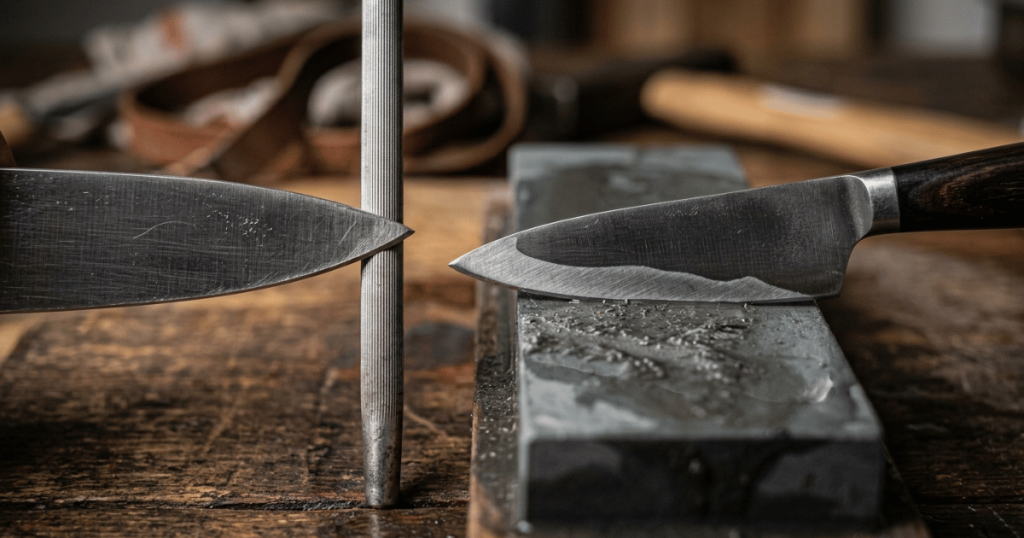
Stand the rod point down on a cutting board, hold the blade against it at the angle your knife’s own maker publishes, and draw the blade down and across the rod from heel to tip with almost no pressure, switching sides after each stroke. A handful of passes per side is the whole job. The rod is not sharpening anything: it is straightening an edge that has bent over, which is why it takes seconds and why it stops helping once the edge is genuinely worn away. If your knife is serrated, ceramic, or coated, keep it off the rod.
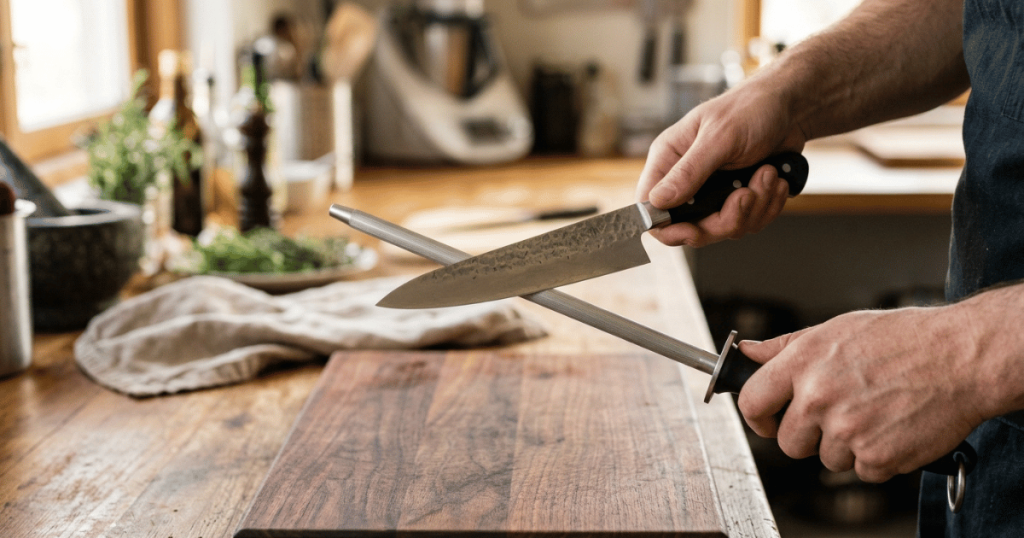
What the rod is actually doing
An edge that has been used for a week is usually not worn down. It is bent. The apex of a kitchen knife is thin enough that ordinary work rolls it to one side, and a rolled apex presents its shoulder to the food instead of its point, which is what “gone dull overnight” really feels like.
The makers describe the fix in their own words. Wüsthof’s guidance says a honing steel “re-aligns the microscopic teeth in the blade.” Victorinox describes honing as realigning “the blade’s edge, which can bend slightly with use,” and says it removes no metal, or only a little. Shun calls it “realigning it when it begins to roll.” Three pictures of the same result, and none of them claims the rod takes off enough steel to build a new edge. Hold on to that, because everything people get wrong about honing follows from expecting it to sharpen.
Not everything shaped like a rod is a honing steel
Wüsthof draws the line explicitly: its honing steel re-aligns the edge, while a sharpening steel “will actually grind away material from the knife, allowing it to reset the edge.” Two products, two jobs, one shape. Plenty of owners have spent years believing they were honing while the rod in their hand was an abrasive.
- A smooth or lightly grooved steel rod is the classic honing steel. It bends the apex back and takes off very little.
- A ceramic rod is a fine abrasive. It straightens and it also cuts a little, so a light hand matters more.
- A diamond rod is a sharpening tool. Makers sell them as sharpeners, and if your label says sharpener rather than honing steel, believe the label.
Zwilling adds a limit that is easy to miss: its sharpening steels “are only suitable for non-coated knives with a smooth cutting edge.” A coated blade or a wavy edge is out.
The angle: your knife’s number, not a universal one
There is no single honing angle, and the makers who publish figures do not agree, because none of them is describing honing. Each is describing the edge it grinds. You are laying the blade against the rod at the angle that edge already has.
| Source | Published angle | Applies to |
|---|---|---|
| Wüsthof | 14 degrees | Its standard blades. Its Asian-style blades, santokus and nakiris, are 10 degrees. |
| Zwilling | Approximately 15 degrees | Zwilling knives. “Santoku knives and all MIYABI and Kramer made by ZWILLING knives should be 9-12°.” |
| Shun | 16 degrees | Shun knives. Its own honing steel carries a 16 degree guide on the hand guard. |
| Victorinox | 20 degrees | “Hold the knife at a 20° angle to the honing steel.” |
| America’s Test Kitchen | 15 degrees | General instruction: “Hold the blade at a 15-degree angle away from the steel.” |
Every figure there is per side, and the spread from 9 to 20 degrees is not a controversy. It is five organizations describing five different edges. Use your own maker’s number if it publishes one. If it does not, lay the blade flat against the rod and lift the spine until there is a small, consistent gap, then hold that. A degree or two of drift matters far less here than on a stone, because you are bending steel rather than cutting it. A wildly steep angle does nothing useful, and a very shallow one just scratches the face of the blade.
Set it up so the rod cannot be the thing that hurts you
Every maker’s published instruction uses the same setup, and it is not the one on television. Hold the rod point down with the tip on a board or counter. Wüsthof says to rest it “on a dry firm surface such as a cutting board.” Zwilling says to “hold the steel point down on a table or cutting board.” Victorinox adds the beginner’s version: “If you are not experienced at using a honing steel, it’s best to place the tip on a folded tea towel or damp dish cloth for extra stability.”
That matters for one reason. With the tip braced, the edge travels downward and away from the hand holding the rod for the entire stroke, and your rod hand stays above the finger guard where the blade never reaches it. The mid-air version, rod held out and the blade flashing across it, is a professional’s habit built up over years, and it puts a sharp edge on a path that crosses the hand holding the rod. It produces no result the braced version does not.
Then: dry hands, because a wet grip on a knife handle is where sharpening injuries come from, and light you can see the blade in. Never run a finger along the length of the edge to check your progress, in either direction. Check by drawing a thumb from the spine outward, across the edge and off it.
The stroke, step by step
- Brace the rod. Tip down on the board, handle gripped above the guard, rod close to vertical and tilted slightly away from you.
- Place the heel of the blade near the top of the rod, at your angle. The heel, not the middle, so the whole edge gets its turn.
- Draw the blade down and across. Zwilling: “pull the knife down and across the steel, moving from the heel of the knife to the tip.” Wüsthof: “gently pull the blade toward you while gliding it downward, ending with the top of the knife at the bottom of the steel.” The two combine into one diagonal, so the contact point runs heel to tip as the blade runs top to bottom.
- Do not hit the guard. America’s Test Kitchen is specific: “do not bang the knife against the finger guard since this can damage the edge.” Finish the stroke and lift off.
- Switch sides and repeat. Same angle, other face of the rod, same diagonal.
- Wipe the blade afterward. Wüsthof asks owners to clean the knife after honing “so that you remove any excess steel.” There is always a little, even from a smooth rod.
How many strokes, honestly
The published counts do not match, and seeing them together is more useful than picking one. Wüsthof: “A fairly sharp knife may only need 2-3 repetitions, while a dull knife will need more.” Zwilling: “Repeat this 3 to 10 times, switching sides after every stroke.” Victorinox: “Repeat this motion five times on each side.” America’s Test Kitchen: “Four or five strokes on each side of the blade (a total of eight to 10 alternating passes).”
Two to ten, across four named sources. That is not carelessness, it is a sign that the count is the wrong variable. What decides the number is how far the apex has rolled, and the only way to know is to stop and test. Take a few passes per side, slice a sheet of paper, and go again if it drags. Twenty strokes on an edge that needed three is not thorough, it is just wear.
Pressure
Almost nobody hones too gently. The instinct is to attack the rod, and a bent apex does not need force to be pushed back into line. Zwilling’s published technique is worth copying exactly: “Use more pressure on the first few strokes then ease up on the pressure until the very last couple of strokes.” America’s Test Kitchen simply calls for light pressure throughout. Either way the last passes should be the lightest, because they set the alignment you are about to cut with. A properly weighted stroke is quiet; if the rod is ringing and the blade is chattering, you are pressing.
Did it work, and what it means if it did not
Slice a sheet of printer paper held by one corner. A restored edge takes it cleanly. The tomato is the honest kitchen test: set the blade on the skin and draw it back with no downward pressure, and see whether it bites on the first pull.
If honing brings the knife back, the system is working as designed. If it does not, stop. There is nothing left to realign, which means the apex has worn away rather than bent, and more passes cannot manufacture steel that is gone. Zwilling states the rule plainly: “If the cutting edge can no longer be renewed by honing, it must be reground to bring on a new edge.” That means a stone, a machine rated for the knife, or a sharpening service.
Knives to keep off the rod
Serrated edges. Zwilling is unambiguous: “don’t ever hone serrated knives. They must be sharpened by a professional or replaced.” A rod cannot reach inside the scallops where the cutting happens, and it flattens the points that do reach it.
Ceramic blades. Ceramic does not bend, so there is nothing to realign, and it chips where steel would deform.
Hard Japanese steel, unless the rod was specified for it. Korin’s care guidance says “Do not use a sharpening steel to sharpen your Japanese knife. Using a sharpening steel can damage your blade.” Global warns against steels “made from other materials” than its own. Shun takes a narrower line but still a line: its own honing steel “has a built-in honing guide set to the correct Shun 16° angle.” Read together, a rod named by your knife’s maker for that knife is a considered tool. A generic grooved steel from an old block, used freehand at whatever angle a wrist finds, is a genuine way to chip a hard edge.
Coated blades. Zwilling’s limit again: its steels are “only suitable for non-coated knives.”
How often
The makers differ here too. Shun: “Some cooks hone once a week, while others hone every day. It depends on how often the knife is used.” Victorinox suggests honing before or after each cooking session. Wüsthof says a steel should be used regularly, even after each use. All three describe a rhythm rather than a schedule. Honing costs seconds and almost no metal, so there is little penalty in doing it often and a real one in leaving it until the knife is properly blunt, which turns a ten second job into a stone session.
Frequently asked questions
Does a honing steel sharpen a knife?
No. It realigns an edge that has rolled over. Victorinox describes honing as removing no metal, or only a little, while sharpening “grinds away a small amount of metal to create a new edge.” If your rod is a diamond or ceramic sharpening rod rather than a honing steel, it is doing the second job, and the product label will usually say so.
Which direction do I move the blade?
Down and across the rod in one motion, so the contact point runs from the heel of the blade to the tip while the blade travels from the top of the rod to the bottom. With the rod braced point down on a board, that keeps the edge moving away from the hand holding the rod for the whole stroke.
Can I hone a Japanese knife with my German knife’s steel?
Korin advises against using a sharpening steel on a traditional Japanese knife at all, and Global warns against rods made of materials other than its own. A fine rod specified by the knife’s own maker, used lightly at that knife’s angle, is the cautious middle ground. A generic grooved steel is not worth the risk on a hard, thin edge.
My knife will not come back no matter how much I hone it. What now?
Stop. That is the signal that the edge is worn rather than rolled, and honing has nothing to work on. Zwilling’s own guidance says that when honing can no longer renew the edge, it has to be reground. Take it to a stone, a machine rated for that knife, or a sharpening service.