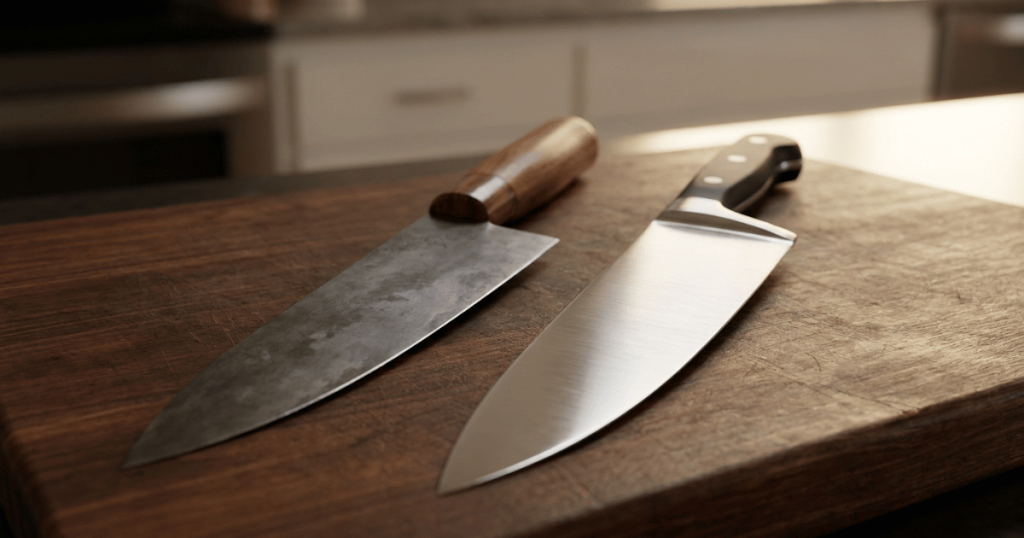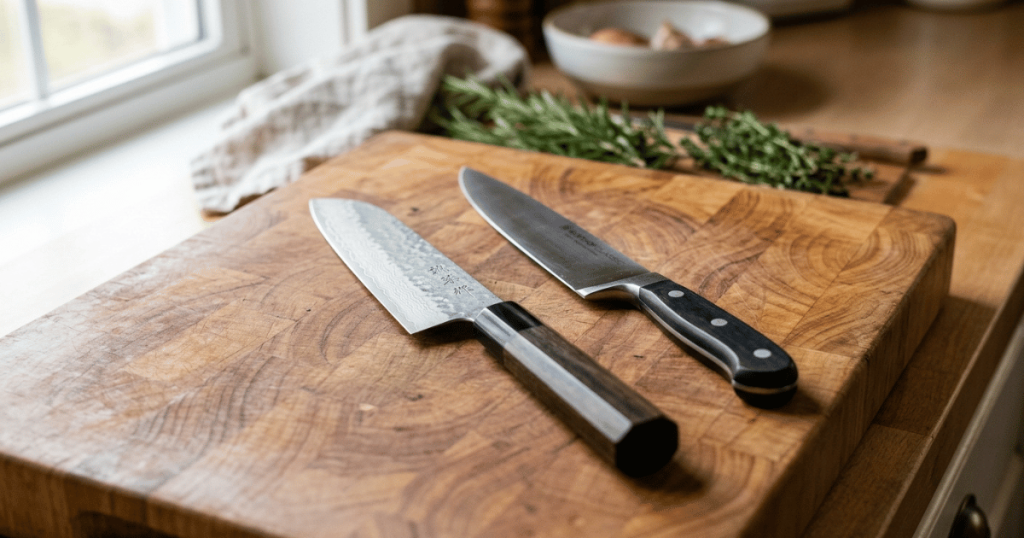
The boning knife vs fillet knife question comes down to one property: how much the blade bends. A boning knife is shorter, a little thicker and stiffer, built to work around joints and separate meat from bone in beef, pork and poultry. A fillet knife is thinner, often longer and much more flexible, built to ride along a fish’s rib cage and peel skin off a fillet. Can one do both? A thin, flexible boning knife can stand in for a fillet knife on the occasional fish. A fillet knife is a poor substitute on a pork shoulder.
The rest of this page explains where that flex actually comes from (it is not the steel), what each shape is for, and how to decide which one belongs in your kitchen.
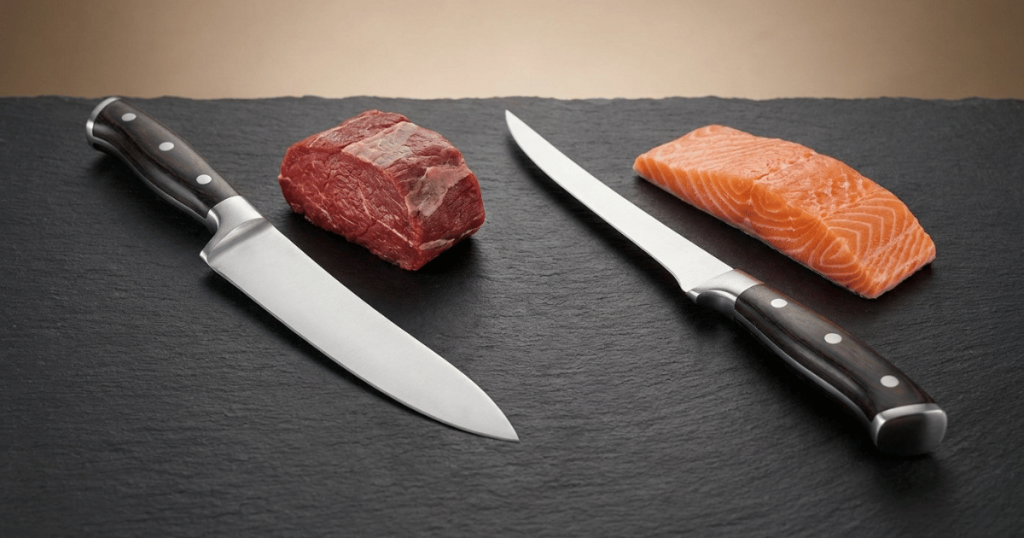
Where the flex comes from: geometry, not hardness
Most shoppers assume a flexible knife is made of “softer” steel and a stiff one of “harder” steel. The metallurgy says otherwise, and it is the single most useful fact for choosing between these two knives.
How far a blade bends under a load and then springs back is controlled by the steel’s elastic modulus, also called Young’s modulus. Metallurgist Larrin Thomas explains in Knife Steel Nerds’ article on why heat treating does not affect flex (read September 27, 2026) that “the hardness or strength of steel does not change its stiffness.” The modulus comes from the strength of the bonds between iron atoms, and, in his words, “the strength of those bonds does not change with heat treatment.”
What hardness does change is how far the blade can bend before it stays bent. A harder blade has a higher yield stress, so it tolerates more flex before taking a permanent set. A softer blade flexes the same amount under the same load but reaches the point of permanent bending sooner.
So why is a fillet knife so bendy? The same article answers directly: “The reason they are so flexible is due to the thin geometry,” because “deflection for a given load is inversely proportional to the thickness cubed.” Halve the thickness and the blade bends roughly eight times as far under the same push. That cube is why a small difference in spine thickness between two knives that look alike produces a large difference in how they feel on the board.
Boning knife vs fillet knife at a glance
| Boning knife | Fillet knife | |
|---|---|---|
| Typical blade length | 5 to 7 inches (F.N. Sharp) | 5 to 9 inches (F.N. Sharp) |
| Thickness and flex | Slightly thicker, stiffer; some models semi-flexible | Thinner, more flexible than most other knives |
| Profile | Mostly flat, with a slightly curved, sharp tip | Prominent upward curve and a sharp curved tip |
| Main work | Separating meat from bone, trimming tendons, silver skin and fat | Removing fish from the frame, skinning fillets |
| Proteins | Beef, pork, lamb, game, poultry; fish at a pinch | Fish first; small, delicate cuts of meat |
| Weak spot | Too stiff to follow fine fish bones | Too thin to lever through joints or heavy cartilage |
The length and shape figures come from F.N. Sharp’s comparison of the two knives (read September 27, 2026), which describes boning knives as “slightly thicker and stiffer than fillet knives” and fillet knives as “thinner and more flexible than most other knives.” Individual models vary, so check the spec sheet of the knife you are looking at rather than assuming a category range.
What a boning knife is built for
A boning knife is a short, narrow blade with a pointed tip. The narrowness is the point: it lets the blade turn inside the tight spaces around a joint, a shoulder blade or a chicken thigh bone, where a chef’s knife is too tall to maneuver. Wüsthof describes its boning knives as having a “thin, narrow, slightly curved blade” that “easily maneuvers around the contours of bone,” and lists the jobs as “removing bones, ligaments, tendons, and larger bits of fat.”
The stiffness matters because boning work involves pressure in unpredictable directions. You pry, scrape along a bone and push the tip into cartilage. A stiff blade goes where you aim it. A very flexible blade under that kind of sideways load bends away from the bone and leaves meat behind.
Boning knives are not all equally stiff. F.N. Sharp notes that “a sturdy, firm-bladed boning knife” suits beef and game, while “a thinner, more flexible boning knife” works better with poultry. Many makers sell stiff and flexible versions of the same boning knife for exactly this reason, which brings the category closer to fillet territory at one end.
What a fillet knife is built for
A fish is a different problem. The rib bones are fine and curved, the flesh is soft and the skin is attached by a thin layer you want to leave on the skin, not on the plate. A fillet knife is thin enough to bend and lie flat against the frame, so the edge follows the bones instead of cutting into them. The same flex lets you hold the blade nearly parallel to the board while you slide it between skin and flesh.
The upward curve toward the tip helps with the long, sweeping strokes that lift a fillet off in one piece, and the extra length on larger fillet knives lets one stroke cover a whole side of a bigger fish. Wüsthof calls the fillet blade “more flexible than a boning knife” and says it is “perfect for removing skin from fish, trimming fat.”
What the fillet knife cannot do is force its way through anything. The thin geometry that lets it bend also means it has little resistance to sideways load and twisting. Levering against a pork joint or cutting through heavy cartilage asks the thin edge to take stress it was not shaped for.
Can one knife do both?
This is the question behind most searches for this comparison, and the honest answer is: one direction works better than the other.
F.N. Sharp puts it plainly: a “thin, flexible boning knife can double as a fillet knife, but the reverse is not necessarily true.” That lines up with the geometry above. A flexible boning knife has enough bend to follow a trout’s ribs reasonably well and enough spine to still handle a chicken. A fillet knife has plenty of bend and not much else.
A useful way to decide:
- You mostly break down chicken and trim roasts, and cook fish that arrives already filleted. A boning knife alone. Stiff if you do more beef and pork; semi-flexible if poultry dominates.
- You fish, or buy whole fish often. A fillet knife earns its place, and a boning knife is the second purchase if you also butcher meat.
- You do a bit of everything, rarely. One flexible boning knife covers most of it.
- You mostly cook boneless cuts. Neither is urgent. A paring knife or chef’s knife handles the trimming most home cooks actually do.
The steel question for thin, flexing blades
Because stiffness is set by geometry, steel choice for these knives is about what happens at the edge and on the surface, not about flex.
Hardness and permanent set. A fillet knife is flexed deliberately, over and over. Following the Knife Steel Nerds explanation, a harder blade can flex further before it stays bent, while a softer one is more likely to take a set if you push it past its limit. Very hard, thin blades have their own risk: a sharp twist against bone can chip the edge rather than bend it. If that happens, our guide on how to fix a chipped knife edge explains what is repairable at home.
Corrosion. Fillet knives spend their working life in contact with fish, blood and often salt water. Stainless steel is the practical default for that reason. If you choose a carbon steel blade, dry it immediately after use; our page on how to keep knives from rusting covers the routine.
Sharpening boning and fillet knives
Both knives do fine, close work where a slightly rolled edge shows up quickly as tearing rather than slicing. A few light passes on a steel between sharpenings straightens that rolled edge; see how to use a honing steel for angle and pressure.
A flexible blade needs a little extra care on a whetstone. Pressing hard in the middle of a thin fillet blade bends it, which changes the angle at the edge mid-stroke. Use light pressure, keep your fingers close to the section you are sharpening, and work in short sections along the curve. For choosing the angle itself, what angle to sharpen kitchen knives explains how to find the one your knife was made with before you change it.
Safety with a flexible blade
A blade that bends can also spring. When a fillet knife is flexed hard against a bone and slips, the edge moves fast and in a direction you did not plan. Keep the hand that holds the fish behind the path of the edge, cut away from yourself, and work on a surface that does not slide. Wet, scaly fish and a slippery handle are a poor combination, so dry the handle and your hand before you start.
Which should you buy?
Choose by what arrives in your kitchen with bones in it. Meat and poultry point to a boning knife, stiff for beef and pork, more flexible for chicken. Whole fish point to a fillet knife. If you want only one and cook a mix, a flexible boning knife is the more versatile compromise, and the reason is geometry: it keeps enough spine for joints while giving up only part of the bend a fish frame asks for.
FAQ
What is the main difference between a boning knife and a fillet knife?
Flexibility. A boning knife is shorter, slightly thicker and stiffer for working around joints in meat and poultry. A fillet knife is thinner and more flexible so it can follow fish bones and slide under skin.
Can I use a boning knife to fillet fish?
Yes, especially a thin, flexible boning knife. It will not follow the ribs quite as closely as a dedicated fillet knife, but it handles occasional fish well. A fillet knife is the weaker substitute in the other direction.
Is a flexible knife made from softer steel?
No. Blade stiffness is set by the steel’s elastic modulus and the blade’s thickness, and heat treatment does not change the modulus. Thin geometry is what makes a fillet knife bend. Hardness decides how far it can bend before staying bent.
Can you use a fillet knife on meat?
For small, delicate cuts and trimming, yes. It is a poor choice for heavy joints, cartilage or anything that requires prying, because the thin blade has little resistance to sideways force.
How long should a boning or fillet knife be?
F.N. Sharp gives 5 to 7 inches as the usual range for boning knives and 5 to 9 inches for fillet knives. Longer fillet knives suit larger fish; shorter boning knives are easier to steer around poultry joints.