The utility knife vs paring knife difference is mostly about where the cut happens. A paring knife, roughly 3 to 4 inches, is built for work held in your hand: peeling, hulling, trimming. A utility knife, and its Japanese cousin the petty, runs roughly 4.7 to 6.5 inches and is built for small cuts on the board: a shallot, a lemon, a sandwich, a chicken breast. Do you need the in-between knife? If you already own a chef’s knife and a paring knife, a utility or petty earns a slot only if you do a lot of small board work where the big knife feels clumsy.
Below: what each knife is, why blade length and height decide how it behaves, where the steel matters, and a simple way to decide.
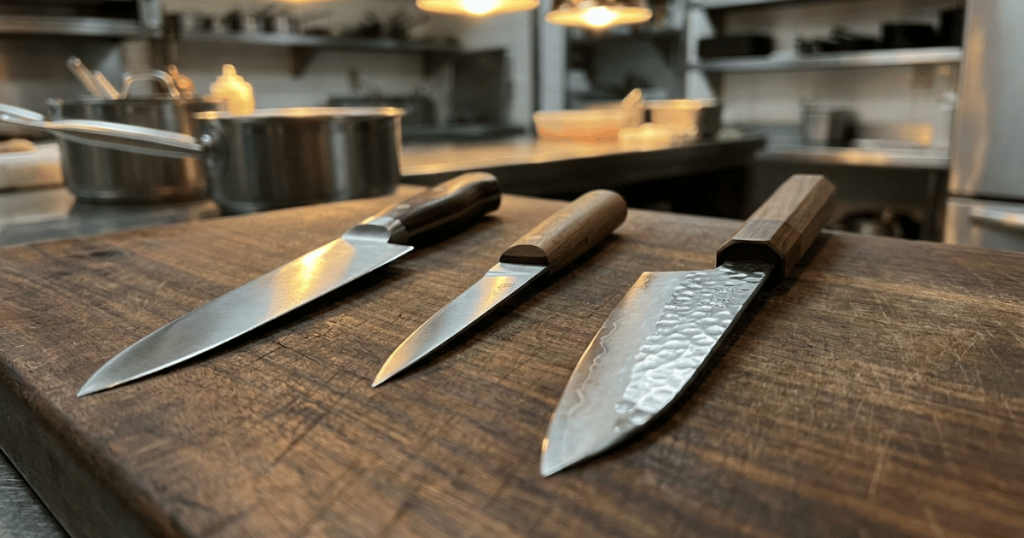
Three small knives, three jobs
Paring knife. A short, narrow blade with a pointed tip. It is designed to be held close to the edge and moved against your thumb. Peeling an apple, coring a tomato, deveining shrimp, cutting a blemish out of a potato: all of that happens in the air, not on the board.
Western utility knife. The mid-size blade between a paring knife and a chef’s knife. Makers sell it with a straight edge or a serrated edge. The straight version is essentially a longer paring knife that you can also use on a board; the serrated version is a small tomato-and-sandwich knife.
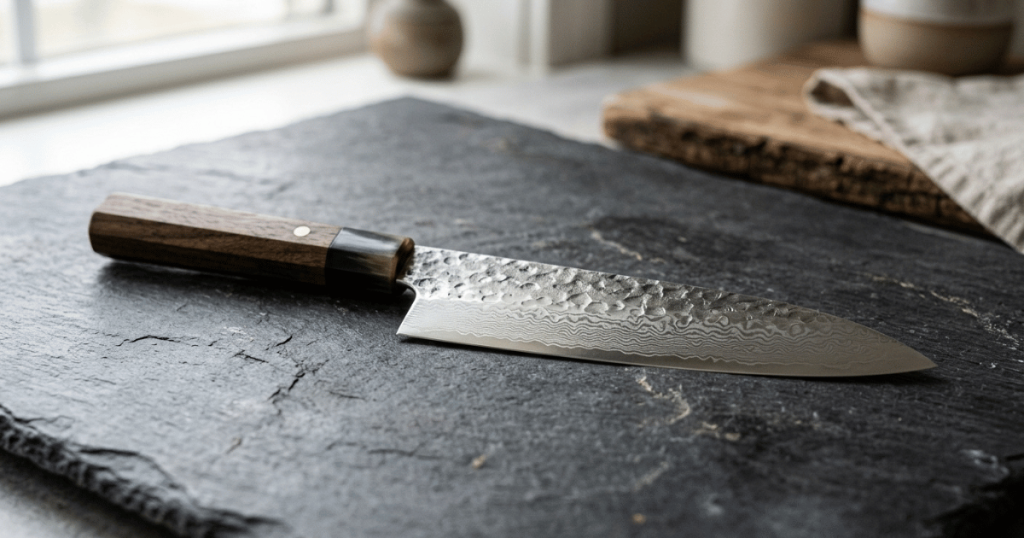
Petty knife. The Japanese equivalent of the utility knife. Yoshihiro’s guide to what a petty knife is (read September 27, 2026) gives the usual length as 120 mm to 165 mm, about 4.7 to 6.5 inches, and traces the name to the French “petite,” from the Meiji era when Western cooking shaped Japanese knife design. Yoshihiro draws the line against paring knives by where the work happens: petty knives work on the board with more reach, while paring knives work in the hand at a smaller size.
Utility knife vs paring knife vs petty at a glance
| Paring knife | Petty knife | Western utility knife | |
|---|---|---|---|
| Typical length | About 80 to 100 mm (3 to 4 in) | About 120 to 165 mm (4.7 to 6.5 in) | About 120 to 160 mm, overlapping the petty |
| Where it works | In the hand | On the board, and in the hand | On the board |
| Edge options | Straight | Straight, usually double bevel | Straight or serrated |
| Best at | Peeling, hulling, coring, trimming | Shallots, herbs, garnishes, trimming boneless meat | Sandwiches, citrus, tomatoes, small produce |
| Weak spot | Too short to slice cleanly on a board | Thin tip, not for prying | Neither as nimble as a paring knife nor as capable as a chef’s knife |
Length ranges come from Yoshihiro (above) and from Japanese Chefs Knife’s comparison of the three (read September 27, 2026), which puts paring knives at 80 to 100 mm and utility and petty knives at 120 to 160 mm. Individual models fall outside these ranges, so check the spec sheet of the knife in front of you.
Why length and blade height decide the job
Two measurements explain almost everything about how these knives behave, and neither is the steel.
Length sets the stroke. A knife slices best when one smooth stroke carries the edge through the food. A 3 inch paring knife cannot do that across an onion half or a lemon on a board; you end up sawing back and forth, which crushes and tears. Japanese Chefs Knife makes the same point in favor of the longer blades: the extra length “lets you complete slices cleanly on the board without repeated saw-like motions.” Going the other way, a long blade is a liability in the hand. The more steel extends past your thumb, the less precise every small movement becomes.
Blade height sets knuckle clearance. When a knife cuts all the way through on a board, your fingers wrapped around the handle need somewhere to go. A taller blade lifts the handle, and your knuckles, further off the board. A short, narrow paring blade leaves very little clearance, so the last part of every board cut ends with knuckles close to or on the cutting surface. This is a large part of why a paring knife feels awkward on the board and a petty or utility knife feels natural there: they are usually a little taller as well as longer.
That is also why none of the three is a chef’s knife. A chef’s knife’s height gives full clearance for rocking and chopping, and its length handles large produce in one stroke. The small knives exist for the jobs where that size gets in the way.
Straight or serrated utility knife?
The serrated utility knife is a different tool from the straight one, and it is worth deciding which you want before you shop.
A serrated edge meets the food only at the tips of its teeth, so each point carries more pressure and breaks a tough skin without squashing what is underneath. That makes a small serrated utility knife good at tomatoes, citrus, crusty rolls and firm sausage. It is poor at anything that needs a clean, precise cut, like mincing a shallot or trimming silver skin, because the teeth tear rather than slice.
A straight-edged utility knife or petty does the precise work and can still handle a tomato if it is sharp. For most kitchens the straight edge is the more useful choice, with the caveat that it has to be kept sharp to do tomato duty. When a serrated knife does dull, it needs a different method; our guide to sharpening a serrated knife one tooth at a time covers it.
The steel question: thin tips and twisting
Among small knives, the steel matters most at the tip, and the material science explains why.
A harder steel holds a fine edge longer, but hardness generally comes at the cost of toughness, meaning less resistance to chipping when the edge is loaded sideways. Japanese Chefs Knife describes the petty as “usually slimmer and more precise than the average Western utility knife, with a fine tip and a light blade.” Combine a thin tip with hard steel and you get a knife that cuts beautifully straight down and forward, and that can chip or snap its tip if you twist it inside an apple core or pry with it.
Western paring and utility knives in the German tradition generally favor tougher stainless steel with a sturdier edge. They dull sooner, but they forgive the twisting and prying that in-hand work invites. Neither approach is better in the abstract. The practical rule: use a hard, thin petty for slicing, and use a tougher paring knife for coring, digging and anything that involves leverage. If a tip does break, our guide on how to fix a broken knife tip explains how to reshape it.
Sharpening follows the same split. A thin Japanese petty wants a whetstone and a light touch; see how to sharpen Japanese kitchen knives without chipping for the method.
Do you need the in-between knife?
This is the question behind the search, and it depends on what you already own and how you cook.
- You have a chef’s knife and a paring knife, and you rarely cut small things on the board. You probably do not need a utility knife. The chef’s knife handles the board, the paring knife handles the hand.
- You often cut one shallot, one lemon or one sandwich and find the chef’s knife clumsy for it. This is the job a petty or straight utility knife is for. Japanese Chefs Knife suggests that for most home cooks with a primary chef’s knife, a petty “provides broader daily utility than a dedicated paring knife.”
- You mainly peel and trim fruit in the hand. Buy a paring knife first. A petty can peel, but its length makes it less precise in the hand.
- You want a tomato and sandwich knife. A serrated utility knife, understood as a specialty knife rather than an all-rounder.
- You are building a small set from scratch. A chef’s knife plus either a paring knife or a petty covers most home cooking. Which of the two depends on whether your small jobs happen in the hand or on the board.
If you are choosing among Japanese makers for a petty, our guide to real vs Japanese-style kitchen knives explains what the label on the box does and does not tell you.
FAQ
What is the difference between a utility knife and a paring knife?
Length and where you use it. A paring knife is about 3 to 4 inches and designed for in-hand work such as peeling and coring. A utility knife is longer, roughly 4.7 to 6.5 inches, and is designed for small cuts on a cutting board.
Is a petty knife the same as a utility knife?
They fill the same role. The petty is the Japanese version, usually slimmer and lighter with a finer tip, and almost always straight-edged. Western utility knives are often a little sturdier and are also sold with serrated edges.
Can a utility knife replace a paring knife?
For board work, yes. For in-hand work like peeling and coring, a paring knife is easier to control because less blade extends past your thumb. Many cooks keep both.
Should I get a serrated or straight utility knife?
A straight edge is more versatile and handles precise cuts. A serrated utility knife is better at tomatoes, citrus, rolls and sausage but tears delicate cuts. Choose serrated only if those foods are what you would use it for.
Can I use a petty knife in my hand?
Yes, for light slicing and peeling. Avoid twisting or prying with the tip, because a thin, hard tip is more likely to chip or break under sideways force than the sturdier tip of a Western paring knife.