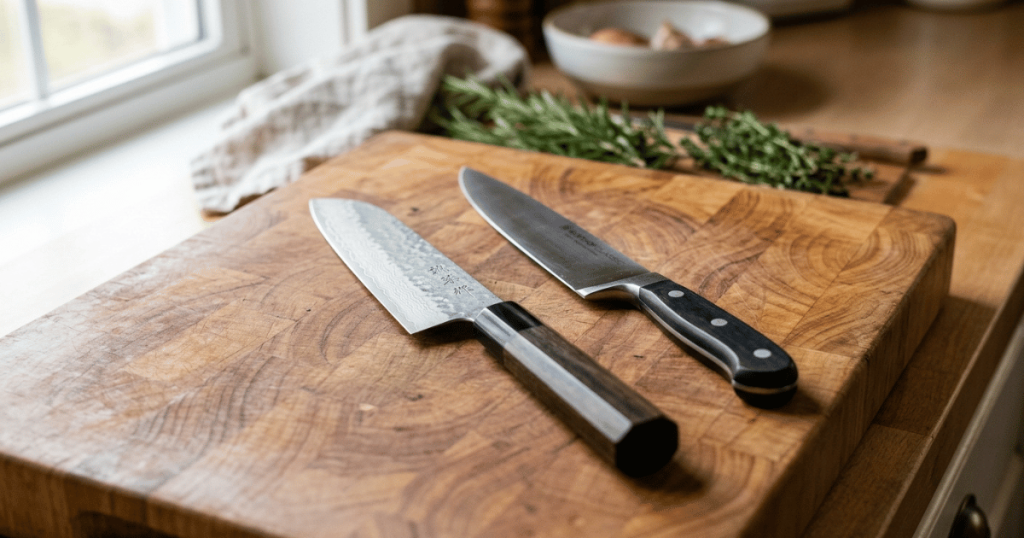
In the santoku vs chef knife choice, the real difference is the edge profile. A chef’s knife has a curved belly and a pointed tip, which suits rocking cuts and longer slicing strokes. A santoku is shorter, usually thinner and flatter along the edge, which suits a straight up-and-down chop and thin, precise slices. Both are general-purpose knives, so most home cooks need one, not both. Choose the chef’s knife if you want reach and a rocking motion; choose the santoku if you prefer a lighter blade and chop straight down.
So is the santoku a real tool or just a shape? It is a real tool, but its advantages come from specific geometry, not from the name on the blade. The rest of this page explains which measurements matter, what each shape gives up, and how the choice changes your sharpening.
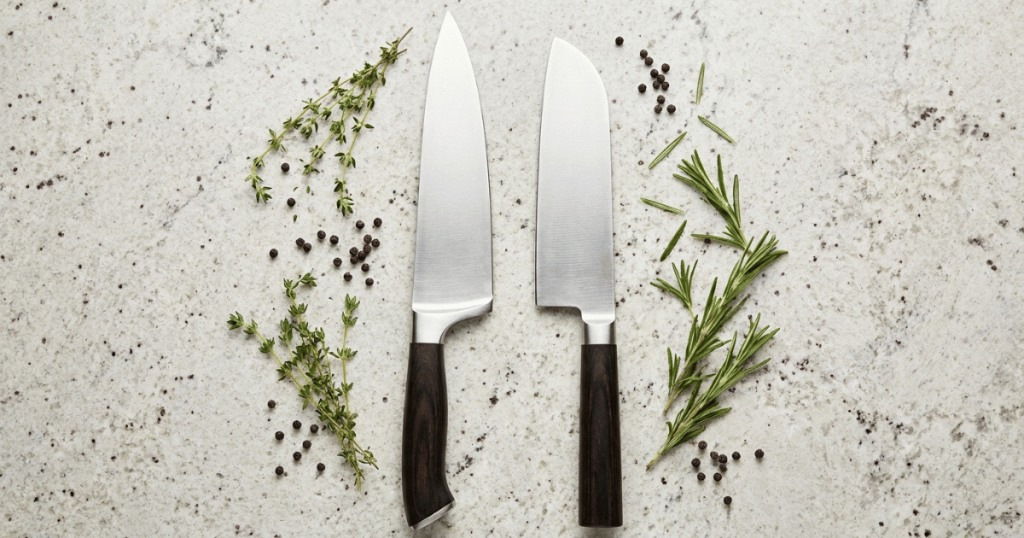
Santoku vs chef knife at a glance
| Feature | Chef’s knife | Santoku |
|---|---|---|
| Typical length | 6 to 10 in, 8 in most common (Wikipedia) | 5 to 7 in (Wikipedia) |
| Edge profile | Curved belly rising to a pointed tip | Flatter edge, with the spine curving down to the tip |
| Motion it suits | Rocking, long slicing strokes | Straight up-and-down chop, push or pull cuts |
| Tip | Sharp point for tip work | Less pronounced point, still usable for fine work |
| Weight | Often heavier, especially Western forged knives | Often lighter and thinner |
| Example edge angle | 14.5 degrees per side on WÜSTHOF chef’s knives | 10 degrees per side on WÜSTHOF santokus |
| Common extras | Full bolster on many Western knives | Dimpled or hollow edge on many models |
The lengths come from Wikipedia’s kitchen knife entry (read September 27, 2026). The edge angles come from a single maker, WÜSTHOF, and apply to its knives; other makers set their own.
Where the santoku came from and what the name means
WÜSTHOF’s article What is a Santoku Knife? (read September 27, 2026) explains that “santoku” means “three virtues” or “three strengths” in Japanese, referring to the three ingredients it prepares: meat, fish and vegetables. The same page describes it as slim and lightweight, with “a straight cutting edge and a pointed tip.” Its sister guide, Asian-Style Knives 101, calls it “the most frequently used knife in Japanese home kitchens.”
In other words, the santoku was designed as an all-rounder, the same role the chef’s knife plays in Western kitchens. It is not a specialist vegetable knife. That role belongs to the nakiri, which has a fully flat edge and a blunt tip.
The geometry that actually separates them
Edge profile
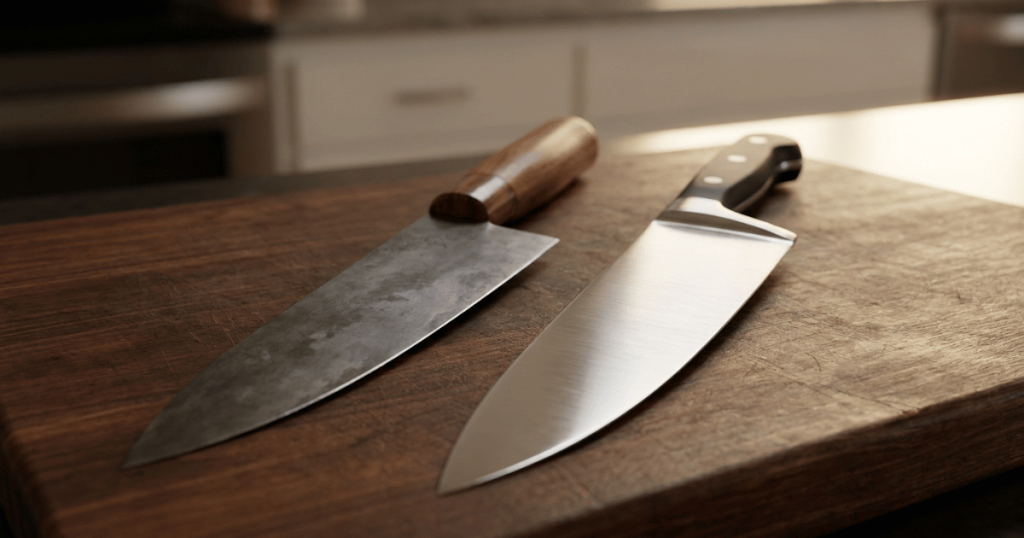
This is the difference you feel first. A chef’s knife’s curved belly lets the blade roll forward along the board, so the edge stays in contact while the handle rises and falls. A santoku’s flatter edge meets the board along more of its length at once. WÜSTHOF’s guidance for its santoku is to keep the edge moving in “a straight, up-and-down chopping motion” or to draw the blade back through ingredients. Try to rock a flat santoku and it simply does not roll; try to chop straight down with a strongly curved chef’s knife and only part of the edge reaches the board.
Length
The santoku’s shorter blade makes it easier to control in a small space and lighter in the hand. It gives up reach. A large cabbage, a whole squash or a boneless roast that an 8-inch chef’s knife slices in one stroke may take a santoku several.
Edge angle and thinness
On WÜSTHOF’s own knives the santoku is ground to 10 degrees per side against 14.5 degrees per side for its chef’s knife. A lower angle cuts with less resistance but leaves less metal behind the edge, so it is more easily damaged by bone, frozen food or twisting. This is a maker’s choice, not a law of the shape. A thick, heavy santoku ground at a Western angle cuts like a short chef’s knife, and a Japanese gyuto is a chef’s knife shape that is often as thin as a santoku.
The hollow edge
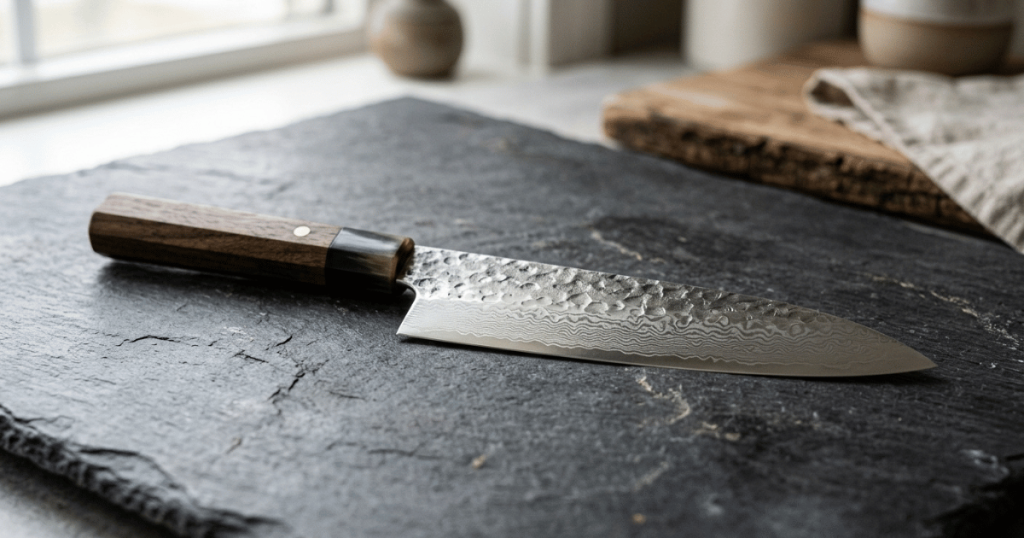
Many santokus carry oval dimples along the side. WÜSTHOF says the dimples “create small air pockets to prevent ingredients from sticking.” Hollows appear on some chef’s knives too, and they are a convenience feature for starchy or wet foods, not a sharpness upgrade.
Which one should you reach for?
Decide by how you cook, not by which knife sounds more professional.
| If you… | Reach for | Why |
|---|---|---|
| Cook a bit of everything and want one knife | Chef’s knife | Longer reach and a curved belly cover the widest range of jobs |
| Prefer a light, compact knife | Santoku | Shorter, often thinner and lighter |
| Mostly prep vegetables, herbs and boneless protein | Santoku | The flatter edge suits straight chopping and thin, even slices |
| Often slice large roasts or big produce | Chef’s knife | Length finishes long cuts in fewer strokes |
| Rock the knife through herbs and garlic | Chef’s knife | A flat santoku edge will not roll |
| Have a small workspace | Santoku | A shorter blade is easier to move |
| Already own a gyuto | Neither, yet | A gyuto already fills the chef’s knife role in a thinner form |
If you truly cannot decide, the chef’s knife is the safer default for a single knife because it covers large items as well as small ones. If you already own a chef’s knife and want a second general knife, a santoku adds a different profile and length rather than duplicating the one you have. Our guide on how to choose kitchen knives by type, steel and budget covers how to build around your first knife.
What nobody selling santokus will tell you
“Santoku” on a blade tells you the outline, not the performance. Plenty of santokus sold in Western stores share the steel, thickness and handle of the same maker’s chef’s knife, so the only real change is the profile and the length. That can still be worth it if the profile suits you. But a santoku will not be sharper or thinner simply because it is a Japanese shape.
The better signal is the spec sheet: stated edge angle, blade thickness and weight. If those are close to the maker’s chef’s knife, you are choosing a shape. If the santoku is noticeably thinner and ground at a lower angle, you are also choosing a different kind of edge, with the extra care it needs. Our guide to Japanese kitchen knives, real vs Japanese-style goes further into what the label does and does not guarantee.
How the choice changes your sharpening
A santoku ground at a low angle should be sharpened back to that angle. Sharpening it at a Western angle adds metal behind the edge and slowly turns it into a thicker knife. Check the maker’s stated angle before you start; our guide on what angle to sharpen kitchen knives explains how to find yours.
Thin santokus also reward whetstones and gentle pressure, because a thin, hard edge can chip under an aggressive tool. See how to sharpen Japanese kitchen knives without chipping. A Western chef’s knife at a wider angle is generally more forgiving of whatever sharpener you already own.
FAQ
Is a santoku better than a chef’s knife?
Neither is better overall. A santoku is shorter, often lighter and flatter, and suits straight chopping and thin slicing. A chef’s knife is longer and curved, and suits rocking cuts and large items. The right one depends on how you cook and the space you have.
Can a santoku replace a chef’s knife?
For many home cooks, yes. It handles meat, fish and vegetables, which is what the name refers to. It gives up some reach, so very large produce and big roasts take more strokes than with an 8-inch chef’s knife.
Why does a santoku have dimples on the blade?
The dimples, often called a hollow or granton edge, create small air pockets between the blade and the food. WÜSTHOF says this helps prevent ingredients from sticking. It is a convenience feature, not a sign of a sharper edge.
What size santoku should I buy?
Santokus are commonly 5 to 7 inches long, according to Wikipedia’s kitchen knife entry. A 7-inch santoku is the closest match to a standard chef’s knife as an only knife; a shorter one works better as a second knife.
Do santoku and chef’s knives use different sharpening angles?
Often, but it depends on the maker. WÜSTHOF, for example, grinds its santokus at 10 degrees per side and its chef’s knives at 14.5 degrees per side. Always sharpen to the angle the maker states for your knife.