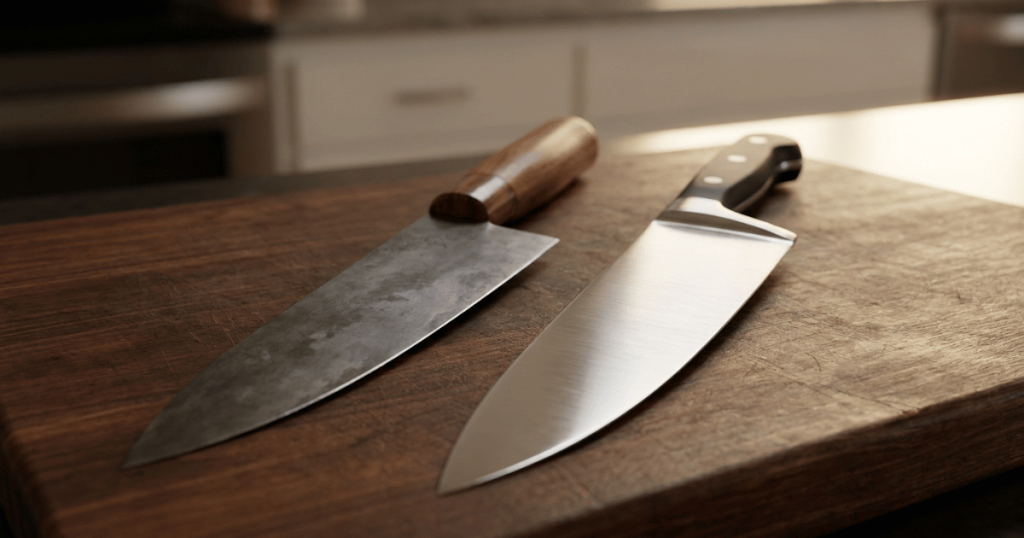
The Chinese cleaver vs meat cleaver question has a short, firm answer: do not split bones with a thin Chinese vegetable cleaver. Despite the shape, it is a slicing knife, a Chinese chef’s knife, with a thin, keen edge meant for vegetables, herbs and boneless meat. A meat cleaver is thick, heavy and deliberately less sharp, built to take the shock of hitting bone. Use the thin one on bone and the likely outcome is a chipped or cracked edge, and a chipped blade that glances off a bone is a safety problem, not just a repair job.
Below: why the two knives behave so differently, how to tell which one you are holding, and which one your kitchen actually needs.
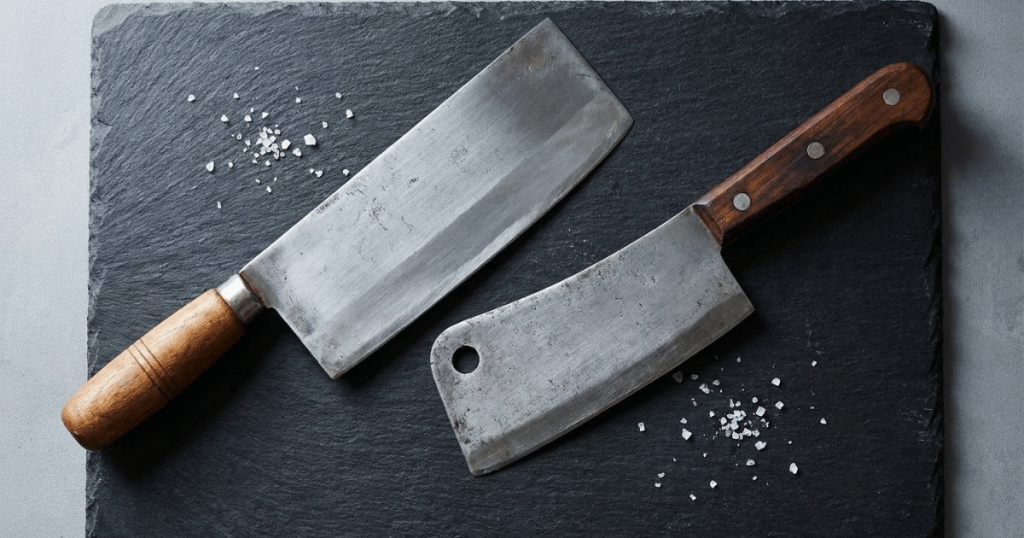
Same outline, different tools
Both knives are rectangular, both are tall, and both get called “cleaver” in English. That shared outline is where the confusion starts.
In Chinese cooking the rectangular knife is a family, not a single tool. Wikipedia’s entry on the caidao describes it as “a Chinese, rectangular-bladed, all-purpose chef’s knife” and separates three weights: slicers, which “have the thinnest and sharpest blades” for vegetables, herbs and thin strips of meat; choppers, a medium-thickness multipurpose type; and bone cleavers (gudao), which “have thick heavy blades” for pork ribs and hard-shelled seafood. The same entry is blunt about the thin one: “The thin blade makes slicers unsuitable for chopping any bones.”
A Western meat cleaver sits at the heavy end. Made In describes it as a knife that is “less sharp than other kitchen knives, as weight and power is more crucial than finesse,” and calls the Chinese vegetable cleaver “thinner, sharper, and comparably more delicate” and “much lighter weight than a meat cleaver.”
So when a recipe or a shop listing says “Chinese cleaver,” the useful question is which weight it means.
Chinese cleaver vs meat cleaver at a glance
| Chinese vegetable cleaver (slicer) | Meat or bone cleaver | |
|---|---|---|
| Blade | Tall, thin, light | Tall, thick at the spine, heavy |
| Edge | Keen, fine | Deliberately less sharp, more robust |
| Built for | Slicing, mincing, julienne, boneless meat, scooping food off the board | Chopping through bone, joints, frozen blocks |
| Force it expects | Slicing and push cuts | Impact |
| Fails by | Chipping or cracking on hard material | Crushing and tearing soft food |
| Steel priority | Holding a fine edge | Absorbing shock without breaking |
Why the thin one chips on bone: the steel reason
A cleaver that hits bone is not slicing. It is taking an impact, concentrated on a small length of edge, often with a twist as the blade meets the bone at an angle. Whether the edge survives depends on toughness, not sharpness.
Metallurgist Larrin Thomas defines toughness in Knife Steel Nerds’ ranking of knife steels (read September 27, 2026) as “a measure of how much resistance a steel has to fracturing. In the context of a knife this would be chipped edges or broken knives.” He also explains the trade-off that decides cleaver design: as hardness goes up, “the toughness is reduced by more than the edge retention is increased.”
A thin slicing cleaver is designed around the other side of that trade. It is made to take and hold a fine edge, so its edge is thin and the steel is usually chosen to hold that edge. Thin geometry and a steel tuned for edge-holding are exactly the combination that chips under impact.
A bone cleaver is designed the opposite way. The thick spine and heavy blade carry the momentum, the more robust edge spreads the impact over more steel, and the steel is chosen to absorb shock. It gives up fine slicing in exchange for surviving the hit.
Geometry matters as much as steel. A thin blade flexes and twists far more easily than a thick one, so when a thin cleaver strikes bone off-center, the edge takes sideways stress it was never shaped for. That is how a chip starts.
A practical rule for the thin cleaver
Knifewear’s guide to Chan Chi Kee cleavers (read September 27, 2026) gives the clearest rule we have found for a thin Chinese slicer. Of CCK’s thin mulberry knife, it says you can “cut all kinds of food, but only use it on things you can chew with your teeth,” and that “hard stuff like bones or frozen food would chip it.” Of a small stainless slicer, it says to “stay away from hard bones, shells, pits, and stems.”
The same guide describes a middleweight CCK model that “can do just about everything; it goes from fine mincing garlic to chopping up turkey carcasses,” and a heavier chopper for robust chopping. That is the family structure again: the middle and heavy weights take some bone work; the thin slicer takes none.
If you are not sure which one you own, assume it is the slicer. Check the maker’s own description of the model before you use it on anything harder than you could bite through.
Safety: what goes wrong when the wrong cleaver meets bone
This section is the reason this comparison matters.
- A chipped edge is sharp in unpredictable places. Small chips can end up in food. After any chip, inspect the food you were cutting and discard pieces that may hold fragments.
- A thin blade can deflect. When a light cleaver glances off a bone, it moves sideways, fast, toward whatever is beside the board. Keep your guiding hand well clear of the chopping line.
- Do not hammer the spine of a thin cleaver. Striking the spine of a slicer with a mallet or your palm to force it through bone loads a thin blade in exactly the way that cracks it.
- Do not chop frozen food with a slicer. Frozen meat behaves like bone to a thin edge.
- Never try to catch a falling cleaver. Step back and let it fall.
- Stop using a cracked blade. A visible crack in the blade, as opposed to a small chip at the edge, is a reason to retire the knife or have a professional look at it, not to keep chopping.
If the edge on your cleaver has already chipped, our guide on how to fix a chipped knife edge, and when not to try explains what can be repaired at home and when to hand it to a professional.
What each one is good at
The Chinese vegetable cleaver is one of the most versatile knives in any kitchen. The tall, flat blade slices, minces, crushes garlic with the side and scoops chopped food off the board in one move. For vegetables, herbs, boneless chicken, pork and beef for stir-fry, it does the whole job a Western chef’s knife does, with a different feel.
The meat cleaver is a specialist. It breaks down poultry frames and splits ribs and joints where a thin knife would fail. It is poor at anything delicate; it crushes a tomato rather than slicing it.
Which one do you need?
- You cook mostly vegetables and boneless meat. A Chinese vegetable cleaver can be your main knife. You do not need a meat cleaver.
- You regularly break down whole chickens or buy bone-in cuts that need splitting. A meat or bone cleaver earns its place, alongside whatever you slice with.
- You want one rectangular knife that does a little of both. Look at the middleweight choppers some Chinese makers sell for exactly this role, and read the maker’s own statement of what bone work the model is designed for before you buy.
- You only occasionally deal with small poultry bones. Kitchen shears or a boning knife working through the joint, rather than chopping through bone, may be all you need.
Caring for each edge
The two edges want different sharpening. A thin vegetable cleaver takes a fine edge on a whetstone like any thin chef’s knife; our step-by-step guide on sharpening kitchen knives with a whetstone covers the method, and a tall flat blade is easy to hold at a steady angle. A meat cleaver needs less refinement. A coarser, more robust edge suits its job, and polishing it to a razor edge gains little.
Many traditional Chinese cleavers are carbon steel, which rusts if left wet. Wipe and dry the blade straight after use; our page on how to keep knives from rusting has the full routine.
FAQ
Can a Chinese cleaver cut through bone?
A thin Chinese vegetable cleaver, or slicer, should not be used on bone. Heavier Chinese choppers and bone cleavers exist for that job. Check the maker’s description of your model; if in doubt, treat it as a slicer.
What is the difference between a Chinese cleaver and a meat cleaver?
A Chinese vegetable cleaver is a thin, sharp, light chef’s knife with a rectangular blade, used for slicing and mincing. A meat cleaver is thick and heavy with a more robust edge, built to take the impact of chopping bone.
Why does my Chinese cleaver chip?
Usually because it met something hard: bone, frozen food, a pit or a shell. Its thin edge is designed to hold sharpness, and a steel set up for that has less resistance to fracture under impact.
Is a Chinese cleaver the same as a chef’s knife?
In role, largely yes. Wikipedia describes the caidao as an all-purpose Chinese chef’s knife. It slices, minces and chops vegetables and boneless meat, with a tall blade that also works as a scoop.
Do I need a meat cleaver at home?
Only if you regularly chop through bone. Most home cooks who buy boneless or pre-cut meat never need one.