The main types of kitchen knives are the chef’s knife, santoku, paring knife, serrated bread knife, utility knife, boning and fillet knives, carving or slicing knives, nakiri, and cleavers. Most home cooks only need three: a chef’s knife or santoku for general prep, a paring knife for small work in the hand, and a serrated bread knife for crusts and soft interiors. Every other type is a specialist. It either does one job better than the big three, or it duplicates a knife you already own.
This guide sorts each type by the job it does, what it can replace, what it cannot do, and how its edge is sharpened, so you can tell a real gap in your drawer from a redundant slot in a block.
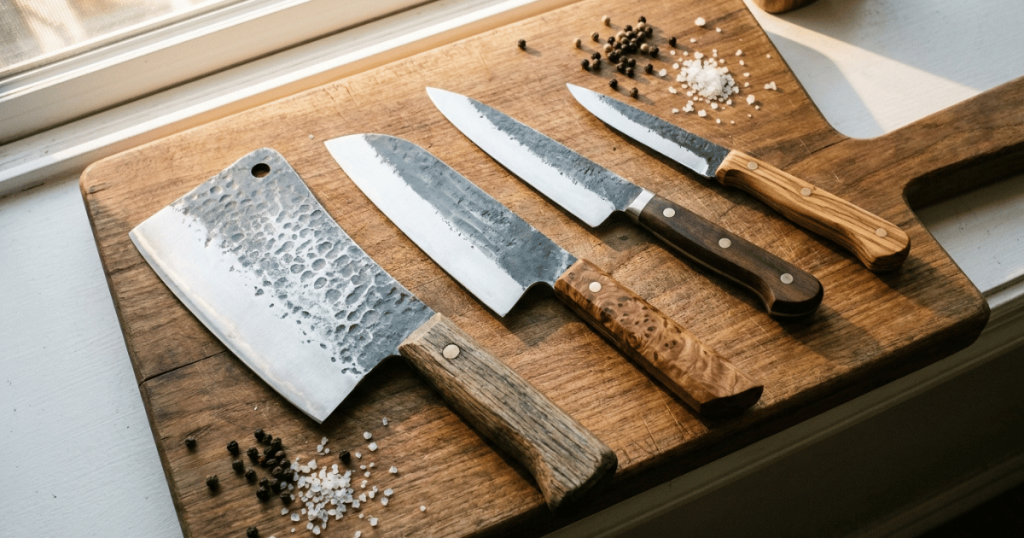
The three knives that cover most cooking
Before any specialist, get these right.
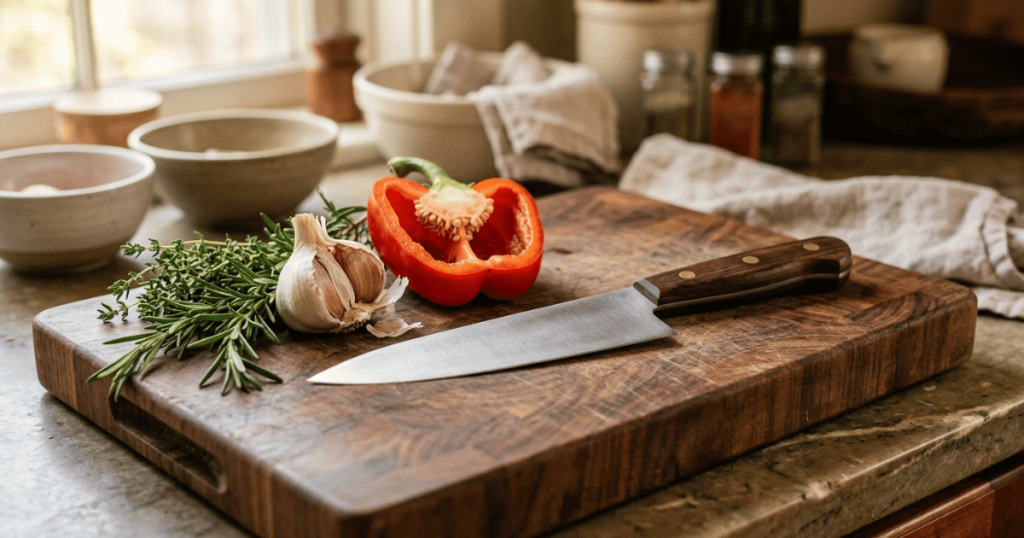
Chef’s knife. The general-purpose knife of Western kitchens: a pointed tip, a curved belly and enough height at the heel to keep your knuckles off the board. Wikipedia’s kitchen knife entry (read September 27, 2026) says chef’s knives are most commonly sold between 6 and 10 inches, with 8 inches the most common size. It chops, slices and minces most vegetables, herbs and boneless meat.
Paring knife. A short blade, which the same entry puts at usually 2 to 4 inches, for work where the food is in your hand or the cut is small: coring, trimming, hulling, segmenting citrus. A chef’s knife is too long and too tall for these jobs.
Serrated bread knife. Long, usually 8 to 12 inches per Wikipedia, with a toothed edge that bites through a hard crust before the blade reaches the soft crumb. A smooth edge tends to crush the loaf instead.
If you own these three and they are sharp, you can cook almost anything. The rest of this page is about when a specialist genuinely earns its space.
Types of kitchen knives at a glance
| Knife | Typical length (Wikipedia, where given) | Main job | What it can replace | What it cannot do well |
|---|---|---|---|---|
| Chef’s knife | 6 to 10 in, 8 in most common | General prep, rock chopping | Utility knife, most slicing | Peeling in the hand, bread crust |
| Santoku | 5 to 7 in | General prep, straight chopping | Chef’s knife for many cooks | Long single-stroke slices of large roasts |
| Paring knife | 2 to 4 in | In-hand and small work | Peeling tools, small utility work | Anything wider than the blade is long |
| Bread knife | 8 to 12 in | Crusty bread, soft interiors | Tomato knife, cake splitting | Fine dicing, precise tip work |
| Utility knife | 4 to 7 in | In-between jobs, sandwiches | Rarely needed if you own chef and paring | Heavy chopping |
| Boning knife | About 5 to 6 in | Separating meat from bone | Some fish work (flexible types) | Chopping, splitting bone |
| Fillet knife | Varies | Fish, following the spine | Some boning jobs | Heavy meat or joints |
| Carving or slicing knife | Varies, longer and narrower | Thin slices of cooked roasts | Chef’s knife for small roasts | General prep |
| Nakiri | Not given | Vegetables, straight chopping | Chef’s knife for produce-heavy cooks | Meat with bone, tip work |
| Chinese-style chef’s knife | Varies | Everyday prep, scooping food | Chef’s knife and bench scraper | Bones, unless built as a heavy cleaver |
| Meat cleaver | Light home version about 6 in | Chopping through joints and small bones | Nothing else in the drawer | Fine or precise work |
Western general-purpose knives
Chef’s knife
The curved belly lets the knife roll along the board, which suits fast, repeated chopping. Length is the main choice, and it matters more than most buyers expect. The trade-off is simple: a longer blade covers more food per stroke and handles large items, while a shorter blade is easier to control in a small space.
Utility knife
The utility knife sits between a paring knife and a chef’s knife, about 4 to 7 inches according to Wikipedia’s entry. It is handy for a sandwich, a block of cheese or a small onion when you do not want to get the big knife out. Honestly, most cooks who own a good chef’s knife and a paring knife rarely reach for it. Treat it as a comfort purchase, not a gap.
Carving and slicing knives
These are long, narrow blades for turning a cooked roast or ham into thin, even slices in one stroke. A narrow blade has less surface for meat to drag against. If you roast large cuts only at holidays, a sharp chef’s knife handles a small roast; the dedicated slicer earns its place when slices need to be long and uniform.
Japanese and Asian shapes
Santoku
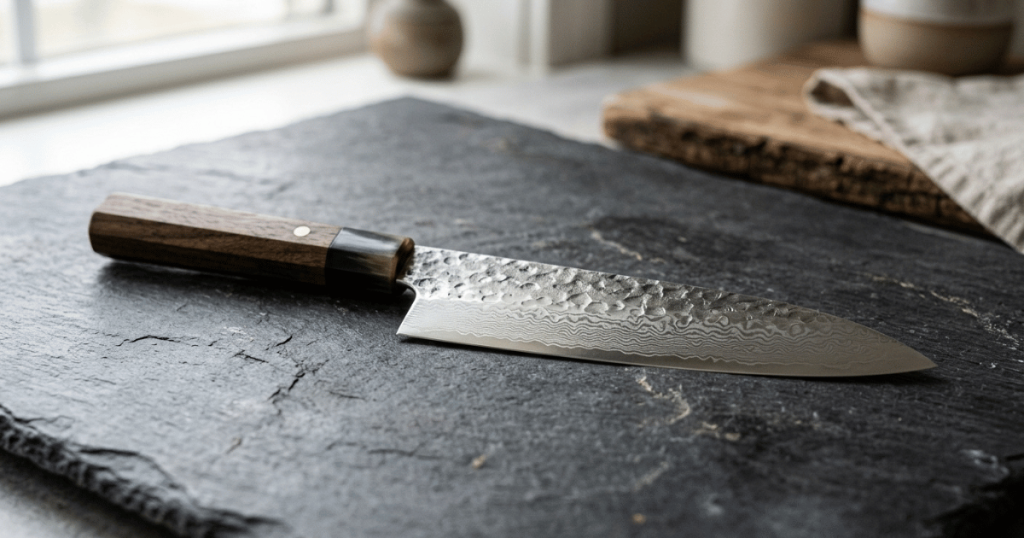
WÜSTHOF’s own guide, Asian-Style Knives 101 (read September 27, 2026), calls the santoku “the most frequently used knife in Japanese home kitchens,” with a “thinner, sharper blade than a Western-style chef’s knife” and a straight or slightly curved edge. It often carries a dimpled or scalloped edge to reduce sticking. The flatter edge suits a straight up-and-down chop more than a rocking one. For many home cooks it replaces the chef’s knife outright; for others it becomes a lighter second knife.
Nakiri
The same WÜSTHOF guide describes the nakiri as a vegetable knife with “a straight edge and a blunt, symmetrical tip,” noting that its shape prevents it from rocking during slicing. The flat edge meets the board along its full length, so a slice goes all the way through instead of leaving connected strips. It is a produce specialist. It has no point for tip work and is not built for bone.
Chinese-style chef’s knife and vegetable cleaver
This is the knife that looks like a cleaver but is not one. WÜSTHOF describes the Chinese-style chef’s knife as having a “wide, square blade” meant for everyday jobs such as mincing garlic or thinly slicing steak, and notes it can also be used to scoop food like a bench scraper. The thinner vegetable cleaver version, the chai dao, is described as lighter and built for produce. The practical warning: a thin Chinese vegetable cleaver is not a bone chopper. Driving it through bone can chip or bend the edge.
Gyuto, bunka, kiritsuke and the traditional single-bevel knives
A gyuto is the Japanese take on the Western chef’s knife, typically lighter and thinner. Bunka and kiritsuke are hybrid shapes with a flatter profile and an angled tip. The traditional knives, such as the yanagiba for slicing raw fish and the deba for breaking down fish, belong to a separate family: WÜSTHOF’s guide notes that traditional Asian-style knives are mostly single beveled, with one side angled and the other straight. That changes how they are sharpened, which we cover in sharpening a single-bevel knife.
Meat and fish specialists
Boning knife
A narrow, pointed blade, about 5 to 6 inches per Wikipedia’s entry, made to follow a bone and separate meat from it with little waste. Stiff versions suit larger cuts of meat; flexible versions bend around curves. It replaces nothing else in the drawer but does its one job far better than a chef’s knife, whose tall blade cannot turn in tight spaces.
Fillet knife
Similar in outline to a boning knife but more flexible, so it can ride along a fish’s backbone and under the skin. If you rarely buy whole fish, you do not need one. A flexible boning knife can cover occasional fish work.
Meat cleaver
A heavy, thick blade built to chop through joints and small bones by weight. Wikipedia puts the light home version at about 6 inches. The thick edge is deliberately robust rather than keen, which is why it is poor at fine work. It is the only knife in the drawer meant to meet bone with force.
How the type changes sharpening
Knife type decides more than the job. It decides how the edge is maintained.
- Double-bevel Western knives (chef’s, paring, utility, boning) are sharpened on both sides and are the easiest to maintain on a stone or a guided system.
- Thin Japanese double-bevel knives (santoku, gyuto, nakiri, bunka) are usually ground at lower angles than Western knives. They reward whetstones and punish aggressive machines. See how to sharpen Japanese kitchen knives without chipping.
- Serrated knives cannot be sharpened like a straight edge. Each scallop needs attention on its own, which we walk through in how to sharpen a serrated bread knife.
- Single-bevel traditional knives have a flat or hollow back and an angled front. Sharpening them like a Western knife ruins the geometry.
What the knife block will not tell you
Most blocks sell slot count, not coverage. A 15-piece set usually includes steak knives, a utility knife and a second small knife that overlap with your paring knife. None of that is wasted if you use it, but it is not the reason to buy.
A better rule: start with the three core knives, then add a specialist only when you notice the same job going badly again and again. Loaves collapsing means you need a better bread knife. Hacking at a chicken carcass means you need a boning knife. If nothing is going wrong, you do not need another knife. For guidance on choosing within each type by steel and budget, see our overview of how to choose kitchen knives by type, steel and budget.
FAQ
What are the 3 most important types of kitchen knives?
A chef’s knife (or a santoku), a paring knife and a serrated bread knife. Together they cover general chopping and slicing, small in-hand work, and crusty or soft foods that a smooth edge would crush. Every other knife is a specialist.
What is the difference between a chef’s knife and a santoku?
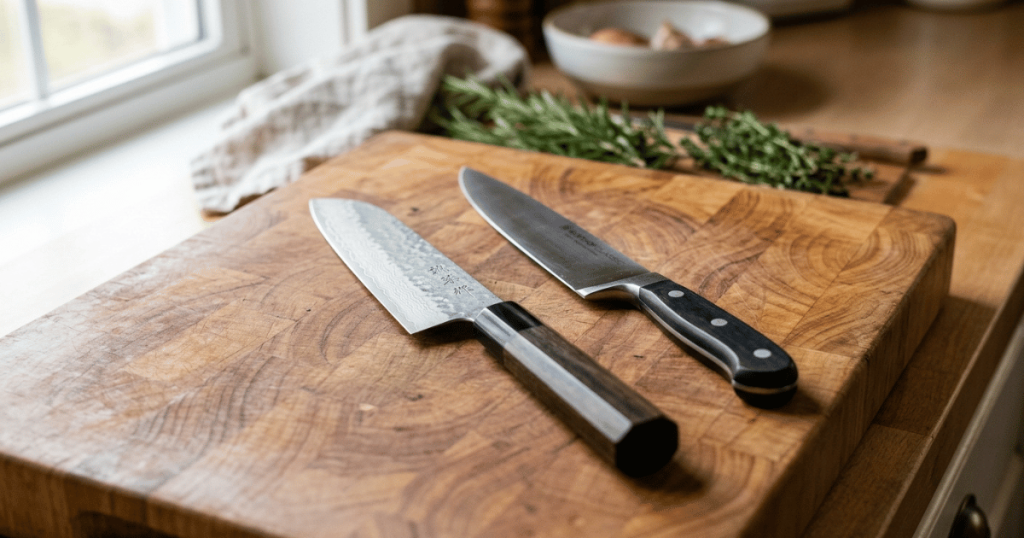
A chef’s knife has a curved belly and pointed tip that suit rocking cuts, and it is commonly 6 to 10 inches long. A santoku is usually shorter, thinner and flatter, which suits straight up-and-down chopping. Both are general-purpose knives, and most cooks need only one of them.
Do I need a utility knife if I have a chef’s knife and a paring knife?
Usually not. A utility knife sits between the two in size, so it duplicates work that one of them already handles. It is convenient for small tasks like sandwiches or cheese, but it rarely fills a real gap.
Can a nakiri or Chinese vegetable cleaver cut through bone?
No. Both are thin vegetable knives, and forcing them through bone risks chipping or bending the edge. Bone work calls for a thick, heavy meat cleaver built for it.
Which kitchen knife types need special sharpening?
Serrated knives, which need each scallop sharpened individually, and traditional single-bevel Japanese knives, which are sharpened differently on each side. Thin Japanese double-bevel knives also do best on whetstones rather than aggressive machines.