Specialty kitchen knives are single-purpose blades such as the tomato knife, soft and hard cheese knives, the curved peeling knife and the grapefruit knife. Most of them are worth owning only if you do their one job often. A sharp chef’s knife or a serrated bread knife already covers the tomato knife’s work. A soft cheese knife and a hard cheese knife earn a place if you serve cheese regularly, because their blade shapes solve problems a normal edge cannot. The peeling and grapefruit knives are niche tools for cooks who do that exact task every week.
Below, each specialty knife gets the same three questions: what it replaces, what it cannot do, and what it costs you to maintain.
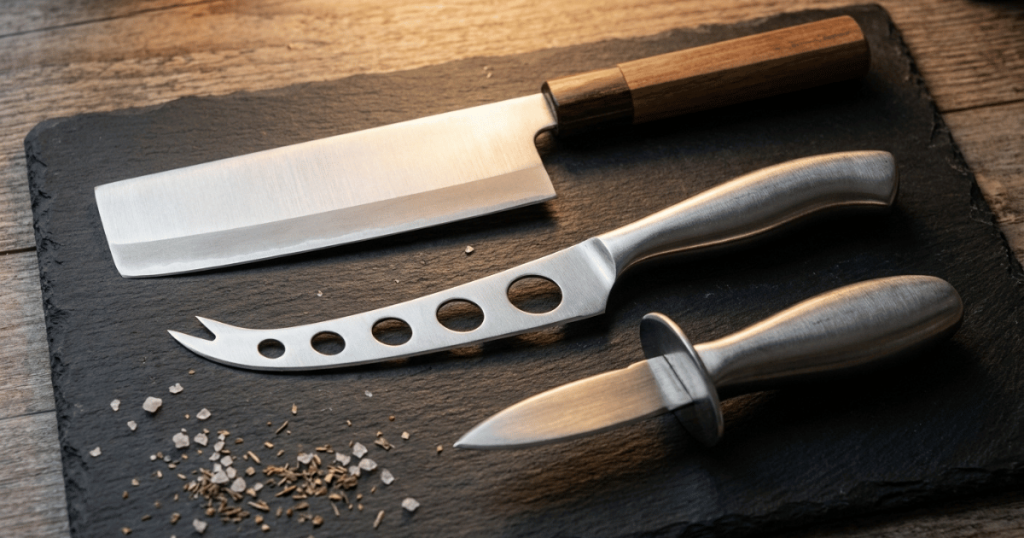
Specialty kitchen knives at a glance
| Knife | What it does | What already covers it | Verdict for most home cooks |
|---|---|---|---|
| Tomato knife | Pierces slippery skins, forked tip lifts slices | A sharp chef’s knife or a bread knife | Optional |
| Soft cheese knife | Cuts sticky soft cheese without it clinging | Nothing does this as well | Worth it if you serve soft cheese often |
| Hard cheese knife | Splits or slices firm cheese | A sturdy chef’s knife, with care | Worth it for regular hard cheese |
| Peeling (bird’s beak) knife | Peels and shapes round produce | A paring knife or a peeler | Niche |
| Grapefruit knife | Frees citrus segments from the rind | A paring knife, more slowly | Niche |
The table is a starting point. The sections below explain why each blade is shaped the way it is, since the shape is what decides whether a knife is a real tool or a duplicate.
The tomato knife: a fix for a dull edge
The tomato knife is a short serrated knife, usually with a forked tip. Wüsthof’s own product page for its Classic tomato knife (read October 2, 2026) describes it as “the knife with a forked tip for tomatoes, cheese and fruit,” with a “finely serrated edge” that “cuts smoothly through firm top layers such as rinds, crusts or skin,” and a forked tip “designed to pick up the small slices.”
The reason a serrated edge works on a tomato is the same reason it works on bread. A tomato skin is smooth and taut. A smooth edge that has lost some keenness slides across it and squashes the fruit before it breaks through. The points of a serration concentrate force on a tiny area, so they pierce the skin with little pressure.
That also explains why the tomato knife is optional. A properly sharp smooth edge bites into tomato skin without sliding. If your chef’s knife squashes tomatoes, the knife is telling you it needs attention, and our guide on how to tell if a knife is sharp ranks the ways to check. Your bread knife will also slice a tomato cleanly.
Earns a slot if: you slice a lot of tomatoes or soft fruit and like the forked tip for serving.
Skip it if: you keep your chef’s knife sharp and own a bread knife.
The soft cheese knife: holes that stop the cling
Soft cheese is a different problem from tomato. The cheese is not hard to cut; it is hard to let go of. A wide, flat blade presses against a large area of sticky paste, and when you lift the knife, the cheese comes with it.
The soft cheese knife solves this with geometry. Wüsthof’s page for its Classic soft cheese knife (read October 2, 2026) describes a “narrow, sharp blade” that “glides through the creamy cheese without pulling or crushing it,” and states that “the classic holes in the blade of this Cheese Knife ensure that stickier cheese does not cling to it.” It names Brie, Camembert and blue cheese as the intended targets.
Fewer square inches of steel in contact with the cheese means less surface for it to adhere to. That is a job a chef’s knife cannot match, because a chef’s knife is wide by design.
The same Wüsthof page is also clear about the limit: “Since the blade is extremely thin, it is not recommended for use on firmer, semi-hard cheeses; ideally, a hard Cheese Knife should be used for these.”
Earns a slot if: you serve soft or blue cheese often.
Skip it if: soft cheese is an occasional treat.
The hard cheese knife: a wedge, not a slicer
Hard and aged cheeses behave differently again. They are firm, sometimes crumbly and crystalline, and a thin blade pushed through them can bind, flex or snap at the tip.
Hard cheese knives come in a few shapes. Some are heavy, rigid blades with a handle above the edge so you can press straight down with both hands. The short, pointed knife used for aged cheeses such as Parmesan is pushed into the wheel and twisted, so the cheese breaks along its own structure rather than being sliced.
The material-science reason is that these tools use thickness and stiffness instead of a fine edge. A thin, hard kitchen edge is built for low-resistance food. Levering it through a hard cheese puts sideways stress on the edge and tip, which is the kind of load that chips a thin, hard blade. A thick wedge has the cross-section to take that load.
Earns a slot if: you regularly break up or portion hard cheese.
Skip it if: you mostly grate hard cheese, which needs a grater rather than a knife.
The peeling knife: the bird’s beak
A peeling knife, often called a bird’s beak or tourné knife, is a short paring knife with a blade that curves downward like a claw. The curve follows the outside of round produce, so the edge stays in contact with a potato or apple as you rotate it.
It is a refinement of the paring knife rather than a separate category. The straight paring knife does almost everything the bird’s beak does, with a little more effort on very round shapes. Restaurant kitchens use the bird’s beak for decorative cuts that turn vegetables into uniform shapes. At home, that is rarely needed.
The curved edge is also harder to sharpen than a straight one, because the stone or rod has to follow the curve through a tight radius. If you already struggle to keep a straight paring knife sharp, a curved one is more work, not less.
Earns a slot if: you peel or trim a lot of round produce by hand.
Skip it if: you own a paring knife and a vegetable peeler.
The grapefruit knife: one fruit, one shape
A grapefruit knife has a short, curved blade designed to slide between the flesh and the rind of a halved citrus fruit, freeing the segments in one pass around the edge. Many are serrated so the blade grips the membrane rather than sliding off it.
It does one job well and nothing else. A paring knife can do the same job, more slowly, by working around the fruit in short cuts. If halved grapefruit is a regular breakfast, the dedicated knife saves time. If not, it is a drawer item you will forget you own.
The maintenance cost of serrated specialty knives
Several of these knives are serrated, and that matters for upkeep. A serrated edge stays usable for a long time, because the recessed part of each scallop is protected from the board and the points do much of the work. When it does dull, it cannot be sharpened like a smooth edge. Each scallop has to be worked individually with a narrow rod, as our guide to sharpening a serrated knife one tooth at a time explains.
Serrated knives should also stay out of most pull-through sharpeners, which are made for smooth edges and can damage the teeth. Our guide to using a pull-through sharpener covers what to keep out of one. Every serrated specialty knife you add is another edge that needs this slower method when it eventually dulls.
How to decide on any specialty knife
The test for specialty kitchen knives is the same test for any knife beyond the basic three:
- Name the task. Not “it might be useful” but “I do this every week.”
- Check what already covers it. If a sharp chef’s knife, paring knife or bread knife does the task acceptably, a new knife saves little.
- Check what the new knife cannot do. Most specialty blades are worse than a general knife at everything outside their one job.
- Count the maintenance. Serrated and curved edges take more effort to sharpen than straight ones.
If you are still building the core set, our guide to the best kitchen knives by type, steel and budget is the better place to start. Specialty knives come after the core three, not instead of them.
A note on steel
Specialty knives from the same maker usually share the steel and heat treatment of its general knives. Wüsthof, for example, lists 58 HRC on the product pages for both the tomato knife and the soft cheese knife cited above. Because these knives do light work, the exact steel matters less than it does on a chef’s knife. A tomato knife or a cheese knife rarely sees the kind of edge stress where a premium steel earns its price. Put the money into the knife that does the most cutting.
FAQ
Is a tomato knife worth buying?
Only if you slice a lot of tomatoes or soft fruit and like the forked tip for serving. A sharp chef’s knife or a serrated bread knife cuts tomatoes cleanly. A chef’s knife that squashes tomatoes usually needs sharpening.
Why do cheese knives have holes?
The holes reduce how much of the blade touches the cheese, so soft, sticky cheese clings less. Wüsthof states on its soft cheese knife page that the holes keep stickier cheese from clinging to the blade.
Can I use a soft cheese knife on hard cheese?
Wüsthof does not recommend its soft cheese knife for firmer or semi-hard cheeses because the blade is very thin. Use a hard cheese knife, which is thicker and stiffer.
What is a bird’s beak knife used for?
It is a short, curved paring knife used to peel and shape round produce. A straight paring knife and a vegetable peeler cover most of the same work at home.
Can I sharpen specialty serrated knives in a pull-through sharpener?
Generally no. Most pull-through sharpeners are made for smooth edges. Serrated knives are sharpened scallop by scallop with a narrow rod.