Wusthof vs Henckels comes down to one question first: which Henckels? If you mean a Zwilling forged line such as Zwilling Pro, the two are close. Both are forged in Germany, both list hardness in the high 50s on the Rockwell C scale, and both makers guide owners to an edge of roughly 15 degrees per side or a little less. If you mean a knife sold under the Henckels brand itself, it is Zwilling’s lower-priced everyday line, and its Classic chef’s knife is made in Spain. Wüsthof (often typed Wusthof) is a single brand whose forged knives are all made in Solingen.
So the real comparison is not two logos. It is Wüsthof against one of two different product families from the same parent company. This page sorts that out first, then compares the specs each maker publishes, then explains what those numbers mean at the edge. Every specification below comes from the maker’s own page, read on October 2, 2026. We did not test these knives; we compare what the makers state.
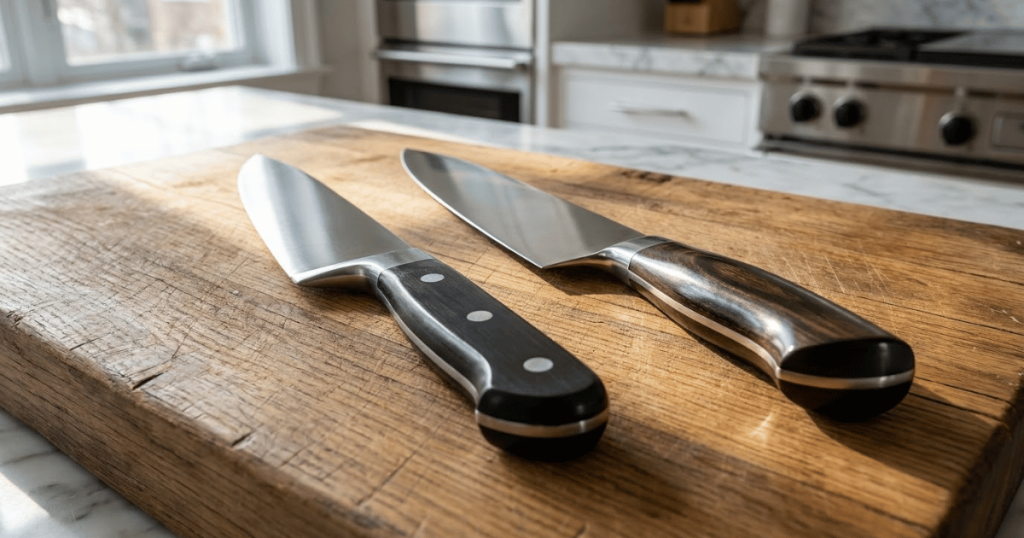
Which Henckels? The confusion that decides the comparison
Henckels is not one thing. Zwilling J.A. Henckels runs a family of brands, and two of them, ZWILLING and HENCKELS, share the J.A. Henckels heritage.
Zwilling’s own page on ZWILLING and HENCKELS (read October 2, 2026) lays out the split. ZWILLING is the premium brand, dating to 1731, with “cutlery crafted in Solingen, Germany since 1731” and “expert, German-made engineering.” HENCKELS, established in 1895, is positioned “For every kitchen,” with the emphasis on “quality, affordability, durable design.” The Henckels side of that page says the brand is “rooted in German engineering” and does not say where its knives are made.
That is why so many Wusthof vs Henckels comparisons seem to disagree. Some pit Wüsthof Classic against a Zwilling forged line. Others pit Wüsthof against a knife sold under the Henckels brand. They reach different verdicts because they are comparing different knives from different tiers. Retail listings add to the muddle by printing “Zwilling J.A. Henckels” on one product and “J.A. Henckels International” or plain “Henckels” on another.
The practical rule: read the brand name printed on the blade and at the top of the product page. If it says ZWILLING, you are in Wüsthof’s tier. If it says HENCKELS, you are in the everyday tier.
Wusthof vs Henckels: the specs side by side
The table compares three 8 inch chef’s knives that represent Wüsthof and both Henckels tiers. Each figure is quoted from the maker’s own product page; “not stated” means the page we read does not list it.
| Wüsthof Classic 8″ Chef’s Knife | Zwilling Pro 8″ Chef’s Knife | Henckels Classic 8″ Chef’s Knife | |
|---|---|---|---|
| Brand owner | Wüsthof (family owned) | Zwilling J.A. Henckels | Zwilling J.A. Henckels |
| Construction | Forged, full bolster | “SIGMAFORGE – Single piece, forged knife” | “One-piece forged construction” |
| Hardness | 58 HRC | 55 to 58 HRC | Not stated |
| Edge angle | 14° per side (FAQ); 14.5° (Q&A and PEtec page) | Not stated on product page | Not stated |
| Country of origin | Germany | “Made in Germany” | “Made in Spain” |
| Handle | Three rivets, synthetic | Full tang, triple riveted | Full tang, triple riveted |
| Warranty wording | “Limited Lifetime Warranty” | Lifetime warranty | “Fully guaranteed against defects in material and/or craftsmanship” |
Sources: the Wüsthof Classic 8″ Chef’s Knife product page, Zwilling’s Pro 8 inch chef’s knife page on zwilling.com, and the Henckels Classic 8 inch chef’s knife page on henckels.com, all read October 2, 2026. Warranty terms differ in wording, so read each maker’s full warranty before relying on it.
Two details in that table are worth slowing down for. Wüsthof publishes a single hardness number, while Zwilling publishes a range. And Wüsthof’s own pages differ by half a degree on the edge angle: the FAQ on the Classic product page gives 14° per side for standard blades, while a Q&A answer on the same page and Wüsthof’s PEtec explainer both say 14.5°.
What 58 HRC versus 55 to 58 HRC actually means
Hardness is the number shoppers fixate on, so it helps to know what it controls.
Rockwell C hardness measures how well steel resists being dented. At a knife edge, that translates into how well the edge resists rolling over. Metallurgist Larrin Thomas puts the mechanism plainly in his Knife Steel Nerds article “What is Edge Stability?” (read October 2, 2026): “If the stress applied to the edge exceeds the yield stress of the material, then the edge will be permanently deformed, or rolled.” Harder steel has a higher yield stress, so it takes more force to roll it.
The same article names the cost: “Higher hardness is required to avoid edge rolling but higher hardness also reduces toughness which increases the possibility of edge chipping.” That is the whole German knife bargain in one sentence. A German chef’s knife sits at moderate hardness on purpose. When it fails, it tends to roll rather than chip, and a rolled edge can usually be pushed back into line on a honing steel.
Now read the two numbers again. Wüsthof says 58. Zwilling says 55 to 58 for the Pro. A range describes the band the heat treatment aims for, and a single figure is a nominal value; neither tells you what one particular knife measured. What the makers’ own figures do show is that Wüsthof’s stated value sits at the top of Zwilling’s stated band. You cannot conclude from published specs alone that one keeps its edge longer in your kitchen, and we do not claim it.
For the Henckels Classic, the henckels.com page we read lists no hardness at all. Treat that as unknown, not as equal to the others.
Edge angle: 14.5 degrees versus about 15
Edge angle shapes how a knife feels in the first weeks at least as much as hardness does.
Wüsthof’s PEtec page (read October 2, 2026) describes PEtec as a “patented, laser-controlled sharpening process” and states an edge of 14.5° per side for Wüsthof knives, against roughly 20° per side for other manufacturers’ kitchen knives. Zwilling does not list an angle on the Pro product page, but its own US care guide on knife sharpening (read October 2, 2026) tells owners to hold a honing steel at “approximately 15°” for ZWILLING knives, and at 9 to 12° for Santoku, Miyabi and Kramer knives.
So on the makers’ own guidance, both German edges sit at or just under 15 degrees per side. A more acute angle cuts with less effort but has less steel behind it, which is the trade-off Thomas describes: “Thinner, sharper, more acute edges are not as strong as heavier edges.” Half a degree is not the difference between a German and a Japanese edge. It is a detail you match when you sharpen.
If you own either brand, our guide on what angle to sharpen kitchen knives explains how to find and keep the angle your knife left the factory with.
Where each line is made
Origin is stated per line, not per brand, and it is the fact most comparisons get wrong.
Wüsthof’s history page (read October 2, 2026) says Johann Abraham Wüsthof founded the company in 1814, that it “remains in family hands,” and that the seventh generation runs it today. It also says: “We have stayed loyal to the City of Blades, and still produce our forged knives only in Solingen, Germany.” Notice the qualifier. The statement covers forged knives, which is what most cooks mean by a Wüsthof chef’s knife.
For the Zwilling Pro, the product page says “Made in Germany.” For the Henckels Classic chef’s knife, henckels.com lists “Made in Spain” and describes the steel as “High-quality German stainless steel.” Both statements can be true at once: German steel, Spanish manufacture.
If country of origin matters to you, check it on the specific product page every time. A brand name is a statement about ownership and design. It is not a statement about the factory.
How the two feel in the hand
Specs explain some of the difference. Geometry and weight explain the rest.
All three knives in the table are forged, with a bolster or heel and a riveted handle. That shared design is what makes a German chef’s knife feel solid and slightly heavy at the heel compared with a thin Japanese gyuto. Wüsthof’s FAQ on the Classic page explains that “Forged knives include a bolster, which helps to balance the knife.” Zwilling describes the Pro’s “curved bolster” as “an extension of the hand,” and its blade as having a “gently curved belly ideal for rocking cuts, straight back excels at chopping.”
Which you prefer is a matter of hand size and habit, not quality. If you can, hold both before you buy. A knife that is technically excellent and uncomfortable in your hand will spend its life in a drawer.
What neither brand’s marketing tells you
- German edges need regular honing. Moderate hardness is a design choice, and its price is an edge that rolls. That is maintenance, not a defect. Our guide to using a honing steel covers angle, pressure and strokes.
- A fine chef’s knife edge is not for bone. Twisting any thin edge against bone or a frozen block can chip it, even at moderate hardness. If that happens, see how to fix a chipped knife.
- “Dishwasher safe” on a spec sheet is not a recommendation. The Henckels Classic page says “Dishwasher safe but Hand washing recommended,” and Wüsthof’s Classic page says “Wash by hand and immediately towel-dry.”
- Missing specs are missing data. The Henckels Classic page does not publish a hardness figure. That is not a hidden advantage, and it is not a hidden flaw. It is unknown.
Who should choose which
- Choose Wüsthof if you want one brand whose forged knives are, by its own statement, all made in Solingen, with a published single hardness figure and a slightly more acute factory edge.
- Choose a Zwilling forged line if you want the same tier from the other big Solingen name. On published specs, the gap between Wüsthof Classic and Zwilling Pro is small.
- Choose Henckels if price matters more than origin and you are happy with a forged, full tang knife made in Spain from German steel, with fewer published specs.
None of these is the right answer for every cook. If you are still deciding between German and Japanese styles altogether, our guide to the best kitchen knives by type, steel and budget starts one step earlier.
FAQ
Is Wusthof better than Henckels?
It depends which Henckels. Against Zwilling’s forged lines such as Zwilling Pro, the published specs are close: both forged in Germany, both in the high 50s HRC. Against the Henckels everyday brand, Wüsthof is the higher tier, and the Henckels Classic chef’s knife is made in Spain.
Are Henckels and Zwilling the same company?
Yes. Zwilling’s own page describes ZWILLING and HENCKELS as two distinct brands from the Zwilling J.A. Henckels heritage. ZWILLING is the premium Solingen brand; HENCKELS is positioned for everyday cooks and affordability.
What angle are Wusthof and Henckels knives sharpened to?
Wüsthof states 14.5° per side on its PEtec page and 14° per side in the FAQ on its Classic chef’s knife page. Zwilling’s care guide says to hone ZWILLING knives at approximately 15°. Match whichever your knife came with.
Where are Henckels knives made?
It depends on the line. Zwilling Pro is listed as made in Germany. The Henckels Classic chef’s knife is listed as made in Spain from German stainless steel. Check the product page for the specific knife.
Do Wusthof and Henckels knives chip or roll?
At moderate hardness, German edges are more likely to roll than chip, because toughness stays higher. A rolled edge can usually be straightened on a honing steel; a chip needs sharpening.