Wusthof Classic vs Ikon is mostly a question of handle and bolster, not blade. On Wüsthof’s own spec pages, the Classic and Classic Ikon 8″ chef’s knives are both forged, both 58 HRC, both made in Germany, and within about a tenth of an ounce of each other in weight. The Classic has a full bolster and a traditional riveted handle; the Classic Ikon has a contoured handle and a double bolster whose heel end lets you sharpen the whole edge. The Gourmet is the real step down: laser-cut rather than forged, 56 HRC, no bolster, and about three ounces lighter.
That is a cleaner answer than most comparison pages give, because those pages disagree with each other on the details: whether the Ikon is lighter, whether its blade is harder, what kind of bolster it has. Wüsthof publishes the answers. Everything below is quoted from wusthof.com, read on October 2, 2026. We did not test these knives; we compare what the maker states.
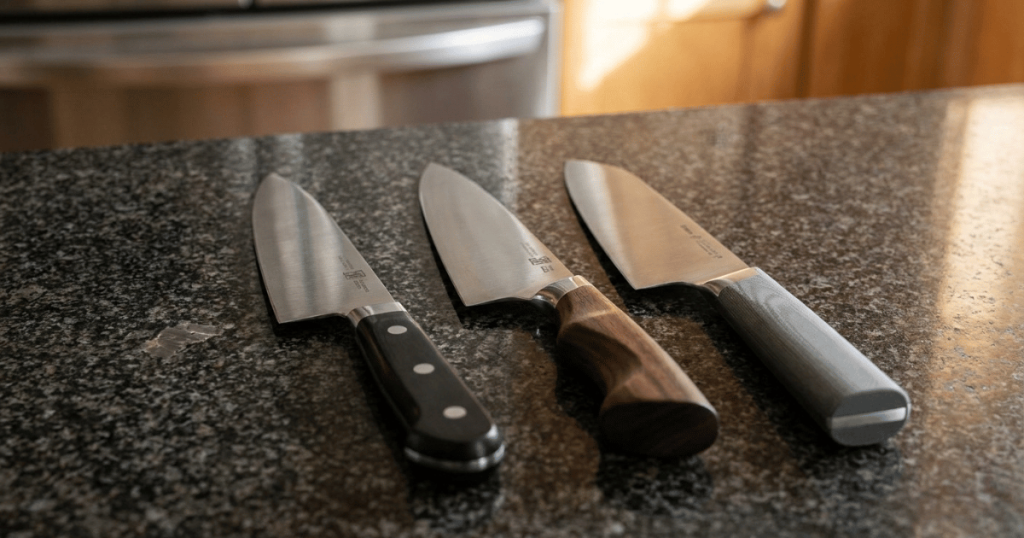
The three lines at a glance
Each figure is for the 8″ chef’s knife in that line and comes from Wüsthof’s own product or series pages.
| Classic | Classic Ikon | Gourmet | |
|---|---|---|---|
| Manufacturing | Forged | Forged | Non-forged (laser-cut) |
| Hardness | 58 HRC | 58 HRC | 56 HRC |
| Weight, 8″ chef’s knife | 9.45 oz | 9.56 oz | 6.49 oz |
| Bolster | Full bolster | Double bolster | None |
| Handle length | 4.5 in | 4.5 in | 5.3 in |
| Handle material | Synthetic, riveted | Synthetic (POM) | Synthetic (POM), triple riveted |
| Country of origin | Germany | Germany | Germany |
Sources: Wüsthof’s Classic Ikon series page and Gourmet series page, both of which include a comparison table, plus the Classic, Classic Ikon and Gourmet 8″ chef’s knife product pages, all read October 2, 2026.
Three things in that table settle arguments you will find elsewhere. The Classic Ikon is not lighter than the Classic; Wüsthof lists it 0.11 oz heavier. Its blade is not harder; both list 58 HRC. And every one of the three is listed as made in Germany.
Wusthof Classic vs Ikon: same blade spec, different hand
If the steel spec is identical, what does the extra money for Classic Ikon buy? Wüsthof’s answer is the handle and the bolster.
The Classic Ikon series page describes the knives as “perfectly balanced” and as feeling “substantial in the hand, thanks to their ergonomic handle, double bolster design, and slightly heavier build.” The handle is contoured and made of POM, where the Classic uses a traditional handle with three exposed rivets.
The bolster is the part worth understanding. A bolster is the thick band of steel where blade meets handle. On a forged knife it adds weight near the hand, which is why Wüsthof’s FAQ says “Forged knives include a bolster, which helps to balance the knife.” The Classic’s full bolster runs down to the edge at the heel. The Classic Ikon’s double bolster splits that weight: there is a bolster at the front of the handle and another at the back. Wüsthof’s product page calls the front one a “half bolster” that “reduces the weight,” and its series page says the design “allows for sharpening the entire blade length.”
That last point is the practical one. A full bolster that reaches the edge sits in the way of a whetstone at the heel. Over years of sharpening, the edge wears back while the bolster does not, and the heel can stop meeting the board. A half bolster at the heel avoids that. If you sharpen on stones, this matters more than the handle shape. Our step by step guide to sharpening kitchen knives with a whetstone shows where the heel sits in the stroke.
One naming trap: Wüsthof also sells a line called simply “Ikon.” In a Q&A on the Classic Ikon page, Wüsthof explains: “Our Classic Ikon line has a synthetic handle made of POM” while “Our Ikon line has a real African Blackwood handle.” Same idea, different handle material.
Classic vs Gourmet: forged against laser-cut
The Gourmet is where the blade itself changes, and Wüsthof is direct about how.
Its FAQ on the Classic product page states: “Forged knives go through over 40 steps in our factory to create the top quality blades WÜSTHOF has to offer.” And: “Laser-cut stamped blades go through 14 steps in our factory, and are more economically priced. They are lighter in weight, and do not have a bolster.” The Gourmet product page describes its chef’s knife as “laser-stamped from a single piece of high-carbon, stain-resistant WÜSTHOF steel” and “uniquely lightweight.”
In numbers from Wüsthof’s own table: 6.49 oz for the Gourmet 8″ chef’s knife against 9.45 oz for the Classic, and 56 HRC against 58. The Gourmet’s handle is also longer, at 5.3 inches against 4.5.
There is one claim to clear up. Some comparison sites say the Gourmet misses out on Wüsthof’s laser-guided edge. Wüsthof says “All forged knives are manufactured using PEtec,” which does not include the Gourmet by name, but the Gourmet series page separately lists “Laser-controlled precision sharpening” for that line. So the Gourmet does get a laser-controlled edge by Wüsthof’s own description; what Wüsthof does not say is whether it is the same PEtec process.
Why 56 HRC instead of 58: the metallurgy
Two points of Rockwell hardness sound trivial. They are a deliberate design choice.
Hardness controls how well an edge resists rolling. Metallurgist Larrin Thomas, in his Knife Steel Nerds article “What is Edge Stability?” (read October 2, 2026), explains: “If the stress applied to the edge exceeds the yield stress of the material, then the edge will be permanently deformed, or rolled.” Harder steel resists that better. But he also names the cost: “Higher hardness is required to avoid edge rolling but higher hardness also reduces toughness which increases the possibility of edge chipping.”
A 56 HRC Gourmet edge will, in general terms, roll a little more readily than a 58 HRC Classic edge, and will respond well to a honing steel. Wüsthof describes the Gourmet blades as “laser-cut and toughened,” which fits a lighter blade tuned toward resilience rather than maximum hardness. What we cannot tell you from published specs is how many more meals one edge lasts than the other in your kitchen. Wüsthof does not publish that comparison, and we will not invent one.
Whatever the line, keep the edge where Wüsthof set it. Wüsthof’s FAQ gives 14° per side for its standard blades and 10° per side for Asian-style blades such as Santokus and Nakiris. Our guide on what angle to sharpen kitchen knives explains how to find and hold yours.
What the comparison pages get wrong
The search results for this comparison disagree with each other in three places. Here is what Wüsthof itself says on each.
- “The Ikon is lighter.” Wüsthof lists the Classic Ikon 8″ chef’s knife at 9.56 oz and the Classic at 9.45 oz. The half bolster “reduces the weight” at the heel, but the knife overall is not lighter.
- “The Ikon blade is harder.” Wüsthof lists both at 58 HRC.
- “Half bolster or double bolster?” Both. Wüsthof’s series table calls it a double bolster, and its product page describes the front part as a half bolster.
This is why the maker’s own spec table should be your first stop, not a summary of it.
What none of the three will do for you
- None is a bone or frozen-food knife. A chef’s knife edge at 56 or 58 HRC can still chip or roll if twisted against bone. Use the right tool.
- Honing is part of owning any of them. German edges at this hardness are designed to roll before they chip, and a few strokes on a steel bring them back. Our guide to using a honing steel covers angle and pressure.
- Hand washing is the maker’s instruction. The care instructions on all three product pages say to wash by hand and towel-dry immediately, and to avoid abrasive sponges and soaking.
- A lighter knife is not a lesser knife for everyone. If you do long prep sessions or have smaller hands, the Gourmet’s 6.49 oz may suit you better than three extra ounces of forged steel.
Who each line suits
- Wüsthof Classic suits cooks who want the traditional forged German chef’s knife, with a full bolster and a riveted handle, and who accept that the bolster at the heel will need attention after many years of sharpening.
- Wüsthof Classic Ikon suits cooks who want the same forged 58 HRC blade with a contoured handle and a heel that stays sharpenable along its full length, and who are paying for feel rather than for a different blade.
- Wüsthof Gourmet suits cooks who want a lighter, laser-cut knife from the same maker, made in Germany, with a slightly softer edge and no bolster.
None of these is the right answer for everyone. If you are still deciding between a German and a Japanese style, our guide to the best kitchen knives by type, steel and budget starts one step earlier.
FAQ
What is the difference between Wusthof Classic and Classic Ikon?
The handle and bolster. Wüsthof lists both 8″ chef’s knives as forged, 58 HRC and made in Germany. The Classic has a full bolster and a traditional riveted handle; the Classic Ikon has a contoured POM handle and a double bolster with a half bolster at the heel.
Is Wusthof Classic Ikon lighter than Classic?
No. Wüsthof’s own table lists the Classic Ikon 8″ chef’s knife at 9.56 oz and the Classic at 9.45 oz.
Is Wusthof Gourmet forged?
No. Wüsthof lists the Gourmet as non-forged, “laser-stamped from a single piece” of Wüsthof steel, at 56 HRC with no bolster.
What is the difference between Wusthof Ikon and Classic Ikon?
The handle material. Wüsthof says the Classic Ikon line has a synthetic POM handle and the Ikon line has an African Blackwood handle.
Are all Wusthof knives made in Germany?
All three lines on this page list Germany as the country of origin on Wüsthof’s product pages. Wüsthof says it produces its forged knives only in Solingen; for any other product, check that item’s own page.