Kitchen shears vs knife comes down to how each tool cuts. For cutting out a chicken backbone, snipping through cartilage, trimming fat and skin, or cutting herbs and twine, kitchen shears are usually the better tool, because two blades closing past each other with leverage do the work without loading a thin knife edge. For long, smooth cuts, such as taking a breast off the bone or slicing cooked meat, a knife is better. A mezzaluna is a specialist herb chopper, and an oyster knife is a prying tool that only shares the name “knife.”
This page explains the mechanics behind each answer, then looks at the two other tools at the edge of the knife drawer.
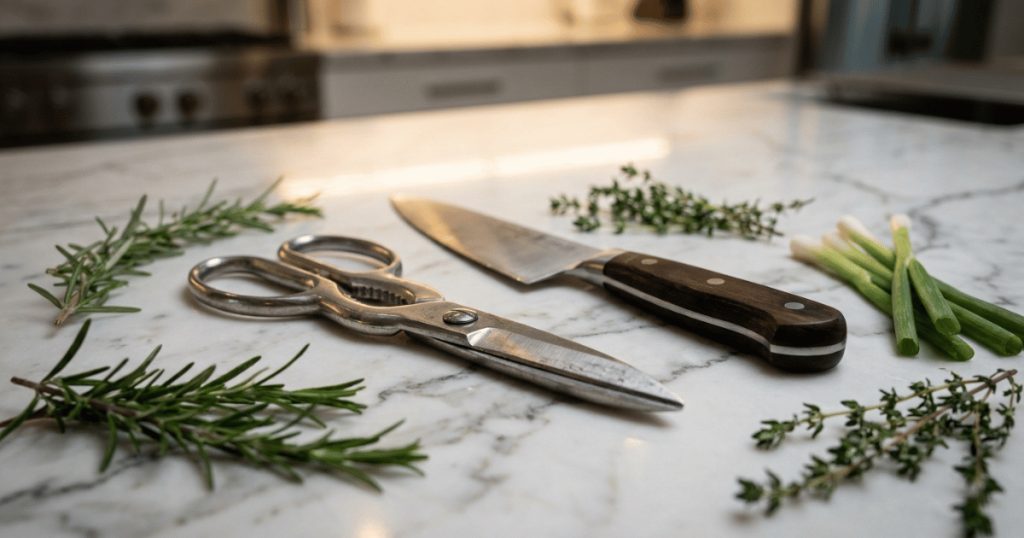
How a knife cuts, and how shears cut
A knife cuts with a single thin edge. The edge concentrates force on a narrow line, and the blade behind it acts as a wedge that pushes the food apart. That works beautifully on vegetables and boneless meat. It works badly when the food resists hard, because the thin edge then has to carry a heavy, often sideways load.
Shears cut differently. Two blades slide past each other, and the material between them fails in shear, like paper between scissors. The pivot acts as a lever: force applied at the handles is multiplied near the pivot, so the base of the blades can bite through cartilage and small bones that would stop a knife.
That difference shapes the edges themselves. A shear blade’s edge is ground much steeper than a kitchen knife edge, because the cutting comes from the two blades passing, not from a fine edge wedging into the food. A steeper edge is far less likely to chip. A knife edge has to be thin to cut well, and the thinner and harder an edge is, the more easily it chips when it meets bone or is twisted.
Kitchen shears vs knife for poultry
Poultry is where the comparison is most practical.
| Task | Better tool | Why |
|---|---|---|
| Cutting out the backbone (spatchcocking) | Shears | Leverage through ribs and cartilage, no strain on a thin edge |
| Splitting wings at the joint, trimming tips | Shears | Short cuts in tight spots |
| Trimming fat and loose skin | Shears | Snips cleanly without sliding on slippery skin |
| Removing a breast from the bone | Knife | Long, controlled cut along the bone |
| Separating thigh from carcass at the joint | Knife or shears | A knife follows the joint; shears cut the skin and cartilage around it |
| Slicing cooked meat | Knife | Long strokes for even slices |
The backbone is the clearest case. Driving a chef’s knife through a chicken’s ribs and spine puts exactly the kind of sideways stress on a thin edge that causes chips. If that has already happened to your knife, our guide on how to fix a chipped knife edge, and when not to try covers the repair. Shears avoid the problem entirely.
Where shears lose is length and finesse. They cut in short bites, and every closing of the blades leaves a slight step. For a long, clean cut along a bone, a knife, or a dedicated boning knife, gives you a single smooth line.
Kitchen shears vs poultry shears
General kitchen shears and poultry shears overlap. Poultry shears are usually heavier, often with curved blades and a spring that reopens them between cuts, and they are built specifically for bone and cartilage. General kitchen shears are lighter and more versatile.
Wüsthof’s product page for its stainless come-apart kitchen shears (read October 2, 2026) describes them as “great for everything from taking apart a whole chicken and snipping dried fruit to harvesting fresh herbs, cutting flowers and opening bottles.” That range is the argument for one good pair of general shears in most kitchens: they handle a chicken and still do everyday jobs.
If you spatchcock birds often, or break down larger poultry, dedicated poultry shears are worth considering. For an occasional whole chicken, a sturdy pair of kitchen shears is enough.
Why come-apart shears are worth it
Shears used on raw poultry need cleaning in the joint, where food and juices collect around the pivot. Come-apart shears separate into two blades so you can wash each one fully, including the inside faces that are hard to reach on a fixed pair.
Wüsthof’s care instruction on the same page is to “wash by hand and immediately towel-dry,” avoiding abrasive sponges and soaking. The same reasoning applies to kitchen knives generally; our article on whether you can put knives in the dishwasher explains what the dishwasher does to edges and handles.
Taking the blades apart also makes them easier to sharpen. A fixed pair can only be touched up awkwardly, with the other blade in the way.
The mezzaluna: a rocking chopper for one job
A mezzaluna is a curved blade, or a pair of parallel curved blades, with a handle at each end. You rock it across a pile of herbs, garlic or nuts, and the curve keeps a section of edge in contact with the board at every point of the motion.
What it replaces: the rocking motion of a chef’s knife on herbs. A chef’s knife’s curved belly does the same job, and most cooks mince herbs with it without thinking about it.
What it cannot do: almost everything else. It cannot slice, dice large vegetables or do any work that needs a point. A double-blade mezzaluna also traps herbs between the blades, so it needs clearing as you go.
Maintenance is its weak spot. The edge is a long, continuous curve, which is harder to sharpen evenly than a straight or gently curved knife edge, and a double-blade model has two of them. A mezzaluna that is not kept sharp bruises herbs instead of cutting them.
Earns a slot if: you chop large quantities of herbs often and find two-handed rocking easier than a chef’s knife.
Skip it if: you have a sharp chef’s knife and chop herbs in ordinary quantities.
The oyster knife: a lever, not a blade
An oyster knife is called a knife, but it does not cut much at all. Its job is to pry open the hinge of a closed oyster, then sever the muscle holding the shell shut. That needs a short, thick, stiff blade with a strong tip, not a sharp edge.
Dexter-Russell’s product page for its New Haven pattern oyster knife (read October 2, 2026) lists a 2 ¾ inch blade and says the “short blade and convex pointed tip make it easier to tackle oysters of any size, especially using the hinge method,” adding that “the convex tip goes high inside the shell to ensure that it does not tear the tender meat inside.” Other regional patterns differ in blade length and tip shape.
The metallurgy explains why a kitchen knife is the wrong tool here. A paring knife’s tip is thin and hard, which is what makes it precise. Twisting it in an oyster hinge puts a bending load on that thin tip, and a thin, hard tip under bending is likely to snap. A broken tip can sometimes be reshaped, as our guide on how to fix a broken knife tip explains, but the real problem is safety: a tip that breaks or a blade that slips under force can drive into the hand holding the shell.
Safety: always protect the hand holding the oyster, with a folded thick towel or a cut-resistant glove, and keep the oyster on a stable surface. Use a proper oyster knife only.
Earns a slot if: you shuck oysters at home, even occasionally. There is no safe substitute.
Which of these does a home kitchen need?
- Kitchen shears: yes, for most kitchens. They do jobs a knife does badly and spare your knives from bone.
- Poultry shears: only if you break down poultry often or work with larger birds.
- Mezzaluna: optional. A sharp chef’s knife does the same work.
- Oyster knife: only if you shuck oysters, and then it is essential.
If you are still deciding on the knives themselves, our guide to the best kitchen knives by type, steel and budget covers the core set these tools sit alongside.
FAQ
Are kitchen shears better than a knife for cutting chicken?
For cutting out the backbone, splitting wings and trimming fat and skin, yes. Shears use leverage and do not strain a thin knife edge. For long cuts along the bone and slicing cooked meat, a knife is better.
Can kitchen shears cut through chicken bones?
Sturdy kitchen shears and poultry shears can cut through the ribs and backbone of a chicken. Heavy bones from larger animals need a cleaver designed for bone.
Why should I not use a regular knife to open oysters?
A regular knife has a thin tip that can snap when twisted in the oyster’s hinge, and the blade can slip toward your hand. An oyster knife has a short, thick, stiff blade made for prying.
Is a mezzaluna better than a chef’s knife for herbs?
It is not better, just different. A mezzaluna rocks with two hands and suits large quantities. A sharp chef’s knife minces herbs well and does many other jobs.
How should I clean kitchen shears after raw poultry?
Take come-apart shears apart, wash both blades and the pivot area by hand with hot, soapy water, and dry them straight away.