Powder steel knives are made from steel that was sprayed into fine powder and pressed back into a solid bar, which keeps the hard carbide particles small and evenly spread. That structure lets a maker use richer alloys and harder heat treatments without the blade turning brittle. For a home cook, the payoff is longer edge life between sharpenings. It is worth the premium if you hand wash, use a wood or plastic board, and sharpen on stones or pay someone who does. If your knives go in the dishwasher or meet glass boards, the premium buys you almost nothing.
That is the short version. The rest of this page explains why the process matters, what the independent numbers actually show, where titanium and other “premium” labels fit, and how to decide whether you are the cook who benefits.
What “powder steel” means, in plain metallurgy
Every good knife steel contains carbides: tiny, very hard particles of carbon bonded with elements such as chromium, vanadium, molybdenum or tungsten. Carbides are what resist wear, so more of them usually means an edge that lasts longer. The catch is that carbides are also brittle, and big carbides are where cracks start.
In conventional steelmaking, molten steel is poured into large ingots that cool slowly. Metallurgist Larrin Thomas explains in his Knife Steel Nerds article “What is Powder Metallurgy?” (read September 27, 2026) that slow cooling lets the alloying elements segregate, and in highly alloyed steels large primary carbides form while the steel is still partly liquid. Later heat treatment cannot break those up.
Powder metallurgy (often shortened to PM) skips the slow cooling. Thomas describes the process: liquid steel is dripped through a nozzle and “atomized” by gas or liquid sprays that solidify it almost instantly as powder. The powder is then hot isostatically pressed, meaning heated to roughly forging temperature under pressure until the particles bond into a solid ingot. Because each particle froze almost instantly, the carbides inside it never had time to grow large.
Why that opens the door to richer alloys
The same article notes that conventional steels hit a practical limit of roughly 4% vanadium, beyond which the steels became too brittle and the carbides too large to be practical. Powder metallurgy made much richer, more wear-resistant alloys workable, which is why so many high-end knife steels are PM grades.
The powder steels you will actually see on kitchen knives
You do not need to memorize steel codes, but a few names come up again and again on premium Japanese and Western kitchen knives.
| Steel | Maker | How it is made | What the source says |
|---|---|---|---|
| SG2 (Super Gold 2) | Takefu Special Steel, Japan | Powder metallurgy | Composition given by Knife Steel Nerds as 14 to 15% chromium, 2 to 3% molybdenum, 2% vanadium, 0.9 to 1.5% carbon; patent filed in 1991 |
| M390 MICROCLEAN | Böhler, Austria | Powder metallurgy | Böhler lists 1.90% carbon, 20.00% chromium, 4.00% vanadium, 1.00% molybdenum, 0.60% tungsten, and names custom hand knives among its applications |
| VG10 (for comparison) | Takefu Special Steel, Japan | Not described as PM in the source used here | The common mid-range Japanese stainless that SG2 is usually measured against |
The M390 figures come from Böhler’s own M390 MICROCLEAN product page (read September 27, 2026), which describes the steel as having “very high wear resistance and good corrosion resistance.” The SG2 figures come from Larrin Thomas’s Knife Steel Nerds analysis of VG10 and Super Gold 2, read the same day.
Notice what the table does not give you: a hardness number printed on a box. Hardness depends on how each knife maker heat treats the steel, not on the steel name alone, so treat any single HRC figure on a listing as that maker’s claim for that knife.
What the independent numbers actually show
Most pages about powder steel are written by people selling it. The most useful independent data we found is Thomas’s side-by-side of SG2 and VG10, two Takefu steels heat treated to about the same hardness (around 60.7 Rc in his testing).
- Toughness: SG2 averaged 6.5 ft-lbs against 5.8 ft-lbs for VG10. At the same hardness, the powder steel was slightly tougher, not more fragile.
- Edge retention: SG2 was estimated to land a bit below Elmax, S30V and S35VN, but ahead of VG10 and 440C.
- Corrosion resistance: almost identical, 7.8 for SG2 against 7.9 for VG10 on his 10-point scale.
Two conclusions follow. First, powder steel is not a magic tier. SG2 holds an edge longer than VG10, but it sits in the middle of the PM pack, not at the top. Second, the belief that “super steels chip” is really about hardness and geometry. At equal hardness, the finer PM structure was the tougher of the two.
Thomas also notes that VG10 polishes easily, and that its only added sharpening challenge is occasional large carbides compared with powder steels. That is the everyday benefit of a fine structure: fewer big particles at the edge while you sharpen.
Where the extra money actually goes
A premium PM knife costs more for several reasons, and only some of them improve cutting.
- The steel itself. Atomizing and pressing powder is a more involved route than pouring an ingot, and the alloys are richer.
- Heat treatment. The fine structure tolerates higher hardness, and harder steel resists rolling and holds a thin edge longer. Check the maker’s stated hardness for the specific knife rather than assuming it.
- Thinner grinds. A maker who pays for a premium core steel often grinds it thin behind the edge, and thin geometry can matter more to how a knife cuts than the steel does. We explain this in our guide to Japanese kitchen knives and what separates real from Japanese-style.
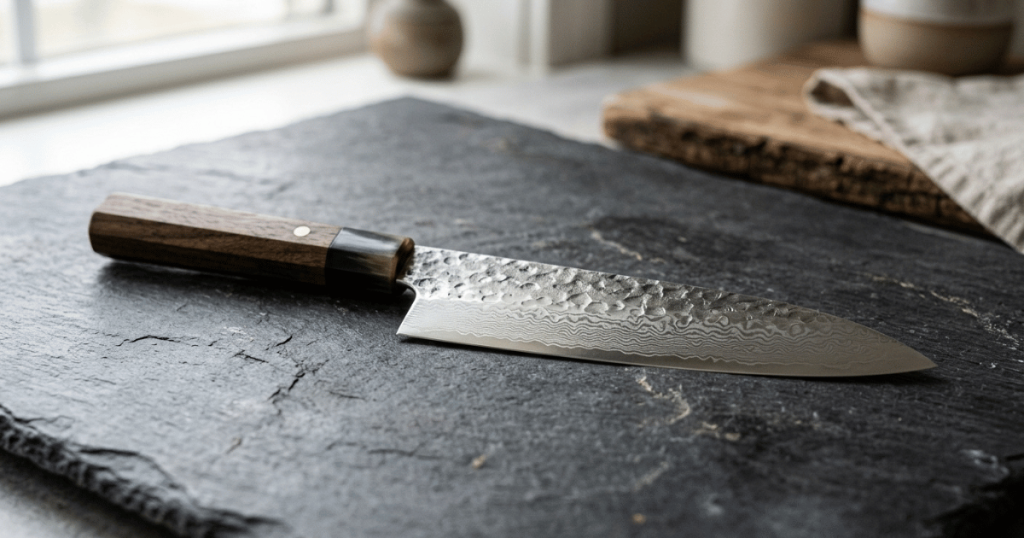
- Cladding, finish and handle. Damascus-pattern cladding, hammered finishes and exotic handles add cost and look, but they do not cut. The core steel at the edge is the only part that meets the food.
A PM core in a thick, poorly heat treated blade will disappoint. A well-made VG10 knife with a thin grind can out-cut it. The steel name is one input, not the verdict.
Titanium, ceramic and other “premium” labels
“Titanium” on a kitchen knife listing can mean a titanium-based coating on a steel blade, titanium in the handle or bolster, or, less often, a titanium blade. Wikipedia’s kitchen knife entry (read September 27, 2026) states that titanium is lighter and highly corrosion resistant but “not harder than steel,” and calls it “not well suited to kitchen cutlery.” A softer blade cannot hold a fine edge as long, so a titanium blade is a corrosion and weight choice, not an edge-retention one. A coating sits on the surface, and sharpening exposes the steel at the edge, which is what does the cutting.
Ceramic is a different material altogether. The same Wikipedia entry describes ceramic blades as sintered zirconium dioxide, “extremely hard, but brittle.” It is a separate choice from powder steel, with its own sharpening problems, and an ordinary whetstone barely touches it.
Are powder steel knives worth it for you?
Match the steel to your habits, not to the marketing.
| Your kitchen | Powder steel worth it? | Why |
|---|---|---|
| Hand wash, dry right away, wood or soft plastic board | Yes | You keep the edge long enough to feel the difference |
| Sharpen on stones, or use a professional service | Yes | Longer intervals between sharpenings are the main payoff |
| Dishwasher, even occasionally | No | Heat, detergent and knocking against other items damage edges no matter the alloy |
| Glass, stone or ceramic board | No | A hard surface dulls and chips a thin, hard edge regardless of steel |
| Pull-through or electric sharpener only | Rarely | These are built for speed, not for following a thin, hard edge precisely |
| Frozen food, bones, twisting cuts | No | A hard, thin edge is the wrong tool; a softer, thicker blade forgives abuse |
If the dishwasher row applies to you, fix that habit before spending more on steel. No alloy survives it well.
What changes when you own one
Owning a hard PM knife shifts your maintenance, it does not remove it.
- Sharpening takes a little longer per session, because harder, more wear-resistant steel is slower to abrade. You will do it less often. A sensible grit progression matters here; our whetstone grit guide covers which stone does what.
- A grooved steel honing rod is a poor match. A very hard blade can be as hard as the rod. A fine ceramic rod or a light strop is the gentler choice.
- Chips are repairable, but annoying. A hard edge that meets a bone or a hard board tends to chip rather than roll. If it happens, see how to fix a chipped knife edge.
What nobody selling premium steel will tell you
The biggest variable is not the letters on the blade. Two SG2 knives from two makers can behave very differently, because heat treatment and grind vary. Hardness numbers on listings are the maker’s own figure, and a higher number is not automatically better: harder steel resists wear and rolling, but past a point it gives up toughness.
And the cook matters more than the alloy. A mid-range stainless knife that is sharpened when it needs it will cut better than a premium PM knife left dull for months. If you are unsure where to start, our overview of how to choose kitchen knives by type, steel and budget puts steel in its proper place among the other decisions.
FAQ
What is a powder steel knife?
A powder steel knife has a blade made from powder metallurgy steel. Molten steel is atomized into powder that freezes almost instantly, then pressed back into a solid bar under heat and pressure. The result is small, evenly spread carbides, which allow harder, more wear-resistant alloys without extreme brittleness.
Are powder steel knives more likely to chip?
Not because of the powder process itself. In Knife Steel Nerds testing at the same hardness, powder-made SG2 was slightly tougher than VG10. Chipping usually comes from very high hardness, a very thin edge, hard cutting boards, or twisting and prying cuts.
Do powder steel knives rust?
It depends on the alloy, not the process. SG2 and M390 are sold as stainless grades, and Knife Steel Nerds rated SG2 and VG10 almost identically for corrosion resistance. Any knife still needs washing and drying after use.
Is a titanium kitchen knife better than steel?
For edge retention, no. Titanium is lighter and very corrosion resistant, but it is not harder than steel, so it cannot hold a fine edge as long. Many “titanium” kitchen knives are steel blades with a titanium-based coating or titanium handle parts.
Can I sharpen a powder steel knife myself?
Yes, on whetstones. Expect each session to take a little longer than with softer steel, use light pressure, and finish on a fine stone. Skip coarse pull-through sharpeners, which are not built for a thin, hard edge.