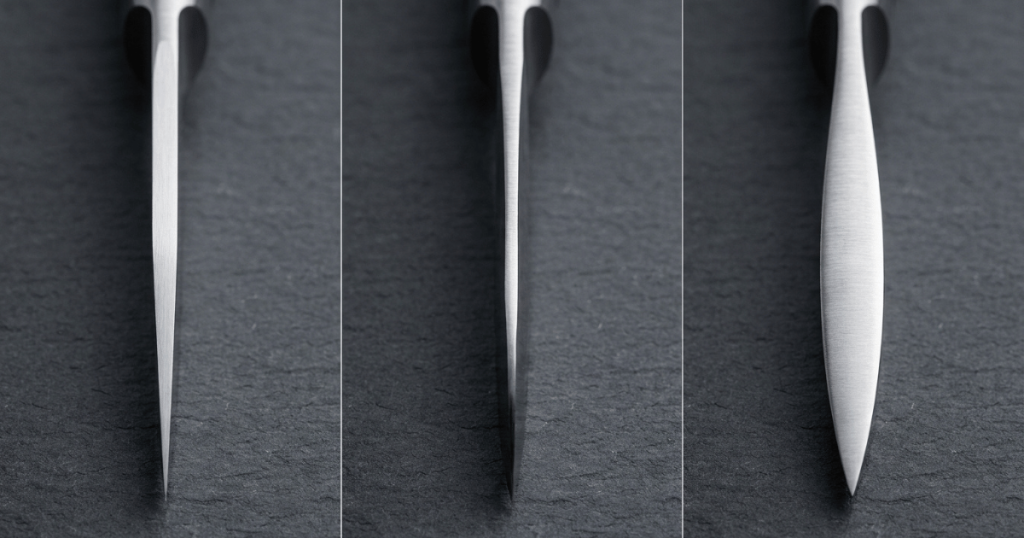
Knife grind types describe the shape of a blade in cross-section, from spine to edge. The main kitchen grinds are flat (a straight taper), hollow (faces curved inward, very thin near the edge) and convex (faces curved outward, more steel supporting the edge), plus the single-bevel grinds of some Japanese knives. The grind sets how thick the blade is just behind the edge, and that, together with the edge angle, is why two knives in the same steel can cut very differently.
Steel gets the headline on a spec sheet, but geometry decides a large share of what you feel when the blade goes into food. Below is what each grind is, what thickness behind the edge does, what a metallurgist’s test data shows about geometry within a single steel, and what thin geometry costs.
Grind and Edge Bevel: Two Geometries on Every Knife
Every kitchen knife has two shapes stacked on top of each other. The grind is the shape of the blade faces, from the spine down toward the edge. It is set at the factory, and it decides how quickly the blade thickens as you move up from the edge. The edge bevel is the narrow facet at the very bottom that sharpening creates, and it is re-cut every time the knife meets a stone. Some knives add a third, a tiny micro-bevel right at the apex.
The two get mixed up because both are called bevels: the grind is sometimes called the primary bevel, and the sharpened edge the secondary bevel. The angle you hold when sharpening changes only the edge bevel, and our guide to finding the right sharpening angle covers that part. The grind stays as the maker left it until years of sharpening move the edge up into it, or until someone deliberately thins it.
Knife Grind Types Compared
| Grind | Cross-section | Just behind the edge | What it gains | What it costs |
|---|---|---|---|---|
| Full flat | Straight taper from spine to edge | Moderate | Simple, even geometry; easy to keep thin | Broad flat faces that wet slices can cling to |
| Sabre (saber) | Flat taper starting partway down the blade | Thicker than a full flat of the same stock | A stiffer blade | More steel to push through dense food |
| Hollow | Faces curved inward | Very thin | Slices with little resistance | Less steel supporting the edge; the thicker steel above the hollow can bind in deep cuts |
| Convex | Faces curved outward, no hard shoulder | Thicker, well supported | A strong edge that blends smoothly into the blade face | More steel behind the edge; harder to reproduce on flat stones |
| Single bevel | One side ground, the back nearly flat | Very thin on the ground side | Fine, precise slicing | Needs its own sharpening method; made for one hand |
Full flat and sabre. A full flat grind tapers in a straight line all the way from spine to edge. A sabre grind keeps the blade at full thickness for part of its height and starts the taper lower down, which makes a stiffer blade with more steel near the edge. For food, where the whole blade has to pass through, the full flat is usually the thinner and freer-cutting of the two.
Hollow. A hollow grind is cut on the rim of a grinding wheel, which leaves the faces curved inward like the rim itself. The result is very little steel just behind the edge. Do not confuse it with the scalloped dimples on some santoku and slicers, often sold as a “hollow edge” or Granton edge. Those are pockets ground into the blade face to break up contact with food, and they sit on top of whatever grind the blade already has.
Convex. A convex grind curves outward all the way down to the edge, with no crisp line where the face meets the bevel. Some Japanese knives carry a version called hamaguri-ba, or clamshell edge. The outward curve puts more steel directly behind the edge, which supports it.
Single bevel. Traditional Japanese knives such as the yanagiba and deba are ground on one side only. The back is not truly flat, which changes how the knife is sharpened; our guide to sharpening a single-bevel knife explains why.
Outdoor grinds such as the Scandi are built for wood, not food, and this guide leaves them aside.
Thickness Behind the Edge: Why the Same Steel Cuts Differently
Thickness behind the edge is how thick the blade is a short distance above the edge bevel. It is the part of the blade that has to push food apart once the edge has started the cut. A thin blade parts a carrot with little force. A thick one acts as a wedge: the carrot resists, and a firm one may crack ahead of the edge instead of being sliced. That crack is the clearest sign a blade is too thick behind the edge.
Measured data shows how large geometry’s effect is, and what matters even more. Larrin Thomas, the metallurgist who publishes Knife Steel Nerds, ran CATRA edge-retention tests, a machine test that measures how much test card a blade can cut, on knives of one steel composition, 154CM and its powder-made twin CPM-154. He reported them in Maximizing Edge Retention (published June 18, 2018, read September 24, 2026).
Half the knives were ground to 0.010 inch and half to 0.020 inch (about 0.25 and 0.5 mm) before the final edge went on, and edge angles ran from 20 to 56 degrees total. His finding: “Edge angle had by far the strongest effect on edge retention, much stronger than other effects such as PM vs ingot and the finish it was sharpened to.” The highest total card cut was “over 1000 mm with an angle of 20°, and this decreased all the way to under 100 mm with 56°.” Thickness behind the edge mattered less in this test, but it still counted: “Thinner edges, regardless of final edge angle, did have a small advantage in edge retention.”
Put simply, within one steel, geometry alone moved the result by more than ten times. When two knives in the same steel feel completely different, look at the edge angle and the thickness behind the edge before anything else.
The Cost of Thin: Edge Stability
Thin geometry is not free. In What is Edge Stability? (published August 27, 2018, read September 24, 2026), Thomas puts it plainly: “Thinner, sharper, more acute edges are not as strong as heavier edges.” The mechanics are steep: “For a rectangular cross-section the resistance to a deflection is greatly controlled by thickness, as the degree of deflection is divided by thickness cubed.” Halve the thickness and, under the same load, the section bends about eight times as much.
What happens when a thin edge is overloaded depends on the steel. Thomas explains that if the stress “exceeds the yield stress of the material, then the edge will be permanently deformed, or rolled,” while “the resistance to chipping is controlled by the steel toughness.” That is why a very thin grind on a very hard steel tends to chip, and the same grind on a softer steel tends to roll. A rolled edge can be honed back; a chip has to be ground out, and our guide to fixing a chipped knife shows what that repair involves.
The practical rule: the thinner the grind, the more the knife depends on being used for slicing, not for prying, twisting or striking bone.
How a Grind Changes as You Sharpen
Every sharpening removes steel at the edge, so over the years the edge moves up the blade into thicker steel. A knife can be perfectly sharp and still cut worse than it did new, because it is now thicker behind the edge. The fix is thinning: grinding the blade faces just above the edge bevel to bring that thickness back down, usually on a coarse stone. Our whetstone grit guide explains which grits remove steel quickly. Thinning takes off far more steel than sharpening and changes the look of the blade, so if you have never done it, learn slowly on a knife you can risk, or hand it to a professional.
How fast a knife needs thinning depends on the shape of its grind, and that is pure geometry:
- Hollow: the faces curve inward, so the steel just above the edge thickens slowly at first. The early sharpenings cost little.
- Flat: thickness climbs at a steady rate from edge to spine, so each sharpening adds about the same.
- Convex: the faces bulge outward, so thickness rises fastest near the edge. Sharpened back without keeping the curve, it grows thick behind the edge soonest.
Which Grind Suits How You Cook
| If you mostly… | Look for | Why |
|---|---|---|
| Slice vegetables, fish and boneless meat | A thin flat or hollow grind | Little steel behind the edge, so food parts easily |
| Cut dense squash and root vegetables | A flat or convex grind that is thin behind the edge, on a tough steel | Thin enough not to wedge, supported enough not to chip |
| Want the easiest upkeep | A full flat grind | Simple to sharpen and to thin on flat stones |
| Work around bone and joints | A convex or sabre-type grind with more steel behind the edge | Support where the edge takes knocks |
| Want the finest single-purpose slicing | A single-bevel Japanese knife | Very thin and precise, with its own sharpening method |
Frequently Asked Questions
What is the best knife grind for a kitchen knife?
There is no single best. A full flat grind that is thin behind the edge is a versatile default. Hollow grinds favor slicing, and convex grinds favor a supported, durable edge. The right one depends on what you cut most.
What does thickness behind the edge mean?
It is how thick the blade is just above the sharpened edge bevel. A blade that is thin there parts food easily; a thick one wedges, so firm food like carrots may crack instead of being sliced.
Is a hollow grind the same as a hollow edge?
No. A hollow grind is the inward-curved shape of the blade faces. A “hollow edge,” or Granton edge, is a row of scalloped dimples ground into the side of the blade to reduce sticking, and it can sit on any grind.
Why does my knife cut worse even after sharpening?
Years of sharpening move the edge up into thicker steel, so the blade gets thicker behind the edge. It can be sharp and still wedge. Thinning the blade faces above the edge restores the cut.
Does the grind matter more than the steel?
Both matter, in different ways. Geometry decides how easily the knife cuts: in Knife Steel Nerds’ CATRA tests within one steel, edge angle had “by far the strongest effect on edge retention.” The steel decides how long that edge lasts and whether it rolls or chips when overloaded.