Single bevel vs double bevel comes down to where the edge is ground. A single bevel knife is ground on one face only, with a nearly flat, slightly hollow back, so the whole edge angle sits on one side. A double bevel knife is ground on both faces, so the edge sits near the centerline. Single bevels, like the yanagiba and deba, slice very cleanly but steer, need their own sharpening method and are made for one hand. Double bevels are the easier, ambidextrous default for most home cooks.
That is the short version. The longer one explains why the one-sided edge behaves the way it does, what the cutting data says about it, and what a left-handed cook should actually buy.
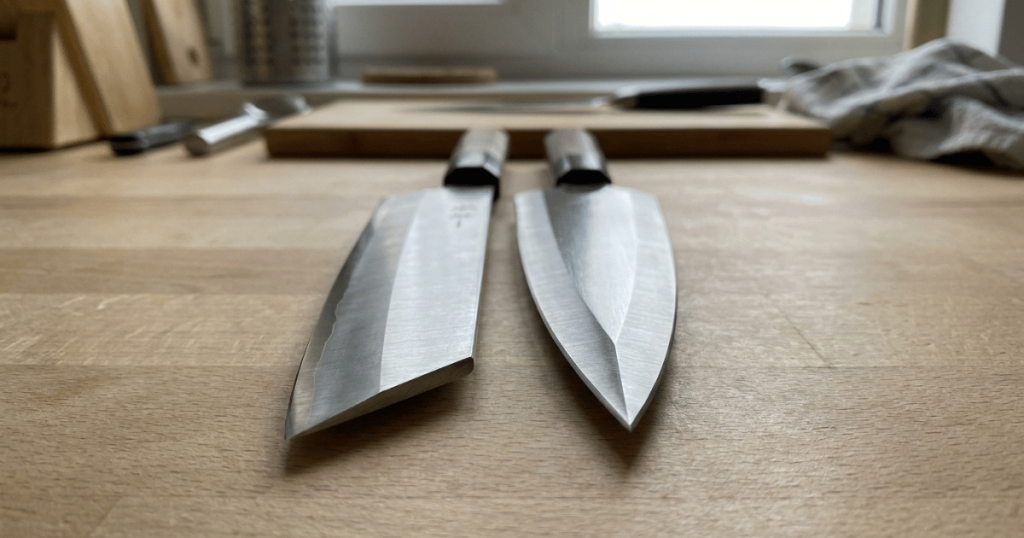
What a Bevel Is, and Where Each Knife Puts It
A bevel is a ground face that narrows the blade down to the edge. On most kitchen knives there are two layers of geometry: the blade faces the maker grinds at the factory, and the narrow edge facet that sharpening re-cuts over the years. The single versus double question is about where that grinding happens.
On a double bevel knife, both faces are ground toward the edge. Most Western chef’s knives, santokus and gyutos are built this way, and on a symmetric one the edge sits on the centerline of the blade.
On a single bevel knife, only the front face is ground. Yoshihiro Cutlery, a Japanese knife brand, describes the anatomy on its page The Anatomy of the Japanese Single-Bevel Knife (undated, read September 25, 2026). The front face has the shinogi, “the flat grind on the beveled side of the blade, tapering down to the edge.” The back is not simply flat: it carries the urasuki, “the concave surface on the flat side of the blade,” surrounded by the uraoshi, “the thin, flat rim surrounding the urasuki.” That hollow back reduces drag against the food and keeps whetstone contact down to the narrow rim.
Single Bevel vs Double Bevel at a Glance
| Single bevel | Double bevel | |
|---|---|---|
| Where it is ground | Front face only; back hollow with a flat rim | Both faces |
| Where the edge sits | At one face of the blade | Near the centerline |
| Typical knives | Yanagiba, deba, usuba, single-bevel kiritsuke | Western chef’s knife, gyuto, santoku, most paring knives |
| Handedness | Made for one hand; mirrored versions exist | Symmetric ones suit either hand |
| Cutting path | Tends to steer toward the unground side | Tracks straight when the edge is centered |
| Sharpening | Separate method for front and back | Both sides at a matching angle |
| Best at | Precise slicing of fish, thin vegetable sheets, filleting | General prep across all foods |
Why the Single Bevel Cuts So Cleanly: It Is the Total Angle
The common explanation is that single bevel knives are “sharper” because they are ground on one side. The more accurate explanation is that they are ground to a very low total angle, and the one-sided shape is the price paid for it, not the source of it.
Metallurgist Larrin Thomas, who writes Knife Steel Nerds, summarizes published cutting-force research in Sharpness vs Cutting Ability (published August 6, 2018, read September 25, 2026). He describes a test on beet topping blades “with either single bevel (asymmetric) or double bevel (symmetric) with a range of edge angles.” Two findings matter here. First, “the cutting force required for cutting through the beets increased with increasing edge angle.” Second, “double bevel edges cut with less force at the same angle as the single bevel edges. The single bevel edge was equal to a 10-15° greater double bevel edge.”
In a follow-up on edge stability (published September 24, 2018, read September 25, 2026), Thomas puts it as a worked example: “A 20° single bevel edge (which was tested) is approximately equal to a 30-40° double bevel edge in terms of cutting ability.”
Two cautions on that data. It comes from agricultural cutting blades, not kitchen knives on a board, so treat it as the direction of the effect rather than a figure for your knife. And it compares edges at the same total angle, which is not how the two knife families are made.
Read correctly, the data turns the usual claim around. At the same total angle, a symmetric edge takes less force to push through food. Single bevel knives still feel sharper in the hand because traditional makers grind them to a much lower total angle than a typical Western knife, and a thin, hollow-backed blade adds very little wedging above the edge. If you compare knives by angle, compare the total angle, and remember the one-sided edge gives some of it back.
The Steer: Why a Single Bevel Wanders
Because all of the edge angle sits on one face, a single bevel pushes food unevenly. The ground side acts as a wedge; the back side stays nearly flat against the food. On a right-handed knife, that pushes the slice away and lets the flat back ride along the part you are keeping, which is exactly what you want when cutting a thin, clean slice of fish.
The same asymmetry makes the blade drift when you try to cut straight down through something thick. Users learn to angle the knife slightly to correct for it. A double bevel with a centered edge pushes equally both ways, so it tracks straight without that correction. This is one of the two reasons single bevels are specialist tools; the other is sharpening.
Left-Handed? Here Is the Rule
This is the question most guides answer in one line, and it deserves more.
A single bevel knife is handed. Yoshihiro Cutlery states that “most single-bevel knives are ground for right-handed use. Left-handed versions are available from some makers.” The Japanese Knife Lab editorial team, in its guide to left-handed Japanese knives (published June 27, 2026, read September 25, 2026), lists the genuinely handed knives as “Yanagiba, usuba, deba, and single-bevel kiritsuke.” It describes what happens when a left-hander uses a right-handed one: “every force reverses: the blade wanders into your cut, the back faces the wrong way, and food release suffers.”
So a left-handed cook who wants a single bevel needs a mirrored knife, ground on the other face. The same guide gives “roughly a 20-50% price uplift” over the right-handed equivalent as a reasonable expectation, and notes that specific steels or sizes are often special orders. Treat that range as that site’s estimate, not a price list.
A symmetric double bevel is not handed. Its edge sits on the centerline and behaves the same in either hand. The catch is that some Japanese double bevel knives are ground asymmetrically, with more of the edge on one side. Japanese Knife Lab gives “70/30 or 80/20” as example ratios, usually biased for right-handers, and calls the effect far subtler than a true single bevel. If you are left-handed and buying a Japanese double bevel, check the product listing for the grind ratio, or ask the seller. You can also rebalance an asymmetric edge over a few sharpenings.
For most left-handed home cooks, the simplest answer is a symmetric double bevel. Our guide to real and Japanese-style Japanese knives covers which common styles are double bevel.
Sharpening Each Edge Type
Sharpening is where the two diverge most in daily ownership.
A double bevel is sharpened on both faces at a matching angle, raising a burr on one side and then the other. If you are new to it, our guide to finding the right sharpening angle walks through picking an angle and holding it.
A single bevel is sharpened almost entirely on the front, following the shinogi, while the back gets only a light pass on the uraoshi rim to remove the burr. Grinding the back at an angle, the way you would sharpen a double bevel, ruins the hollow and changes how the knife cuts. Yoshihiro Cutlery puts it simply: “Getting the geometry right takes more skill than sharpening a double-bevel edge.” The step by step, including why the back is not truly flat, is in our guide to sharpening a single-bevel knife.
Pull-through and electric sharpeners are designed around symmetric edges and do not suit single bevel knives. For Japanese double bevels, the hard, thin edge also calls for care on the stones; see our guide to sharpening Japanese kitchen knives without chipping.
Which Should a Home Cook Choose?
| If you… | Choose | Why |
|---|---|---|
| Want one knife for everything | Double bevel chef’s knife, gyuto or santoku | Tracks straight, suits all foods, easy to sharpen |
| Are left-handed and want simplicity | Symmetric double bevel | No handedness to buy around |
| Slice raw fish often and want the cleanest cut | Single bevel yanagiba | Thin, hollow-backed slicing geometry |
| Break down whole fish | Single bevel deba | Built for that job |
| Will not learn a second sharpening method | Double bevel | Single bevels need their own technique |
| Are left-handed and want a single bevel | A mirrored, left-handed version | A right-handed one fights you on every cut |
A single bevel knife is rarely a home cook’s first knife. It usually makes sense as a second, dedicated knife once you already sharpen by hand and have a specific job for it. If that is not you, it is fine to say this knife is not for you.
Frequently Asked Questions
Is a single bevel knife sharper than a double bevel?
Not because of the single bevel itself. In the cutting-force data Knife Steel Nerds summarizes, a double bevel cut with less force at the same angle, and a single bevel behaved like a double bevel 10 to 15 degrees wider. Single bevels feel sharper because they are usually ground to a much lower total angle.
Can a left-handed person use a single bevel knife?
Only a left-handed version, ground on the opposite face. A right-handed single bevel in the left hand steers into the cut and the hollow back faces the wrong way. Left-handed versions are made by some makers, often at a higher price or to order.
Are double bevel knives ambidextrous?
A symmetric double bevel is, because the edge sits on the centerline. Some Japanese double bevels are ground asymmetrically, such as 70/30, usually favoring right-handers. The effect is small, and the grind ratio is worth checking before you buy.
Can I sharpen a single bevel knife on a pull-through sharpener?
No. Pull-through and most electric sharpeners grind both sides symmetrically, which destroys the single bevel geometry. Single bevels are sharpened on whetstones, mostly on the front face, with only a light pass on the back rim.
Which Japanese knives are single bevel?
The traditional ones: yanagiba for slicing fish, deba for breaking down fish, usuba for vegetables, and single-bevel kiritsuke. Gyuto, santoku, nakiri and petty knives are usually double bevel.