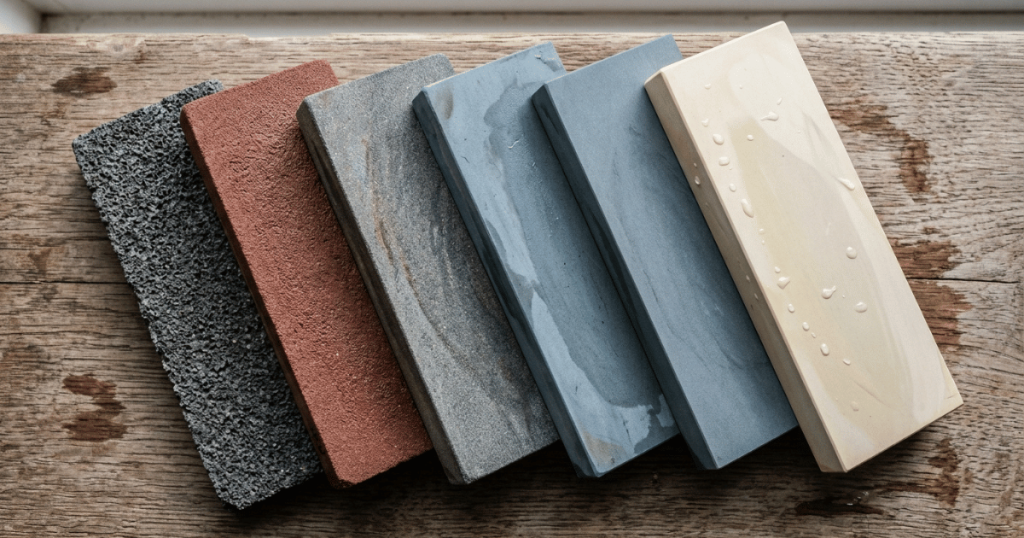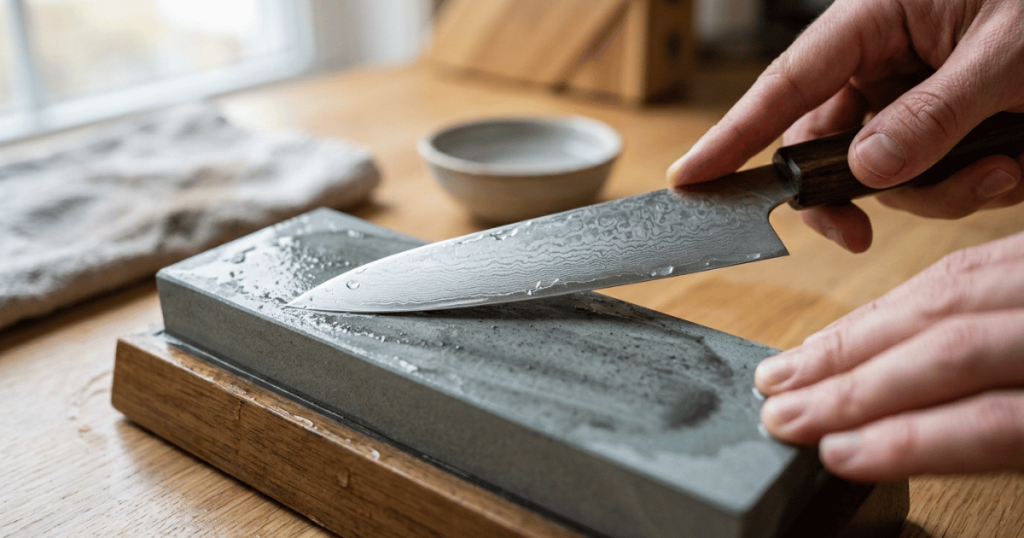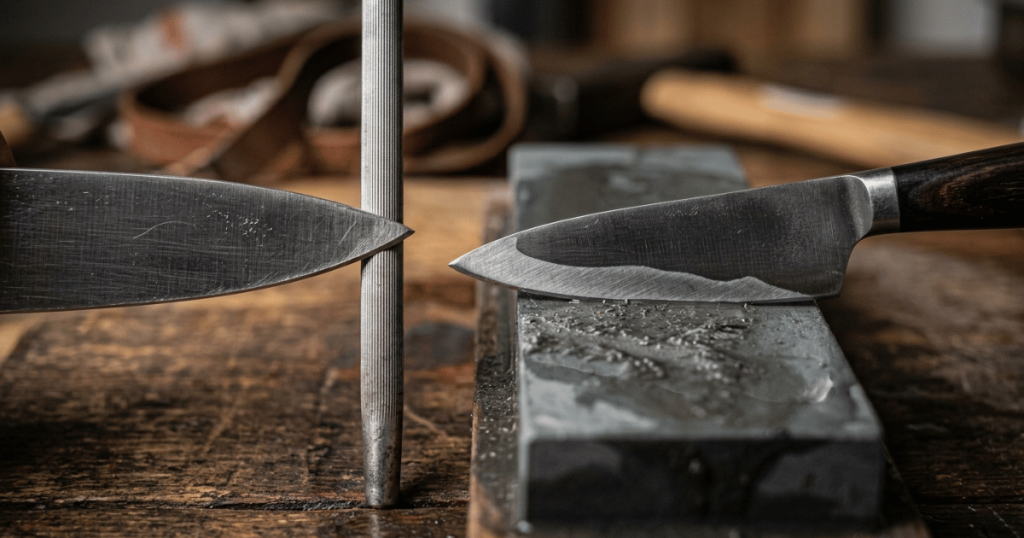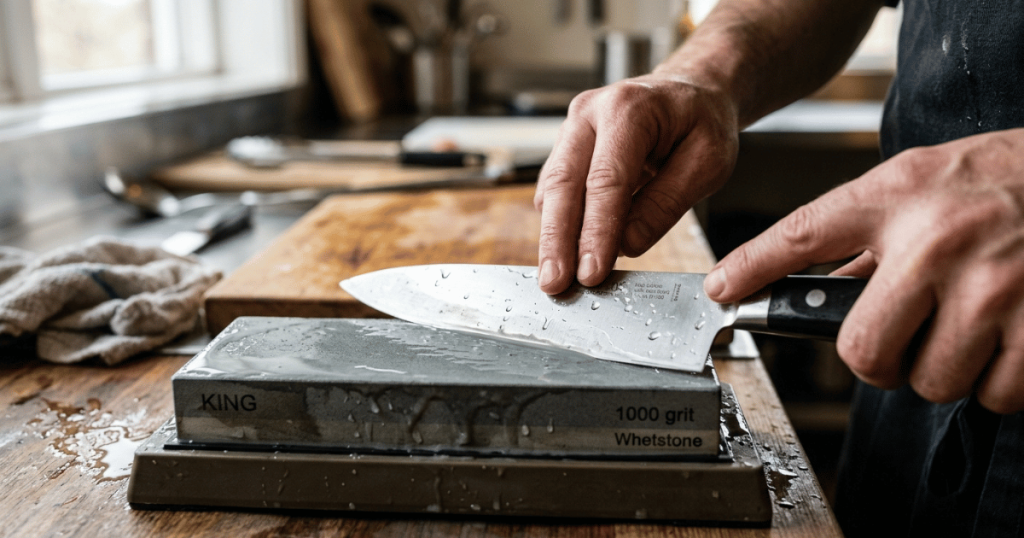
All three genuinely sharpen. The choice is not about which one works, it is about what each one charges you. A whetstone costs the most attention and the least metal. A pull-through costs a couple of minutes and the most metal. An electric machine costs the least effort and removes steel faster than either. Then there is a fourth cost nobody prints on the box: what happens when it goes wrong. A bad session on a stone costs you an evening. A bad pass through a fixed slot can regrind a bevel you cannot put back.
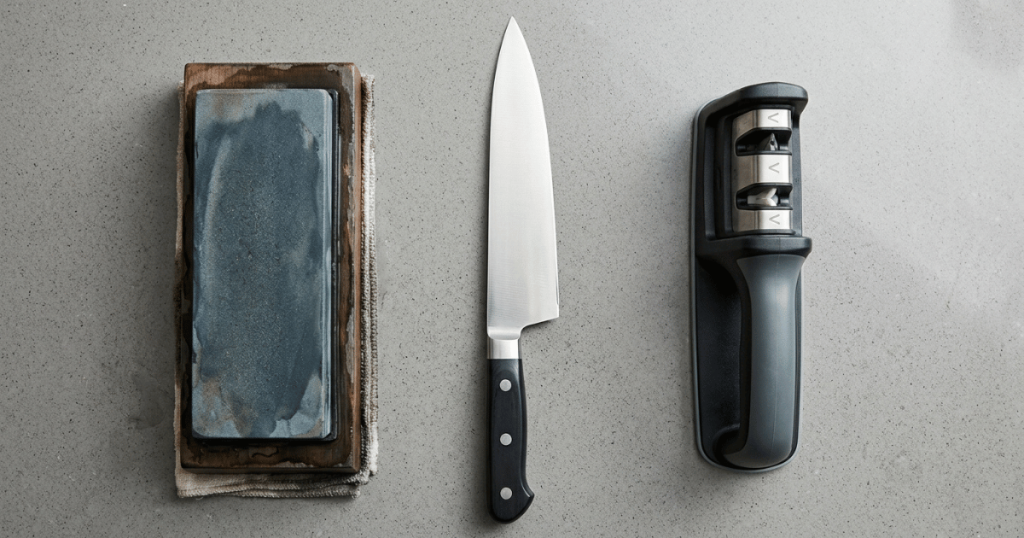
Three currencies, not one ranking
Comparisons of these three usually end in a verdict, and the verdict is usually whichever method the publisher sells. It is more useful to price the decision in the three things you actually spend.
Metal never comes back. A knife has a finite amount of blade behind its edge, and every session is a withdrawal. You will not notice one. You will notice ten years of them, in a blade that has lost height and a bolster that now sits proud of the edge.
Time decides whether the sharpening happens at all. The best method in the world produces a dull knife if it lives in a drawer because setting it up feels like a project.
Recoverability is the axis almost nobody rates, and it separates an annoying afternoon from a ruined knife. Ask not how good the result is when it goes well, but how bad it is when it goes badly, and whether you can undo it.
Metal: what each method takes
The order is not controversial, and a named source states it plainly. The kitchenware retailer Borough Kitchen ranks the three by removal, putting whetstones lowest, sharpening steels in the middle, and pull-through sharpeners at the top: they “shed the most amount of metal, which weakens the durability of knives.”
The reason is mechanical rather than a question of quality. A whetstone is a flat surface you hold the blade against, so the abrasive only touches the metal you present to it, and you decide when to stop. A pull-through drags the whole edge past fixed abrasive in a preset V, so it works on the entire edge at once and grinds toward the machine’s angle rather than the knife’s. If those two angles differ, the first thing it does is remove enough steel to make them match. An electric machine is more consistent than a hand pulling a knife through a slot, which wastes less, but it is also far faster, so the same few seconds take more off. Its failure mode is not the machine, it is the extra pass “just to be sure.”
None of this makes the fixed-angle tools bad. It makes them a specific trade: you spend blade to buy back time and skill. On a thick Western stainless chef’s knife with plenty of steel behind the edge, that is a fair trade that households have been making for decades. On a thin, hard, expensive edge, you are spending something rarer.
Time: the cost that decides whether it happens
A whetstone session has a fixed overhead before any sharpening starts. Some stones need soaking and some do not, and the maker decides: Zwilling’s care guidance says to immerse the stone “in water for about five minutes,” while Global asks for “approximately 10-15 minutes,” and splash-and-go stones want only a wet surface. Then comes anchoring the stone, finding the existing angle, working both sides to a burr, refining, deburring, testing and cleaning up.
We are not going to publish a minutes figure for that, because the honest range is enormous. The first knife you ever sharpen on a stone takes an evening. The tenth takes a fraction of it. What is reliable is the shape of the cost: high setup, high skill early, dropping steeply with practice. A pull-through has essentially no setup, and an electric machine has none beyond finding a socket. That gap is why a lot of well-meaning stone owners have duller knives than the neighbor with a cheap slot sharpener. A method you use four times a year beats a method you admire twice a year.
Recoverability: how each one fails
This is the section that should decide the choice, and it is missing from most comparisons.
| Method | Typical mistake | What it costs | Can you undo it? |
|---|---|---|---|
| Whetstone | The angle drifts, or you never reach the apex | Scratches on the blade face, a knife that is still dull, and lost time | Yes. Reset and work it again on the same stone |
| Pull-through | The knife’s angle does not match the slot | A new, usually blunter bevel, ground in with a lot of metal removed | Not easily. Restoring the original geometry means grinding the whole edge back |
| Electric | Too many passes, or one stage used too long | The fastest metal loss of any home method, and heat at the edge | No. The steel is gone |
| A sharpening service | Choosing one that grinds every knife to a single house angle | Your knife comes back sharp but reprofiled | Only by asking first, which is free |
Read that next to the metal section and a pattern appears. The method that removes the least is also the one whose mistakes are cheapest, because both come from the same cause: on a stone, you decide every stroke. The fixed-angle tools take those decisions away from you, which is exactly what makes them fast and exactly what makes their errors permanent.
What each one is actually good at
The whetstone
It is the only method that matches the angle your knife already has instead of imposing one, and the only one that will take an edge as far as the steel can go. It also repairs: drop to a coarse grit and you can grind out damage no slot sharpener will touch.
The concession: the learning curve is underestimated, the stone needs maintenance of its own since stones dish in the middle and a dished stone rounds the edge you are trying to make, and it is the method most likely to be bought with enthusiasm and used twice.
The pull-through
Quick, no skill required, and it produces a usable edge on a softer Western knife in under a minute. For a household whose realistic alternative is never sharpening anything, that is a real benefit and it is silly to pretend otherwise.
The concession: heaviest on metal of the three, the angle is the tool’s rather than the knife’s, and the knives it should stay away from are the expensive ones. A thin, hard edge does not deform in a slot the way soft steel does, it chips.
The electric sharpener
The most consistent of the fixed-angle options. It handles a whole block in the time a stone handles one knife, and a multi-stage machine does coarse and fine work without you changing anything.
The concession: it removes steel faster than any other home method, and the machine’s angle rules unless the machine was built for your knife’s. Speed and irreversibility in one tool deserves respect rather than confidence.
Which specific knives are safe in each of these, including the edges that should never meet a flat stone or a fixed slot at all, is a compatibility question rather than a choice, and this site answers it separately in its main guide to sharpening kitchen knives. This page is about deciding, not about checking.
The option most comparisons leave out
You can pay someone. A sharpening service owns equipment you will not, works in minutes, and can repair damage that would take you hours to attempt badly. For a household with a few good knives, a service once or twice a year with honing in between is a completely coherent strategy, and it is often the right one for hard Japanese steel, serrated blades and ceramic.
The honest caveat is in the table above. Ask what angle they sharpen to and whether they match the knife’s existing grind. A service that runs everything across the same belt at the same angle hands you a sharp knife that is no longer the knife you bought.
The best way to sharpen kitchen knives depends on three questions about you
The knife sets the ceiling. Your habits decide everything under it.
| Question | If the answer is | It points to |
|---|---|---|
| How many knives actually get used? | One or two | A stone is realistic. The time cost is small when it is not multiplied |
| A full block, plus steak knives | A fixed-angle tool or a service, unless you enjoy the process for its own sake | |
| What are they? | Western stainless, replaceable | All options open. Choose on time |
| Hard, thin or expensive | Stone or a service. The fixed-angle shortcuts stop being cheap | |
| Will you honestly do it? | Yes, and I like this sort of thing | Stone. It rewards the attention |
| Only if it takes two minutes | Take the fast tool and accept the metal cost. A sharp knife you maintain beats a perfect method you avoid |
Two of those rows are the whole article. If you have one good knife and some patience, the stone is not a hobbyist affectation, it is the cheapest option in the currency that matters. If you have twelve knives and fifteen minutes, the machine is not a compromise, it is the correct answer to your actual situation.
What none of them fixes
Sharpening assumes an intact edge on a straight blade. A chip has to be ground back behind its deepest point before any of these methods can form an apex again, which is a repair with a real cost in blade height. A bent blade or a broken tip is the same category. Ceramic is outside all of it, since ordinary abrasives will not touch it. And a knife that feels dull after a good week may not need sharpening at all: if the edge has rolled rather than worn, a honing rod fixes it in seconds, and every method above is an expensive way to solve a free problem.
One note on what this page is not. This site does not sell, rank or link sharpeners, and it does not test them. Every figure above is attributed to the company or publication that printed it, and where no source publishes a number we have left the number out rather than invent one.
Frequently asked questions
What is the best way to sharpen kitchen knives at home?
For an edge as good as the steel allows, and for the least metal removed, a whetstone. For a result you will actually get around to, whichever method fits the time you will really spend. Those two answers differ for a lot of households, and the second is not the wrong answer.
Do pull-through sharpeners ruin knives?
They remove more metal than the alternatives. Borough Kitchen’s comparison puts them highest on removal, saying they “shed the most amount of metal, which weakens the durability of knives.” On a thick Western stainless knife that is a trade many people are happy with. On a thin, hard edge ground to a much lower angle than the slot, the machine regrinds the bevel, and that is the case where “ruin” is a fair word.
Is an electric sharpener better than a whetstone?
It is faster and more consistent than any hand-held fixed-angle tool, and it removes more metal than a stone. Better depends on which of those you are optimizing for. A stone gives you control and costs you attention; a machine gives you repeatability and costs you steel.
Can I use one method on every knife in the drawer?
No. Serrated, ceramic and single-bevel edges each need their own treatment, and hard Japanese steel narrows the options considerably. Compatibility is a separate question from preference, and it should be settled before you buy anything.
How often does any of this need doing?
Less often than most people fear, if you hone regularly. Honing straightens a rolled edge in seconds and delays real sharpening. The signal is behavioral rather than a date: when honing stops bringing the edge back, the apex is worn rather than bent, and one of the methods on this page is required.