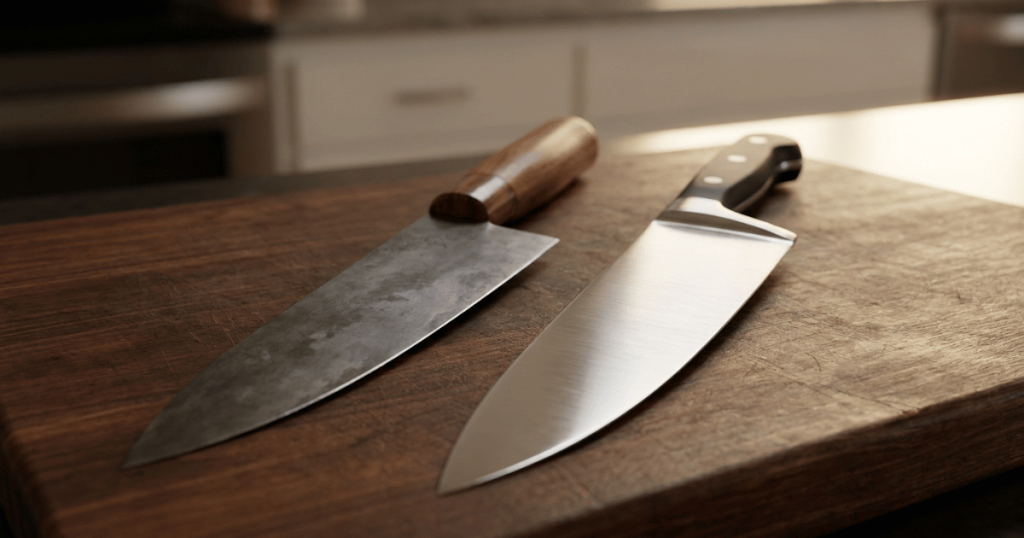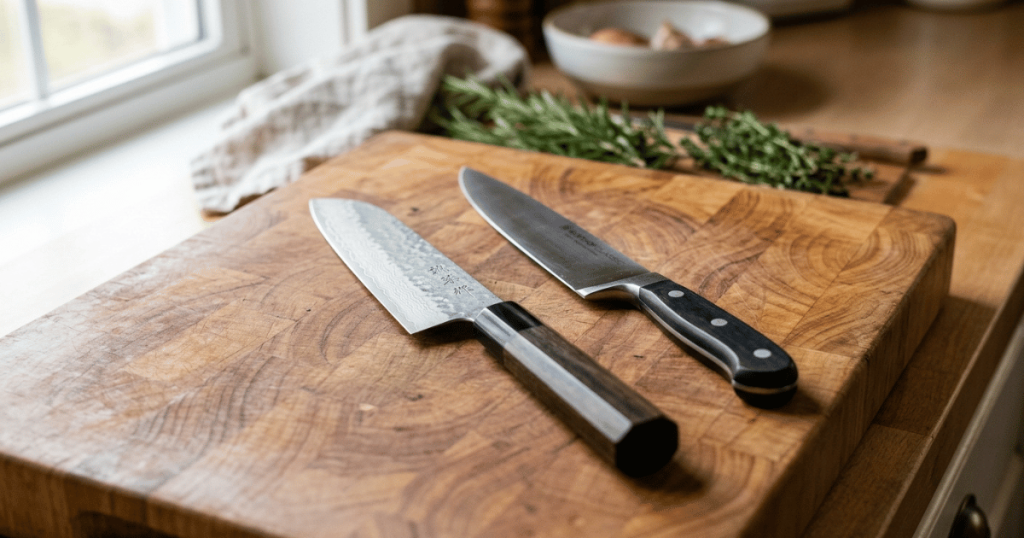
The carving knife vs slicing knife difference is shape and job. A carving knife is shorter, narrower and pointed, around 8 to 10 inches, made to work close to bones and joints in a roast bird or a leg of lamb. A slicing knife is longer, around 10 to 12 inches or more, usually with a rounded tip and a slightly taller blade, made to cut wide, even slices from boneless meat in one stroke. For the Thanksgiving turkey: the carving knife, or the chef’s or boning knife you already own, takes the meat off the frame; a slicer then slices the breast most cleanly.
Below: why the shapes differ, where flexibility actually comes from, what the dimples on the blade do, and which of the two, if either, is worth buying.
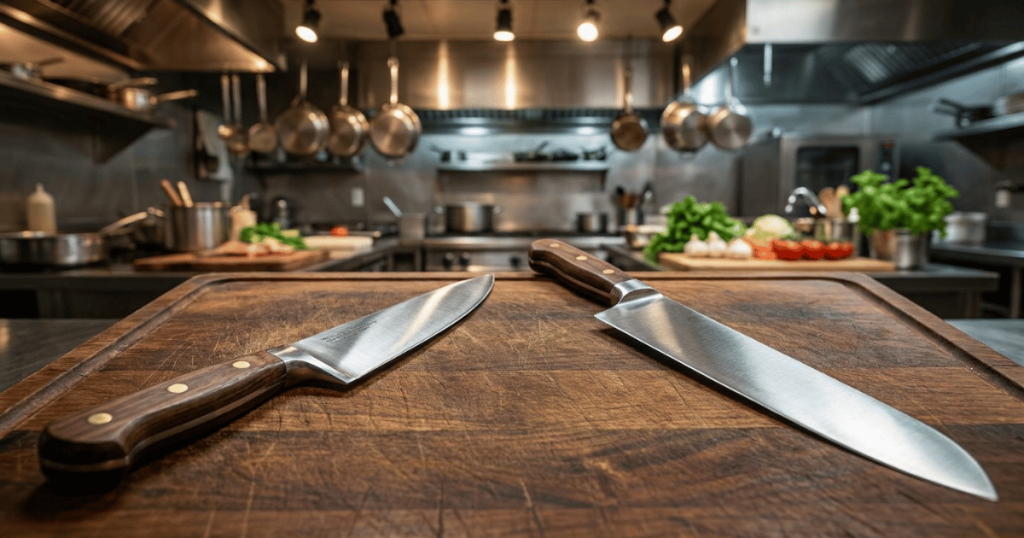
Carving knife vs slicing knife at a glance
| Carving knife | Slicing knife | |
|---|---|---|
| Blade length | About 8 to 10 inches | About 10 to 12 inches, some longer |
| Tip | Pointed | Blunt, rounded |
| Blade height | Narrower | Often a little taller |
| Works on | Bone-in roasts, whole birds, leg of lamb | Boneless roasts, brisket, ham, turkey breast off the bone |
| Strength | Steering around joints and bones | Long, even slices in one stroke |
| Weak spot | Short for a wide brisket flat | Round tip is no help at a joint |
The length, tip and height figures come from America’s Test Kitchen’s review of slicing knives (read September 27, 2026; page last updated July 9, 2025): “Carving knives have shorter, narrower blades measuring about 8 to 10 inches; they also have pointy tips. Slicing knives are longer (10 to 12 inches) and often a bit taller from edge to spine; they have blunt, rounded tips.” Makers vary; Wüsthof, for example, describes its own carving knife blade as between eight and nine inches.
What a carving knife is built for
A carving knife is a long, narrow knife with a point. Wüsthof’s page on its carving knife and meat fork (read September 27, 2026) calls the blade “strong yet slightly flexible,” says it is “designed to maneuver around bones,” and describes the pointed tip as one that “acts as a built-in fillet knife.” It also mentions the blade’s role to “guide the meat away from the bone” and “trim tough pieces of fat.”
That is the carving knife’s niche: a roast that still has its skeleton. The narrow blade fits between a thigh and the frame, the point finds the joint, and the length is still enough to slice what comes off.
The honest counterpoint comes from the same America’s Test Kitchen review, which quotes knife expert N. Brian Huegel calling the carving knife’s point “virtually useless” for fine work, because it sits at the end of a blade that is still relatively long and hard to control for jobs like deboning. The review’s reasoning is that a carving knife adds little over the chef’s knife or boning knife most kitchens already own.
What a slicing knife is built for
A slicer is about one thing: a clean, even slice across something wide. The long blade crosses a whole brisket flat or a boneless ham in a single draw, so the edge keeps moving instead of sawing back and forth. Sawing is what tears the grain and squeezes out juice.
The rounded tip is not a styling choice. With no bones to work around, a point is useless, and a blunt end cannot stab into the meat as you draw the blade back. The slightly taller blade also keeps a long, thin knife tracking straight through a tall roast.
America’s Test Kitchen reports that a 12 inch blade handled substantial cuts better than shorter blades in its testing, and that grantons helped keep brisket and turkey from sticking during repeated slicing. That is their test, not ours; we report it as their finding.
Where the flex comes from, and why it matters here
Carving knives and slicers are often described as “stiff” and “flexible,” and it is tempting to put that down to the steel. Metallurgy says otherwise.
Knife Steel Nerds, the metallurgy site run by Larrin Thomas, explains that heat treatment and hardness do not change how much a steel blade bends under a given load; that is set by the steel’s elastic modulus, which is essentially the same across knife steels, and by the blade’s shape. Deflection is inversely proportional to the cube of thickness, so a thinner blade flexes far more than a thicker one of the same steel.
For these two knives, that means the feel you notice in the hand comes from geometry. A long, thin slicer flexes because it is long and thin. A carving knife feels firmer because it is shorter and, usually, a little thicker for its size. When comparing two models, look at the stated length and, if the maker gives it, the spine thickness, rather than assuming the steel grade tells you anything about flex.
The dimples: what a hollow or granton edge does
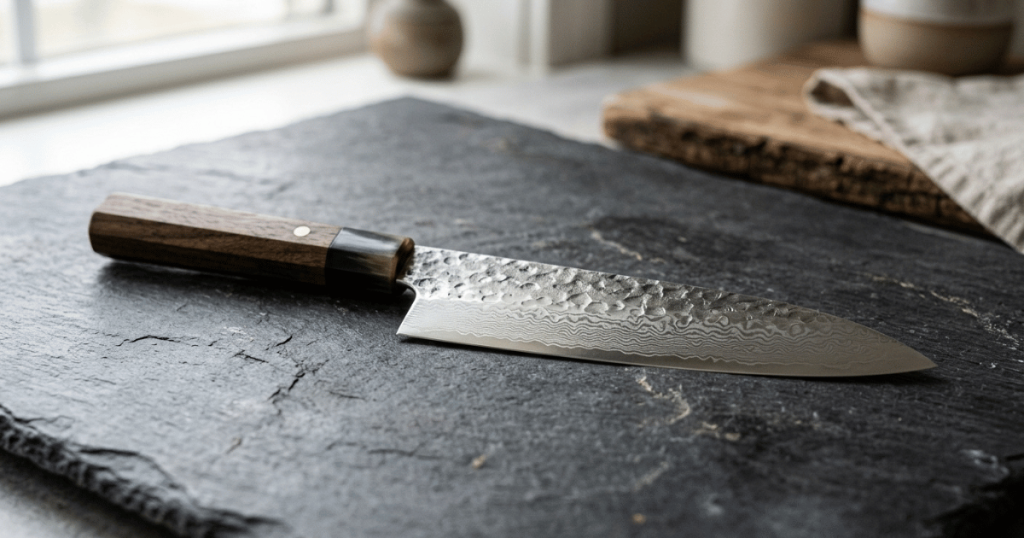
Many slicers, and some carving knives, have a row of shallow scallops ground into the side of the blade just above the edge. Wüsthof describes the function this way: “These evenly spaced, vertical indentations along the blade create small air pockets that gently push ingredients off the knife to reducing sticking, friction, and drag.”
The physics is about contact area. A flat, wet blade pressed against a moist slice of meat holds on by suction and surface tension across its whole face. The hollows break up that contact, so the slice falls away and the blade keeps moving. It matters most on moist, wide slices such as brisket, ham and turkey breast. It matters little on a quick cut or dry food.
Which one for the Thanksgiving turkey?
This is the micro-question behind most searches for this comparison.
- Taking the bird apart. Legs, thighs, wings and the whole breast lobe come off the frame at the joints. A carving knife is designed for this. So is a chef’s knife or a boning knife, and many cooks never reach for anything else.
- Slicing the breast. Once the breast is off the bone and on the board, a slicer’s length gives the cleanest, most even slices. A sharp carving knife or chef’s knife does a good job too.
- Only one turkey a year. Buy neither just for the day. Sharpen the knife you already have, because a dull edge tears poultry skin however long the blade is.
Which one should you buy, if either?
- You roast whole birds and bone-in joints often, and you do not own a boning knife. A carving knife earns its place, especially as a set with a meat fork.
- You smoke brisket, bake hams or serve large boneless roasts. A slicer is the one that does something your chef’s knife cannot: cross a wide cut in a single stroke.
- You own a chef’s knife and a boning knife and cook roasts a few times a year. You probably need neither. If you add one, America’s Test Kitchen’s reasoning favors the slicer because it adds a capability rather than duplicating one.
If you are building a set and want to see where these fit against the knives everyone uses daily, our guide to choosing kitchen knives by type, steel and budget covers the core lineup.
Keeping a long blade sharp
Long knives are used rarely and for big jobs, which makes the state of the edge easy to forget until the day it matters. Before a holiday roast, check the edge; our guide on how to tell if a knife is sharp gives four quick tests.
A few strokes on a honing steel before carving straightens an edge that has rolled in storage; see how to use a honing steel for the angle and pressure. If the edge is truly dull, sharpen it well before the day. A 12 inch blade takes more care on a stone than a chef’s knife because you work it in sections; our guide on how to sharpen kitchen knives covers the method. Hollow-edge blades sharpen the same way; the dimples sit above the edge and are not touched.
A note on safety with long blades
A long, thin blade can flex and slip sideways off a bone or a crisp skin. Keep the hand holding the fork or the roast out of the path of the edge, and carve on a stable surface that does not slide. A carving fork keeps your fingers further from the blade than holding the meat by hand.
FAQ
What is the difference between a carving knife and a slicing knife?
A carving knife is shorter, narrower and pointed, around 8 to 10 inches, for working around bones in roasts and poultry. A slicing knife is longer, around 10 to 12 inches, usually with a rounded tip, for even slices of boneless meat.
Is a carving knife or slicing knife better for turkey?
Use a carving knife, chef’s knife or boning knife to take the meat off the frame at the joints. A slicing knife then gives the cleanest slices of the breast once it is off the bone.
Can I use a slicing knife for brisket?
Yes. A long slicer is the usual choice for brisket, because it crosses the whole flat in one stroke, and a hollow edge helps moist slices fall away from the blade.
Do the dimples on a carving knife actually help?
They help most on moist, wide slices like brisket, ham and turkey breast, where a flat blade tends to stick. On small cuts and dry foods the difference is small.
Do I need a carving knife if I have a chef’s knife?
Often not. A sharp chef’s knife handles most carving jobs. A slicer is the more useful addition if you regularly serve large boneless roasts or brisket.