The question that decides whether a sharpening service is good value is not what it charges. It is what it does to your knife.
Two services at the same price can be doing completely different things: one restoring your knife’s own geometry on stones, the other running it through a powered belt at whatever angle the machine is set to and returning something sharp that is also permanently changed.
This page is about telling them apart before you hand anything over.
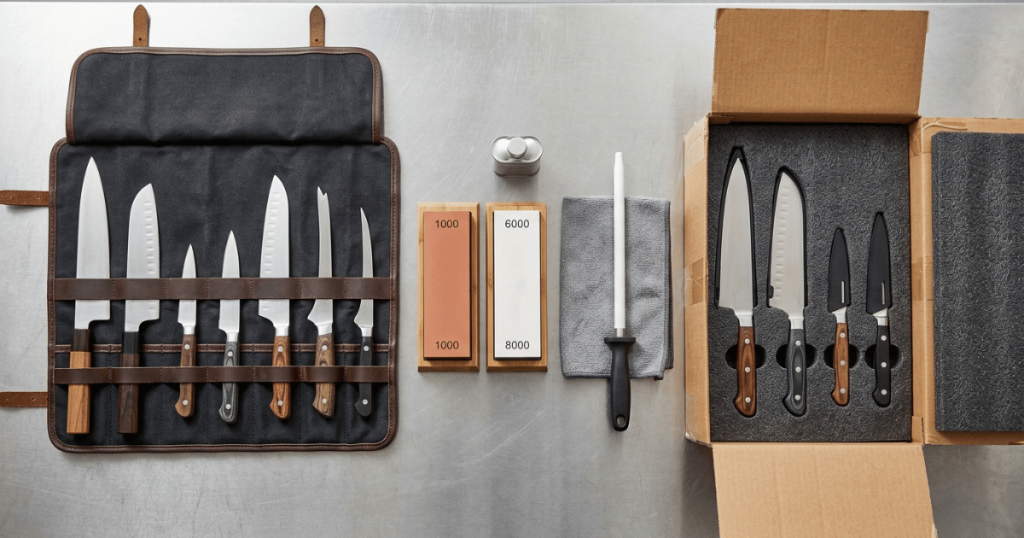
What “professional” covers, which is a wide range
The word covers at least four different operations.
The mobile service or market stall. Usually a powered wheel or belt, fast, cheap, one angle for everything. Excellent for the household knives nobody has sharpened in years. Not where a good Japanese knife should go.
The hardware store or kitchen store counter. Often a commercial machine, often staffed by someone whose main job is something else.
The dedicated sharpener, local or mail-in. A person whose whole business this is. Usually a range of equipment, usually willing to talk about what they will do. This is the category worth finding.
The manufacturer’s own service. Some knife makers sharpen or refurbish their own products. Slowest, and the one most likely to return the knife to its original geometry, because they know what that was.
The ten questions
Ask these before you hand over anything you would be sorry to lose. A good service will answer all of them without irritation. A service that will not answer them is the answer.
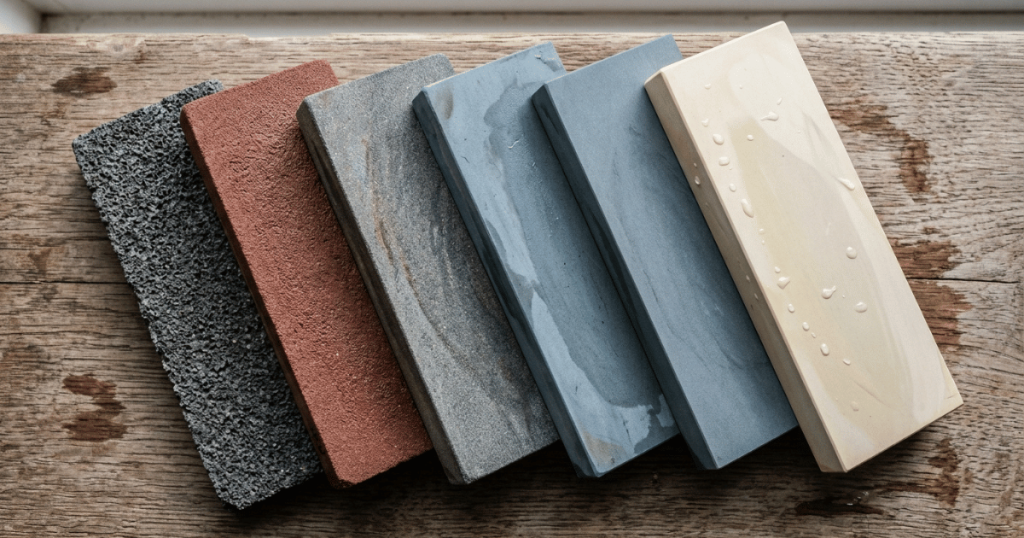
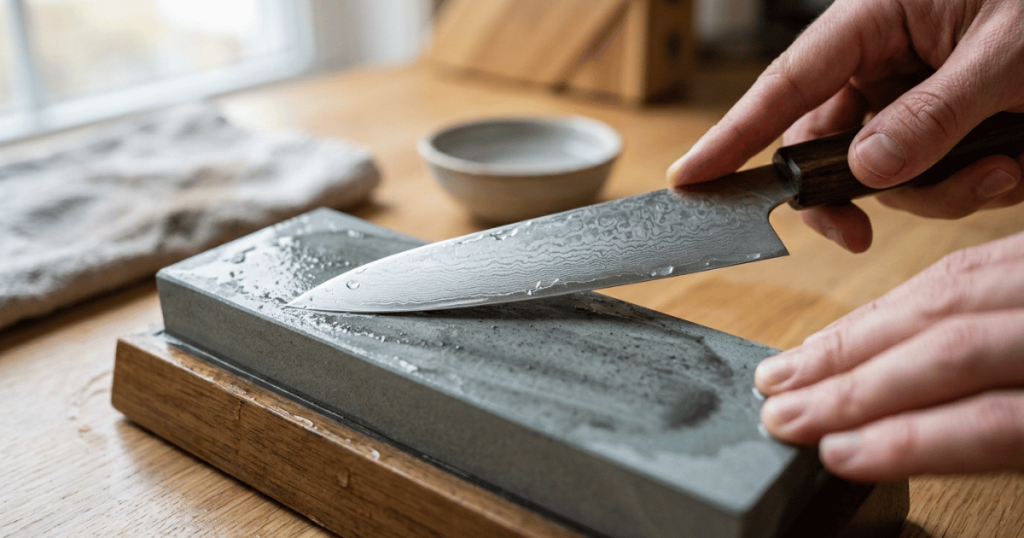
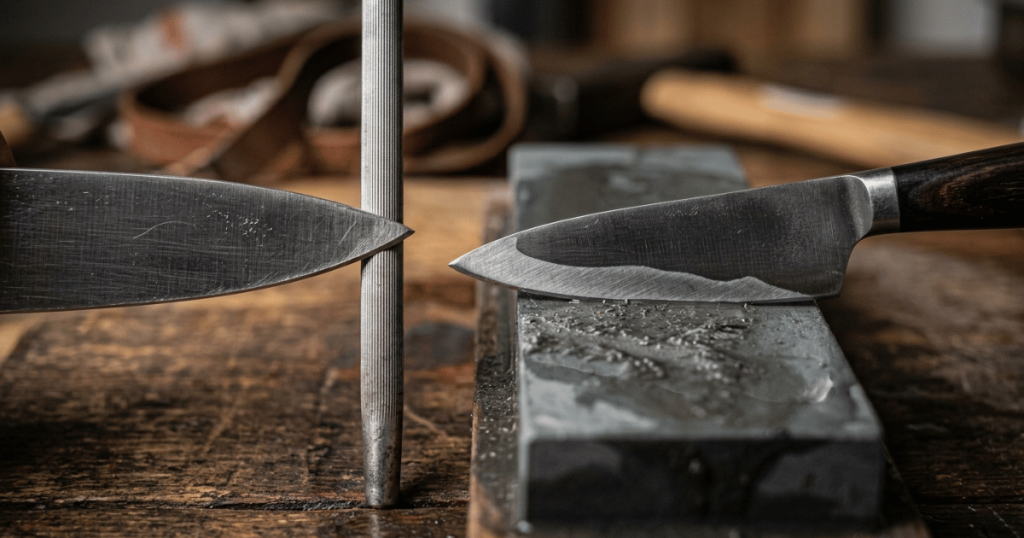
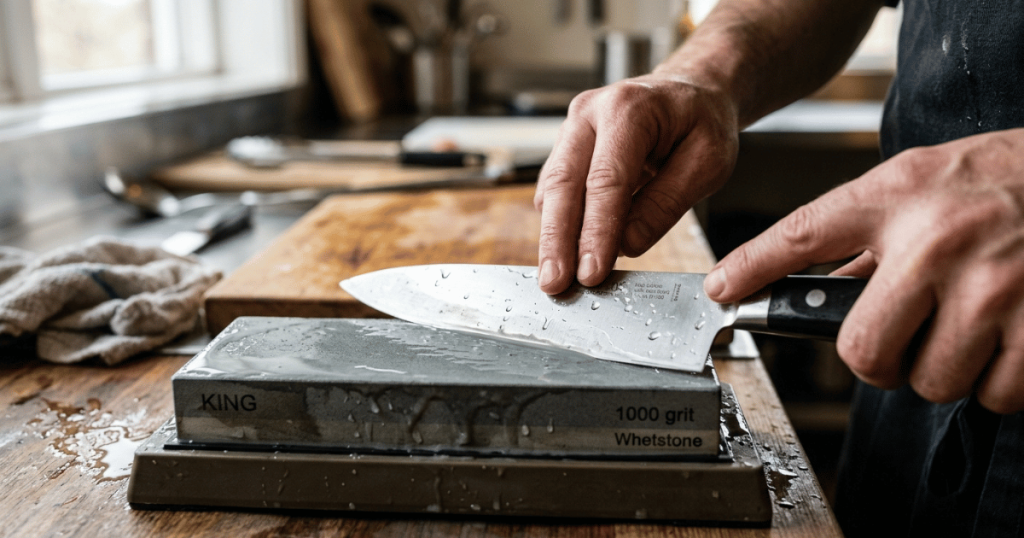
1. What equipment do you use? Waterstones, a guided system, a wet-wheel machine, a belt grinder. All of these can produce a sharp knife and they differ enormously in how much steel they take and how much heat they generate.
2. What angle will you put on it, and can you match my knife’s existing angle? The right answer to the second half is yes, or a question back about what the knife is. A service that puts everything at one angle is reshaping rather than maintaining. Finding your knife’s own angle before you go means you can ask the question specifically.
3. How do you keep the blade cool? This is the question that most reliably separates the careful from the fast. Heat above a certain point permanently softens hardened steel, and a knife that comes back overheated will never hold an edge again. Wet systems and light passes are the answer you want. Discomfort with the question is itself informative.
4. Do you sharpen Japanese knives, and single-bevel ones? Two separate questions. Plenty of good general sharpeners will tell you honestly that single-bevel work is not what they do, and that honesty is worth more than a yes.
5. Do you do serrated blades? Many services do not, and a service that says it will run a serrated knife through the same process as a straight one is telling you something. Serrations need one tooth at a time.
6. How much steel will come off? A sharpener who thinks in these terms is the sharpener you want. Every sharpening consumes the blade, and the difference between a light touch-up and a full regrind is years of knife life.
7. Will you reprofile it, or maintain what is there? Reprofiling is sometimes necessary, on a knife whose edge has been ruined or thickened over years. It should be a decision made with you, not a default.
8. What happens if you damage it? Not an aggressive question. Any established service has an answer.
9. What is the turnaround? Especially for mail-in, where you are without the knife for the whole time.
10. What does it cost, per knife, including anything extra? Ask directly and ask what varies. Longer blades, damage repair, serrations and reprofiling are commonly priced differently, and shipping both ways is a real cost on mail-in.
Mail-in against local
Neither is better. They are different trades.
Mail-in gives you access to specialists. If you own Japanese knives and there is nobody local who works on them, mail-in is how you reach someone who does. It is also the route to manufacturer service.
Against that: you are without the knife for the round trip, you are packing and shipping a sharp object, which needs doing properly, there is shipping in both directions to pay for, and you cannot have the conversation face to face.
Local gives you the conversation and the speed. You can see the setup, ask the ten questions in person, get a knife back the same week, and build a relationship with someone who then knows your knives.
Against that: you get whoever is nearby, and the range of quality is wide.
The practical arrangement many people land on: local for the everyday knives, mail-in or the manufacturer for the one or two knives that matter.
What it should cost, and why this page will not tell you
Prices for this service vary by region, by blade length, by condition and by what is actually being done, and they change.
This site will not publish a figure it has not read on a named service’s own page with a date on it, because a made-up range is exactly the sort of number a reader would carry into a shop and be wrong about.
What you can do instead, in ten minutes: get quotes from three services and ask each of them questions 1, 2, 3 and 6 as well as the price. The spread in the answers to those four will tell you more about the difference between them than the spread in the prices will.
And put the price against the knife. Sharpening a knife more than a few times costs more than the knife did if the knife was cheap. That is the arithmetic that decides whether to pay someone or to learn a stone, and it comes out differently for a supermarket knife and for one that will outlive you.
When a service is clearly the right call
- A knife with a deep chip or a broken tip. The repair is long and easy to get wrong.
- A knife that has been through a carbide pull-through for years and now has a thickened shoulder behind the edge. That needs thinning, which is real work.
- Single-bevel Japanese knives, unless you have learned specifically on them.
- Anything you are frightened of ruining. There is nothing wrong with that answer.
- A drawer of neglected household knives where the goal is functional rather than fine.
When it is not
- Routine maintenance on a knife you use daily. Honing and an occasional stone session are faster than a trip, and you get the knife back the same evening. The comparison between the methods covers where the line falls.
- A knife that only needs honing. Test first: hone it and see whether it comes back. A service will happily sharpen a knife that did not need sharpening, and steel will come off it.
- Cheap knives, repeatedly.
Handing the knife over
Say what you use it for. A sharpener who knows the knife meets bone will put a different edge on it than one who assumes vegetables.
Say if it is Japanese, and say if you know the maker’s angle. The steel behaves differently and a good sharpener will want to know.
Ask for it not to be reprofiled without asking you.
For mail-in, pack it properly: edge guarded, blade immobilized, box rigid, and labeled so nobody opens it carelessly. Check the service’s own packing instructions, which most publish.
Checking the knife when it comes back
Slice hanging paper, downward and away from you, and read the result along the whole blade rather than at one point.
Look down the edge under a light for surviving chips or flats.
Look at the blade height against your memory of it, or against another knife from the same set. A visibly narrower blade means a lot came off.
Look for discoloration near the edge: straw, blue or purple tinting means heat, and heat means softened steel. That is the one outcome a sharpening cannot be undone from, and it is worth raising immediately if you see it.
The short version
Ask what equipment they use, what angle they will set, how they keep the blade cool and how much steel comes off, before you ask the price. Mail-in reaches specialists and manufacturer service; local gives you speed and a conversation. Send out chips, broken tips, single-bevel knives and anything you would hate to ruin, and keep routine maintenance at home. When it comes back, check the paper cut along the whole blade, look for surviving chips, and check the steel for the heat colors that mean it was worked too fast.