An electric sharpener does not know when your edge is finished. It removes steel for as long as you feed the blade in, at whatever rate the motor turns. That is the entire risk with this tool and it is the reason the question people ask about it is how many passes rather than how to hold it.
The answer to that question is not a number. It is a stopping rule, and it is below.
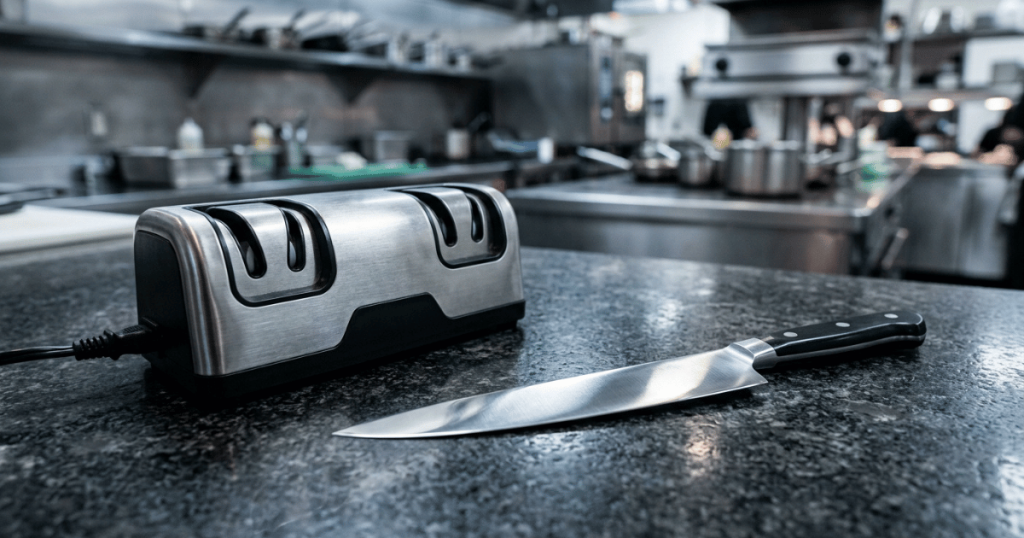
What the machine is doing
Inside an electric sharpener are motor-driven abrasive wheels, usually diamond-coated, set in guides that hold the blade at a fixed angle as you draw it through. Most have two or three stages: a coarse grinding stage, a finer sharpening stage, and often a honing or stropping stage.
Two things follow.
The angle is the machine’s. Like a pull-through, an electric sharpener imposes the angle built into its guides. Some machines have selectable angles, which helps, and none of them can measure the bevel already on your knife. Check your knife’s existing angle with a marker before the first use, so you know whether the machine is maintaining your edge or regrinding it.
The removal rate is set by the motor, not by you. On a stone, pressure and stroke count are yours and the feedback is immediate. On an electric machine, the wheel turns at its own speed regardless of what your hand is doing, and the only variables you control are how long the blade is in contact and how many times you pass it through. Time in contact is steel removed.
Four knives that should not go near one
Single-bevel Japanese knives. Ground on one side with a flat or hollowed back. A machine that works both sides equally destroys the geometry, and it is not recoverable at home.
Ceramic knives. Brittle, and a standard machine’s abrasives are not intended for them. Some manufacturers make specific ceramic-capable machines; that is a claim to check on the machine’s own documentation, not to assume.
Serrated knives, in a straight-edge stage. Some machines have a dedicated serrated stage, most do not, and running a serrated blade through a straight-edge stage flattens the scallop points without touching the recesses that do the cutting. Serrations are worked one tooth at a time unless the machine explicitly says otherwise.
Hard Japanese double-bevel knives, with caution. Harder steel chips under aggressive uncontrolled removal, and most carry a shallower factory bevel than a general-purpose machine assumes. If your machine has a selectable angle that matches, that is a different conversation, and the specific procedure for those knives is worth reading first.
Before you turn it on: read the machine’s manual
Not a formality. Electric sharpeners differ from each other more than any other category of sharpening tool, and the manual is the only document that governs yours.
Four things to find in it:
- The stage order and what each stage is for. Some machines require every stage every time. Some require the coarse stage only on a genuinely damaged edge. Getting this backwards is how blades get eaten.
- The angle the guides hold, and whether it is adjustable.
- Which knife types the maker says are not compatible. This list exists, it is specific to the machine, and it overrides anything general you read anywhere including here.
- Alternating sides. Most machines have a left and a right slot per stage and expect you to alternate. Doing all the passes on one side and then all on the other produces a lopsided edge.
The procedure
1. Set the machine on a stable surface at a comfortable height, with room on the far side for the blade to come out. Plug it in last.
2. Your free hand stays off the machine and off the blade path. The knife is held by its handle only. The other hand may rest on the counter or the body of the machine well away from the slots, and nothing goes near the exit.
3. Turn it on, then insert. Not the other way round. Placing a blade into a slot and then starting the motor is how a knife jumps.
4. Set the heel of the blade into the slot with the spine vertical, then draw the knife toward you at a steady speed so that the blade travels heel to tip through the wheel. Let the guides set the angle. Do not tilt, do not press down, do not push against the wheel. Pressure does not sharpen faster on a powered tool; it just holds more steel against a turning abrasive.
5. Alternate sides, one pass each, keeping the count equal. Left slot, right slot, left, right. Same speed each time.
6. Test after every full set of passes, not at the end. This is the stopping rule and it replaces the number you were hoping for.
How many passes: the stopping rule
Stop the first time it passes the test. Not the second time, not after a finishing set for luck.
The test: slice a sheet of hanging paper, downward and away from you, holding the paper by a top corner and moving the blade heel to tip. Or rest the edge on a tomato skin with no downward pressure and see whether it starts the cut on its own.
The moment it does, unplug the machine and put the knife away. Every additional pass after that point removes steel and buys you nothing measurable.
This is worth stating as a rule rather than as advice because of how the failure happens. Nobody grinds a knife away in one session. They do it two extra passes at a time, a dozen times a year, for six years, and then wonder why the blade is visibly narrower than the one they bought with it.
The coarse stage discipline
The coarse stage is for repairing damage, not for routine sharpening. Reach for it when there is a visible chip or a genuinely rounded edge, and skip it entirely the rest of the time.
Machines that walk you through all three stages by default are optimized for a good result rather than for a long blade life. Using only the fine and honing stages for maintenance is the single change that makes an electric sharpener a reasonable long-term tool rather than a fast one.
Afterward
Wipe the blade, from spine to edge, never along the edge. Grinding leaves fine steel particles.
Look down the edge under a light. Bright dots are chips that survived. If a chip is still there after your normal passes, that is the coarse stage’s job on a separate occasion, or a stone, or a professional. Repeating fine passes will not remove it and will thin everything else.
Clean the machine. Filings collect inside and most machines have a way to empty them. A machine full of swarf grinds worse.
Let it cool between knives if you are doing several. Motors in domestic machines have duty cycles, and the manual will say.
Signs the machine has stopped being the right tool
The knife will not come back. After years of a fixed-angle machine, the shoulder behind the edge thickens and the blade stops performing even when the edge itself is sharp. That is a reprofiling job, on a stone or by a professional.
The blade is visibly narrower. Compare against an unsharpened knife of the same model.
You have moved to better knives. Which method suits which knife is the decision to redo whenever the knives change.
Where you stop
- Turn the machine on before the blade goes in, and off before you take it apart or clean it.
- Unplug it before any cleaning or emptying.
- Never reach into a slot with the machine plugged in.
- Never run a finger along an edge to test it. Across, or use paper.
- Never force a blade that does not fit the slot.
- Stop if the blade catches, jumps or heats up. A blade getting hot to the touch is being ground too long in one place, and heat changes steel.
The short version
The machine removes steel for as long as you feed it, so the only question that matters is when to stop, and the answer is the first time the knife cuts paper. Read your machine’s manual, because these differ more than any other sharpening tool. Check your knife’s existing angle before the first use. Keep single-bevel, ceramic and serrated knives out of it, and be careful with hard Japanese steel. Alternate sides with equal passes, no downward pressure, and stay out of the coarse stage unless there is actual damage to repair.