Zwilling vs Henckels is not a contest between rival companies. Both brands belong to Zwilling J.A. Henckels. ZWILLING is the premium brand, which the company says has crafted cutlery in Solingen, Germany since 1731. HENCKELS is its everyday brand, established in 1895 and positioned on affordability. The price gap comes from how the blade is made and treated: Zwilling’s German lines state the company’s FRIODUR ice-hardening and a published hardness, while the Henckels chef’s knives we checked list no hardness, are made outside Germany or do not say where, and in one line are stamped rather than forged.
That last point is where most comparisons go wrong. They say “Zwilling is forged, Henckels is stamped,” and leave it there. The makers’ own pages show it is not that simple: there is a stamped Zwilling and a forged Henckels. What actually separates the brands is steel treatment, origin and how much each maker is willing to publish. Every specification below comes from zwilling.com or henckels.com, read on October 2, 2026. We did not test these knives.
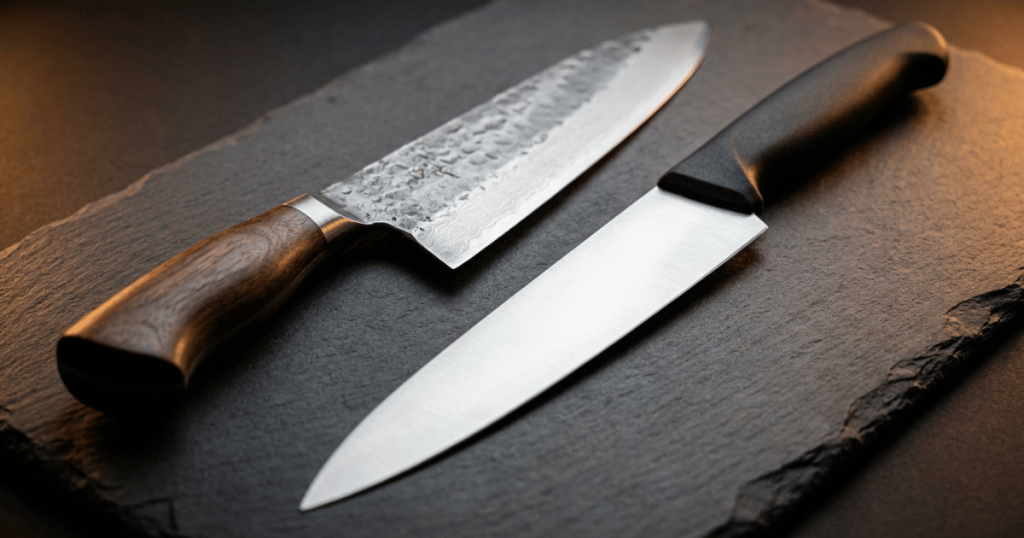
Why Zwilling and Henckels share a name
The name confusion is historical, and the company now leans into the split rather than hiding it.
Zwilling’s own page on ZWILLING and HENCKELS (read October 2, 2026) describes them as two distinct brands from one heritage. ZWILLING is presented with the line “LIVE EVERY MEAL,” “expert, German-made engineering,” and “cutlery crafted in Solingen, Germany since 1731.” HENCKELS is presented with “For every kitchen” and an emphasis on “quality, affordability, durable design.” The page says Henckels is “rooted in German engineering” but does not say where Henckels knives are made.
Over the years, retail listings have printed the names in every combination: “Zwilling J.A. Henckels,” “J.A. Henckels International,” “Henckels.” That is how a shopper ends up buying a “Henckels” knife believing it is the Solingen product. The fix is simple. Look at the brand name at the top of the product page and on the blade itself. On the Zwilling Gourmet chef’s knife, for example, Zwilling notes that “The center rivet is laser inscribed with the ZWILLING logo.”
Zwilling vs Henckels: four chef’s knives compared
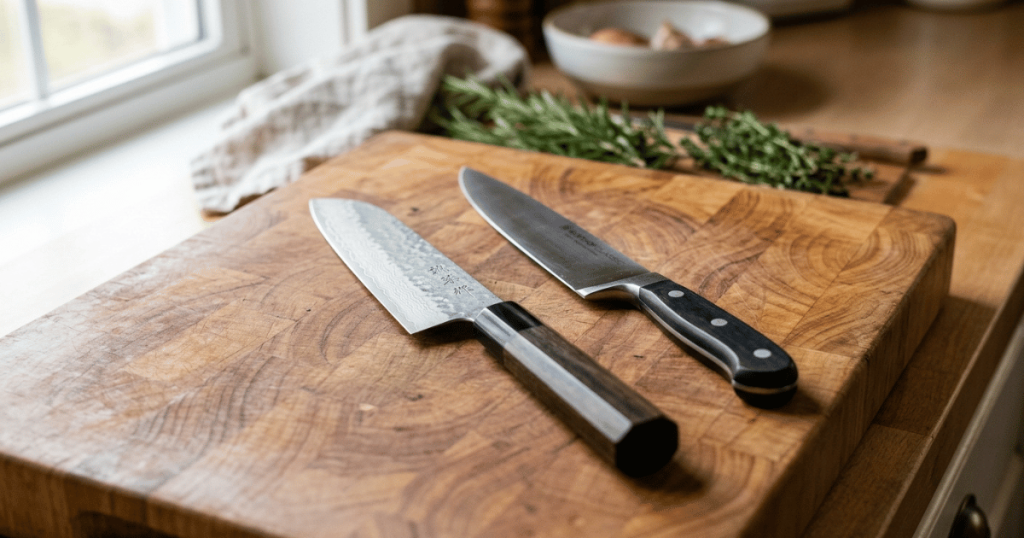
The table compares two 8 inch chef’s knives from each brand, chosen to show that construction alone does not divide them. Every entry is quoted from the maker’s own product page; “not stated” means the page we read does not list it.
| Zwilling Pro | Zwilling Gourmet | Henckels Classic | Henckels Statement | |
|---|---|---|---|---|
| Construction | “SIGMAFORGE – Single piece, forged knife” | “Precision-stamped from a single-piece of solid steel” | “Fully forged construction” | “Single-piece, precision-stamped, blade” |
| Steel treatment named | “Ice-hardened FRIODUR blade” | “Ice-hardened FRIODUR blade” | Not stated | Not stated |
| Steel description | “special-formula, high-carbon stainless steel” | “special-formula, high-carbon stainless steel” | “High-quality, German stainless steel” | “high-quality stainless steel” |
| Hardness | 55 to 58 HRC | 55 to 58 HRC | Not stated | Not stated |
| Origin | “Made in Germany” | “Made in Germany” | “Made in Spain” | Not stated |
| Handle | Full tang, triple riveted | Full tang, triple rivet | Triple-rivet | Triple rivet, full tang |
Sources: Zwilling’s product pages for the Pro and Gourmet 8 inch chef’s knives on zwilling.com, and Henckels’ product pages for the Classic and Statement 8 inch chef knives on henckels.com, all read October 2, 2026.
Read across the rows rather than down the columns. A stamped Zwilling (Gourmet) carries the same named hardening process, the same published hardness band and the same German origin as a forged Zwilling (Pro). A forged Henckels (Classic) carries none of those three statements. So “forged versus stamped” is not the brand line. Treatment, origin and disclosure are.
What the price difference actually buys
The product pages answer the “why is one twice the price” question better than any review, once you know what to look for.
A named heat treatment. Zwilling’s magazine article on how it makes its knives (read October 2, 2026) describes FRIODUR in four steps. “The steel is heated to above 1000 °C. It is then very quickly cooled so its temperature falls below 800 °C, subsequently being left to slowly cool down to room temperature.” Then: “Ice-hardening causes the steel to transform even more, further improving its hardness, as well as its resistance to wear and tear and corrosion.” Finally, “Tempering harmonizes the grain structure and relieves any stress from the material.”
A published hardness. Both Zwilling knives in the table list 55 to 58 HRC. Neither Henckels page we read lists a figure.
German manufacture. Both Zwilling knives state “Made in Germany.” The Henckels Classic states Spain; the Henckels Statement page does not state an origin.
For the forged lines, the forging method. The same Zwilling article explains SIGMAFORGE: “In the pre-treatment phase, heat is only applied to the part of the blank which is to be shaped into the bolster during forging,” which the company says leaves the steel’s structure “completely unaffected by the heat.”
None of this means a Henckels knife is poorly made. It means the Henckels pages give you less information to judge it by, and the premium brand is selling process and origin as much as steel.
The metallurgy behind ice-hardening, in plain terms
Why would a knife maker chill a blade below room temperature at all? The reason sits in what happens when steel is quenched.
Metallurgist Larrin Thomas explains it in his Knife Steel Nerds article “Cryogenic Processing of Steel Part 1: Maximizing Hardness” (read October 2, 2026). Quenching “transforms the steel to a phase called martensite which has high hardness.” But the transformation is not always finished at room temperature: “austenite is retained after quenching, because the martensite finish is below room temperature and therefore the transformation to martensite is never totally complete.” The cold step exists for that reason: “we can use cold temperature treatments to transform more of the austenite to martensite.”
That lines up with Zwilling’s own wording that ice-hardening “causes the steel to transform even more.” Zwilling does not publish the temperature it uses, so we will not guess at one. Tempering then trades back some brittleness for flexibility, which Zwilling describes as preventing “the blade from breaking.”
The practical result of a moderate hardness in the high 50s is a blade that tends to roll before it chips. That is the classic German edge: forgiving, easy to straighten on a honing steel, and in need of regular honing. If you own either brand, our guide to using a honing steel covers angle and pressure. Zwilling’s own care guide gives approximately 15° per side for honing ZWILLING knives.
Where the knives are made, line by line
Origin belongs to the product, not the brand. Here is what each page we read says, and what it leaves out.
- Zwilling Pro: “Made in Germany.”
- Zwilling Gourmet: “Made in Germany, with lifetime warranty.”
- Zwilling Four Star: the Four Star line page also states “Made in Germany,” and describes “a traditional plastic handle with a partial tang.”
- Henckels Classic: “Made in Spain,” from “High-quality, German stainless steel.”
- Henckels Statement: the product page we read does not state a country of origin.
Two lessons follow. First, a Henckels knife can use German steel and still be made outside Germany; the page tells you those as separate facts. Second, even within Zwilling, construction varies: Four Star has a partial tang, while the Pro and Gourmet pages describe a full tang. “Premium brand” does not mean every feature matches across lines.
What neither brand’s pages tell you
This is the honest part a sales page skips.
- Hardness is missing on the Henckels side. You cannot compare edge behavior on numbers that are not published. Treat the Henckels figure as unknown, not as equal to Zwilling’s.
- “Dishwasher safe” is a durability claim, not advice. The Gourmet page says “Dishwasher safe, hand wash recommended,” and both Henckels pages list dishwasher safe. Our guide on whether you can put knives in the dishwasher explains what the cycle does to an edge and a handle.
- A range is not a measurement. “55 to 58 HRC” is the band a line is made to. It is not a test result for the knife in your hand.
- Origin can change. Lines move between factories over time. The page you read today is the only reliable answer for the knife you buy today.
Who should choose which
- Choose a Zwilling line if you want German manufacture, a named ice-hardening process and a published hardness band, and you are willing to pay for those. If you prefer a lighter knife, the stamped Gourmet line keeps those three features without forging.
- Choose Henckels if your priority is a lower price and you are comfortable buying with fewer published specs. The Classic line is forged; the Statement line is stamped and described by Henckels as lightweight.
- Choose by line, not logo, either way. Read construction, origin and hardness on the product page for the exact knife.
If you are still deciding between German and Japanese styles, our guide to the best kitchen knives by type, steel and budget starts one step earlier.
FAQ
Is Henckels the same as Zwilling?
They are the same company but different brands. Zwilling describes ZWILLING and HENCKELS as two distinct brands from the Zwilling J.A. Henckels heritage: ZWILLING as the premium Solingen brand, HENCKELS as the everyday, affordable one.
Why is Zwilling more expensive than Henckels?
On the makers’ own pages, Zwilling’s German lines state FRIODUR ice-hardening, a hardness of 55 to 58 HRC, and “Made in Germany.” The Henckels chef’s knives we checked state neither a hardening process nor a hardness, and the Classic is made in Spain.
Are Henckels knives made in Germany?
Not the ones we checked. The Henckels Classic chef’s knife is listed as made in Spain from German stainless steel, and the Statement page does not state an origin. Check the product page for any specific knife.
Are all Zwilling knives forged?
No. Zwilling’s Gourmet line is precision-stamped from a single piece of steel, though Zwilling still lists it as ice-hardened and made in Germany. The Pro and Four Star lines are forged.
How can I tell a Zwilling from a Henckels knife?
Read the brand name on the blade and at the top of the product page. Zwilling notes that its Gourmet chef’s knife has the ZWILLING logo laser inscribed on the center rivet.