Yanagiba vs deba vs usuba comes down to three different jobs. The yanagiba is a long, slim knife for slicing raw fish into sashimi in a single pull. The deba is a thick, heavy, pointed knife for breaking down whole fish: heads, collars, fillets and small bones. The usuba is a tall, thin, flat vegetable knife for very fine cuts and paper-thin sheets. All three are traditionally single-bevel. For sushi at home, the yanagiba is usually the first and often the only one you need.
The rest of this page explains why a single-bevel edge suits these jobs, how the three work in sequence, and what the double-bevel alternatives are if you do not want to learn a new sharpening method.
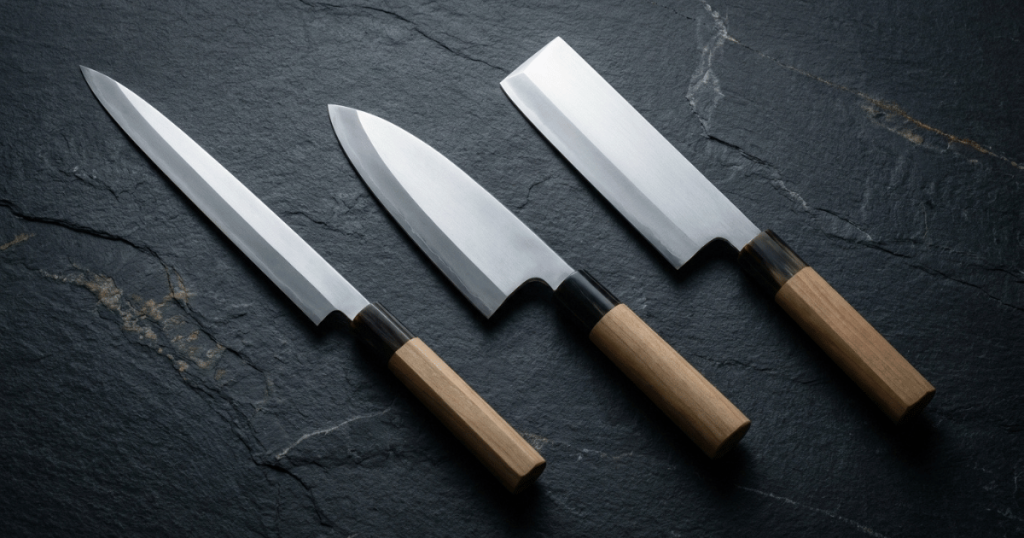
Yanagiba vs deba vs usuba at a glance
| Yanagiba | Deba | Usuba | |
|---|---|---|---|
| Main job | Slicing raw fish for sashimi and sushi | Breaking down whole fish | Fine vegetable work |
| Blade shape | Long, narrow, pointed | Short to medium, wide, thick spine, pointed | Tall, rectangular, flat edge |
| Typical length (Wikipedia) | 27 to 33 cm | 12 to 21 cm | 15 to 24 cm |
| Thickness | Thin | Thick and heavy | Very thin |
| Motion | One long pulling stroke | Controlled cuts, some force at the heel | Push cuts, rotary peeling |
| Double-bevel equivalent | Sujihiki | No true equivalent | Nakiri |
Size ranges are from Wikipedia’s entry on Japanese kitchen knives (read September 28, 2026). Its entry on the deba adds that the blade is usually 5 to 7 mm thick, with some larger examples reaching 10 mm.
Why these three knives are single-bevel
Before choosing between them, it helps to understand what they share, because it explains both their strengths and why they are not beginner knives.
A single-bevel knife is ground on one face only. The front carries a wide bevel that runs from a visible line, the shinogi, down to the edge. The back is not simply flat. Sakai Ichimonji Mitsuhide, a knife maker in Sakai, explains in its article The Structure of a Single-Edge Knife (dated March 27, 2024, read September 28, 2026) that the back is concave, a hollow called the urasuki, so that “the back side of the blade stays away from the pressure that is generated in the food when it is being cut.” A narrow flat rim around that hollow, the uraoshi, is what actually meets the stone when the back is sharpened.
The maker also describes the traditional construction: a hard carbon steel edge forge-welded to softer iron. The hard steel takes and holds a very keen edge; the soft iron makes the wide bevel easier to grind and keeps the blade from being brittle throughout.
What this does in food:
- Less wedging. A double-bevel knife pushes food apart on both sides as it goes in. A single-bevel knife parts food mostly on the beveled side, while the flat back travels close to the cut face. With raw fish, that means a smoother surface and less crushing.
- A very acute edge. With the angle on one side only, the edge can be extremely thin, which suits soft fish and fine vegetables.
- Handedness. A right-handed knife has its bevel on the right face. Left-handed cooks need a mirror-image knife, which makers produce separately.
- Steering. In thick food the blade tends to drift toward its beveled side. Straight cuts take practice.
The yanagiba: the sashimi slicer
The yanagiba’s length is its whole point. A long blade lets you slice a piece of fish in one continuous pull from heel to tip, instead of sawing back and forth. Sawing tears the flesh and leaves a ragged surface; one pull leaves it glossy and clean.
It is narrow because it does not need height for knuckle clearance on a board, and a narrow blade has less surface for fish to stick to. The single bevel and urasuki then let each slice fall away cleanly.
What it cannot do: cut through bone, chop vegetables, or handle anything hard or frozen. The edge is thin and hard, and twisting or striking it chips it.
The deba: the fish butcher
The deba looks like a small, very heavy chef’s knife with a thick spine that tapers to a fine edge. The weight and thickness let it cut through the heads and collars of fish and the small bones along the spine, and its point and single bevel let it follow the frame of a fish closely when taking off fillets.
Wikipedia’s entry on the deba describes it as “primarily used to cut fish, though are also used occasionally in preparing meat,” and notes it is “not intended for chopping heavy, large diameter bones of beef, lamb, or pork.” It is not a cleaver. The thick spine gives it strength, but the edge is still hard, thin, single-bevel steel.
Wikipedia names two main sizes: the larger hon-deba (“true deba”) and the smaller ko-deba. A smaller deba suits the smaller whole fish a home cook is more likely to buy.
What it cannot do: slice sashimi well (it is too thick and short), fine vegetable work, or heavy bones. Chips on a deba are usually from bones too large for it or a twisting motion; our guide on how to fix a chipped knife edge, and when not to try covers what can be repaired at home.
The usuba: the vegetable specialist
The usuba’s name means thin blade, and it is the thinnest of the three. Wikipedia describes it as “a vegetable cleaver similar in shape profile to the double-bevel nakiri,” with two regional styles: the edo-usuba with a square tip and the kamagata-usuba with a rounded tip.
The usuba exists for tasks where a slight wedge would ruin the result. The best known is katsuramuki, peeling a daikon or cucumber into one long, continuous, paper-thin sheet, which is then cut into fine strips. The flat edge meets the board along its whole length, so push cuts go fully through.
What it cannot do: anything involving bone, hard squash with force, or rocking cuts. It is also the hardest of the three to sharpen well, because the long, flat edge must stay perfectly straight.
How the three work together
In a Japanese kitchen these knives are not rivals. They work in sequence on a whole fish:
- The deba takes off the head, opens the fish and removes the fillets from the frame.
- The yanagiba slices those fillets, or the trimmed blocks cut from them, into sashimi.
- The usuba prepares the vegetable garnishes that go on the plate alongside.
That sequence answers the home cook’s question. If you buy fish as ready-trimmed blocks, often sold as saku, there is no butchery to do, and the deba has no job. Only the yanagiba does something your existing knives cannot.
Which one should a home sushi cook buy first?
- You buy trimmed blocks of fish. A yanagiba. It is the one knife whose job nothing else in a Western kitchen does as well.
- You buy whole fish regularly and break them down. A deba, usually a smaller size, then a yanagiba later.
- You want very fine vegetable cuts and garnishes. An usuba only if you want to learn the single-bevel technique. Otherwise a double-bevel nakiri does most of the work.
If you are new to single-bevel knives, consider the double-bevel routes first:
- Sujihiki instead of a yanagiba. A long, narrow double-bevel slicer. It gives up some of the clean release of a single bevel but cuts straight and sharpens like any other knife.
- Nakiri instead of an usuba. Same rectangular shape, double-bevel, far more forgiving.
- No real substitute for the deba. A Western boning or fillet knife handles the filleting; nothing double-bevel matches the deba’s strength on fish heads.
For a broader look at how these fit with the everyday Japanese shapes, and how to tell a knife made in Japan from one only styled that way, see our guide to real vs Japanese-style kitchen knives.
Sharpening single-bevel knives
All three share the same sharpening logic, and it is different from a Western knife. The wide front bevel is laid flat on the stone and sharpened across its whole face. The back is only lightly worked on the uraoshi rim to remove the burr, never ground flat across, or the urasuki hollow is lost and the knife stops behaving like a single-bevel knife. Our guide to sharpening a single-bevel knife explains why the back is not flat and how to treat it.
Because the whole bevel face sits on the stone, a dished stone rounds the bevel and the edge. Flat stones matter more for these knives than for any other; see our guide on flattening a whetstone.
Traditional versions are mostly carbon steel and will rust or discolor if left wet. Wipe and dry them between fish and vegetables, and after every use.
A note on safety
These are very sharp, very hard edges, and the deba is heavy. Cut on a stable board that does not slide, keep fingers well clear of the pulling stroke of a long yanagiba, and never try to catch a falling knife. When cutting near bone with a deba, keep the motion controlled and straight rather than twisting.
FAQ
What is the difference between a yanagiba, deba and usuba?
The yanagiba is a long slicer for sashimi, the deba is a thick, heavy knife for breaking down whole fish, and the usuba is a thin, flat vegetable knife. All three are traditionally single-bevel.
Which Japanese knife should I buy first for sushi?
If you buy fish already trimmed into blocks, a yanagiba. If you break down whole fish, a small deba first. Most home sushi cooks start with the yanagiba.
Can a deba cut through bones?
It handles fish heads, collars and small fish bones. It is not designed for large bones of beef, lamb or pork, and forcing it through them can chip the edge.
Is a nakiri the same as an usuba?
They share the rectangular shape and flat edge. The usuba is single-bevel and thinner, while the nakiri is double-bevel and easier for most home cooks to use and sharpen.
Are left-handed single-bevel knives available?
Yes, but they must be made as mirror images, with the bevel on the other face. A standard right-handed single-bevel knife cannot simply be used in the left hand.