High carbon steel kitchen knives, meaning plain carbon steel without enough chromium to be stainless, are valued for how keenly they sharpen and how readily they return to that edge on a stone. The price is a daily routine: they rust, they react with acidic food, and they need wiping during use, washing and drying right after, and no dishwasher, ever. If that routine sounds fine, the knife rewards it. If it sounds like a chore, a stainless knife will serve you better.
Before any of that, one label problem needs clearing up, because it decides whether this page applies to your knife at all.
What “high carbon” means on a label, and what it does not
Two very different kinds of knife are sold under almost the same words.
- High carbon steel (often just “carbon steel”) is steel that relies on carbon for its hardness and does not contain enough chromium to be stainless. This is the knife that rusts, darkens and needs the routine on this page.
- High carbon stainless steel is stainless steel, meaning it contains at least 10.5% chromium, which is the minimum the stainless industry group Team Stainless uses to define stainless steel. The “high carbon” part means there is enough carbon for it to harden. Most kitchen knives in stores fit this description, and it behaves like ordinary stainless.
If your listing says “high carbon stainless,” most of the daily discipline below is good practice rather than a requirement. If it says carbon steel, or names a non-stainless steel, all of it applies. When in doubt, the maker’s product page or care page will say whether the blade is stainless.
What you gain with a high carbon steel knife
An edge that sharpens keenly and easily. Carbon is what lets steel be hardened to hold a fine edge. Shun, describing its own steel, puts it simply: more carbon improves strength and durability. Carbon steels without heavy alloying have a long reputation among sharpeners for coming back to a fine edge quickly on a stone.
A pleasant sharpening experience. Many stainless steels contain hard carbides that resist abrasion. Simpler carbon steels generally have less of that, so a few minutes on a whetstone often does more. If you already sharpen on stones, this is a real advantage, and our guide to sharpening kitchen knives with a whetstone covers the process.
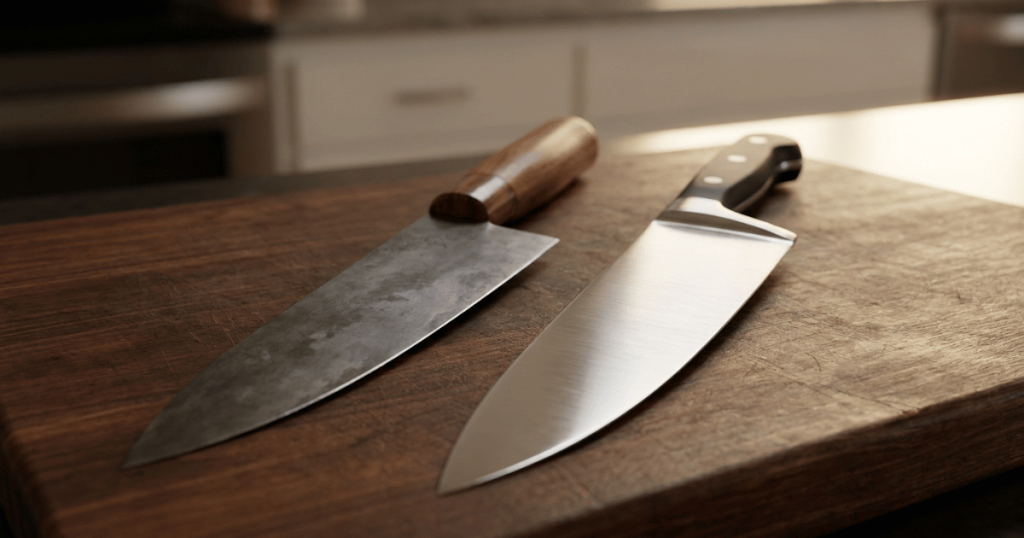
A patina that protects. Carbon steel changes color with use, from gray to blue to darker tones, depending on what you cut. Kramer Knives, a maker of carbon steel kitchen knives, explains that as the steel is exposed to different elements it naturally oxidizes, and that over time this patina acts as a protective layer against rust. The look is part of the appeal for many owners.
Hardness varies from knife to knife and is not guaranteed by the word “carbon.” A carbon steel knife’s hardness depends on its heat treatment, and the Rockwell C figure, measured under ASTM E18, belongs on the maker’s page. We do not quote one here because none was read for a specific knife.
What you give up
- Rust resistance. Without the chromium layer that makes steel stainless, a carbon blade left wet will rust, and it does not take long.
- Tolerance of acid. Kramer Knives notes that carbon tends to react with acid. Cutting tomatoes, citrus or onions can darken the blade quickly, and a wet, acidic blade left sitting is where spotting starts.
- A uniform look. The patina is uneven and changes over time. If you want a knife that always looks new, carbon steel will disappoint you.
- Carelessness. The dishwasher, the soaking sink, the drying rack and a drawer full of damp utensils are all off limits.
The daily routine for high carbon steel kitchen knives
This is the part retail pages leave out. It is not complicated, but it is every day.
- Wipe the blade between foods. Kramer Knives says that because carbon reacts with acid, it is good practice to wipe the blade with a towel in between foods. Keep a dry towel within reach while you prep.
- Wash it gently with soap right after use, by hand, with a soft sponge. Kramer’s instruction is to gently wash with soap and thoroughly dry the knife after each use.
- Dry it completely, immediately. Blade, spine, the joint with the handle, and the handle itself. Victorinox, writing about knives in general, warns against leaving knives to air-dry because water spots can form and lead to rust. On carbon steel that warning is literal.
- Never put it in the dishwasher. Kramer Knives is emphatic that the dishwasher will damage the blade and cause the handle to crack.
- Put it away dry, somewhere with air, not in a closed damp place.
- If it will sit unused for a while, a very thin film of food-safe oil on a clean, dry blade gives extra protection. Wipe off the excess, and follow your maker’s care page on which oil.
The routine works best as a reflex rather than a rule. Wipe, wash, dry, put away, every time, and carbon steel is easy to live with.
Patina: the layer you grow on purpose
New owners often mistake a patina for damage. A gray, blue or darker film that does not wipe off and does not leave orange on a white cloth is the stable oxide that Kramer describes as protective. Orange or red-brown spotting that rubs off is rust, and that is the one to act on.
A patina forms by itself through ordinary cooking. You do not need to do anything special to get one, and it does not affect how the edge cuts. Sharpening removes it from the edge zone, which is expected. The fresh steel at the edge will color again with use.
When rust appears anyway
It will happen at some point, usually after a busy evening or a forgotten wet knife. Kramer Knives describes a graduated approach to rust removal, starting gentle and escalating only as needed: a used scouring sponge with detergent first, then a powdered cleanser such as Bon Ami, then a new sponge with cleaning compound, and only then sandpaper. Start at the gentlest step that works, and move along the flat of the blade with the edge turned away from your hand.
Safety first while you do it. Work with the knife flat on a stable surface, keep your fingers on the spine side, and do not use power tools on a kitchen knife to remove rust. Remove rust fully before the knife touches food again, then wash, dry and oil lightly.
Know where to stop. If dark pits remain after the orange is gone, the corrosion has eaten into the steel and no cleaning will bring it back. Pits on the flat are mostly cosmetic. Pits that reach the cutting edge are a job for a professional sharpener, and deep pitting through the edge may mean the knife is finished.
Sharpening and honing a carbon blade
Carbon steel is at its best on water stones, and many carbon steel kitchen knives are Japanese-style blades ground thin. Our guide on how to sharpen Japanese kitchen knives without chipping covers the angle and pressure, and our whetstone grit guide explains which stones to start with. After sharpening, rinse and dry the blade right away. Freshly exposed steel at the edge, sitting in stone slurry, is the most rust-prone surface the knife has.
Between sharpenings, a light touch on a honing rod straightens a rolled edge. On thin, hard blades keep the pressure gentle, and our guide on how to use a honing steel covers the grip and angle.
Who should not buy a high carbon steel knife
This is a knife for people who want it, not a universal upgrade. Skip it, or buy it as a second knife rather than your only one, if:
- Other people in your house wash up, and not all of them will dry a knife immediately.
- Your knives regularly end up in the dishwasher or the sink.
- You want a blade that always looks like it did in the box.
- You live somewhere humid and have nowhere dry and airy to keep knives.
- You would rather hone and use a sharpening service than ever pick up a stone.
None of those makes you a worse cook. They just describe a kitchen where stainless steel is the more honest choice.
Frequently asked questions
Is high carbon steel the same as high carbon stainless steel?
No. High carbon steel, often called carbon steel, is not stainless and will rust. High carbon stainless steel contains at least 10.5% chromium, the minimum the stainless industry uses to define stainless, plus enough carbon to harden well. It behaves like ordinary stainless and does not need the carbon steel routine.
Do high carbon steel knives rust?
Plain carbon steel knives do, if they are left wet or dirty. Wiping between foods, washing and drying right after use, and keeping them out of the dishwasher prevents most of it. A patina that forms with use also helps, and Kramer Knives describes it as a protective layer against rust.
Is the patina on a carbon steel knife safe?
A patina is a stable oxide layer that forms naturally on carbon steel as it is exposed to food and air, and makers such as Kramer Knives describe it as protective. It is different from rust: patina is gray, blue or dark and does not rub off orange. Rust should be removed before the knife touches food again.
Are high carbon steel knives worth it for a home cook?
They are worth it if you enjoy sharpening and will wipe, wash and dry the knife every time. They are not worth it if knives in your house end up in the sink or dishwasher. Many home cooks keep one carbon steel knife alongside stainless ones rather than switching over completely.