Kitchen knife safety comes down to a few habits: carry a knife with the point down, set it on the counter instead of handing it over, never leave one in a sink full of water, never try to catch one that falls, and work only on a stable surface. These are the same practices the UK’s Health and Safety Executive (HSE) sets out for professional kitchens, and they transfer to a home kitchen unchanged. They are what this page covers.
Something you won’t find here is how to hold food or make a cut. Grip and cutting technique are a skills lesson in their own right. Everything below is about the moments when a knife is not cutting at all, which is when a surprising number of injuries happen.
Why the moments between cuts matter
When you are cutting, your attention is on the knife. When you are carrying it to the sink, reaching past it for a pan, or feeling around in soapy water, it is not. The HSE’s guidance on safe use of knives in catering reflects that. Most of its list is about handling, washing and where a knife is left, not about the cut itself. It also notes that knife injuries in catering typically affect the non-knife hand and fingers, but can reach the upper arm and torso.
A home kitchen has fewer knives than a restaurant, but it also has children, guests, pets, and a single sink that everything goes into. The habits below cost nothing and take no skill.
Carrying a knife across the kitchen
The HSE’s instruction is short: carry a knife with the blade pointing downwards. In practice that means holding it by the handle, close to your side, with the point toward the floor and the edge turned back, away from the direction you are walking. If you trip or someone steps into your path, the point goes toward the floor rather than into them.
Two more items from the HSE list apply at home. Do not carry knives while carrying other objects, because your attention and your balance go to whatever is heavier or hotter. And do not carry a knife in your pocket. In a busy kitchen, it also helps to say out loud that you are behind someone with a knife. Professional kitchens do this for the same reason drivers signal.
Passing a knife to someone
The safest hand-off is not a hand-off. Set the knife down on the counter with the handle toward the other person and the edge facing away from both of you, take your hand off it, and let them pick it up. Nobody has to judge when the other person has a grip, and nobody grabs at a moving blade.
If you must hand a knife directly, offer the handle, keep the edge turned away from both hands, and do not let go until the other person clearly has it. Never pass a knife point-first, and never toss one, even a short distance.
Where a knife sits when nobody is holding it
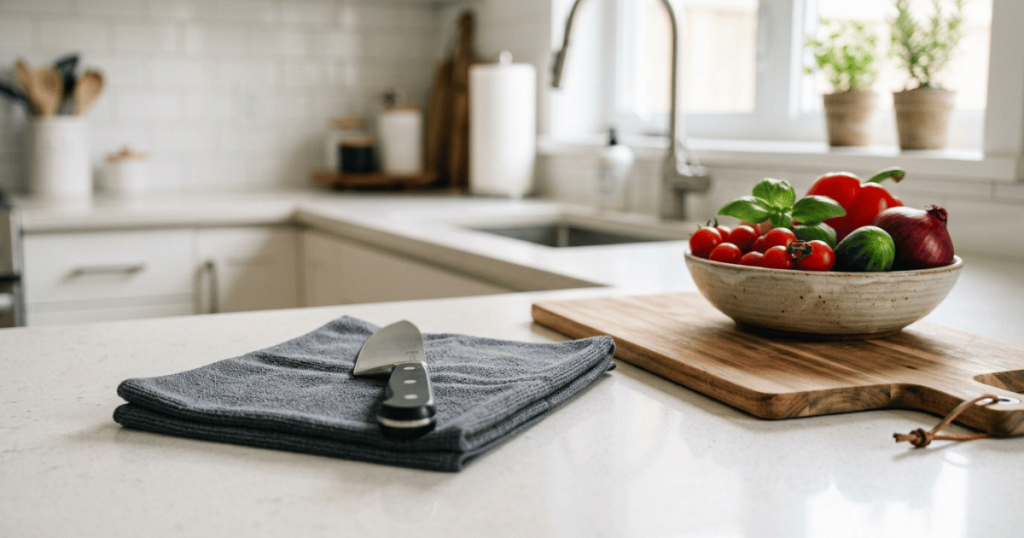
The HSE warns against leaving knives loose on work surfaces where they can be accidentally pushed off. At home that means three things: not near the edge of the counter, not under a towel, peelings or a pile of food where someone reaches in without seeing it, and not sticking out over the edge of a cutting board or counter. After use, the HSE says to store knives securely. How you store them is a separate subject, but a knife left lying out is not stored.
Washing up is where home cooks get cut
A knife dropped into a sink full of soapy water is invisible. The next hand into that water finds it with the fingers first. The HSE lists handling knives carefully when washing up as a core practice, and the most useful version of it is simple: never put a knife into a sink of water. Wash it on its own, right after you use it, and put it away or on the rack before you start on the rest of the dishes.
Direction matters too. Victorinox tells owners to wipe from the spine toward the edge when drying, to avoid accidental cuts. The same logic applies to washing: the cloth or sponge moves along the spine and over the flat of the blade, and your fingers never close around the edge. Keep the edge turned away from your hand the whole time.
Never catch a falling knife
This one is on the HSE’s list of things not to do, and it deserves its own heading because the reflex to catch is strong. A falling knife can tumble so that the edge meets your hand. Step back, move your feet, and let it land. A chipped tip is a sharpening job. A cut palm is a trip to urgent care. Wearing closed shoes in the kitchen when you are cooking with knives gives your feet a margin too.
The dull-knife myth, read honestly
“A sharp knife is safer than a dull one” appears on almost every kitchen knife safety page, including the HSE’s, which lists “keep knives sharp” among its practices. The reasoning is sound. A dull edge needs more force, more force means a slip carries more energy, and a blade that skids on a tomato skin is going somewhere you did not aim it.
Our research went looking for the evidence under the claim. The pages that state it with numbers are mostly knife retailers and sharpening services. We did not find a controlled study comparing injury rates for sharp and dull kitchen knives, and the injury tallies quoted alongside the claim do not record how sharp the knife was.
So the fair summary is this: keeping knives sharp is sensible, reasonable, and recommended by a safety regulator, but “dull knives cause more injuries” is reasoning rather than a measured result. The flip side is also true. A freshly sharpened knife cuts skin as easily as it cuts food, so the day you sharpen is the day to be most careful with the other habits on this page. Our guide on how often to sharpen kitchen knives covers the signs that an edge actually needs attention.
Kitchen knife safety when children start cooking
When a child starts helping in the kitchen, the habits on this page are the right place to begin, before any cutting lesson. How to carry a knife, where to set it down, why it never goes in the sink, and why you step back from a falling one are all things a child can learn and repeat long before they are ready to use a sharp knife. An adult decides when a child is ready to cut, and supervises when they do. Keep knives out of reach when no adult is in the room.
Sharpening is a knife-safety task too
The sharpening session is when your hands spend the most time near an edge that is getting keener by the minute. The HSE’s guidance includes training in safe working practices when sharpening, and the same basic rules apply at home:
- Work on a stable surface. A stone or sharpener that shifts under pressure takes the blade with it.
- Keep the edge moving away from the hand that is steadying anything.
- Use a powered sharpener exactly as its maker’s manual describes, including where your hands go, how the knife enters the slot, and how many passes to make. Our guide on using an electric knife sharpener explains why the manual’s pass count matters.
- Do not test the edge with a thumb or fingertip. Our guide on how to tell if a knife is sharp covers tests that keep fingers away from the edge.
- If you use a honing rod, hold it so the edge travels away from your hand. Our guide to using a honing steel covers the grip and the angle.
If someone does get cut
MedlinePlus, the U.S. National Library of Medicine’s consumer health service, gives the basic first aid for minor cuts: wash your hands, wash the cut with mild soap and water, use direct pressure to stop the bleeding, then apply antibacterial ointment and a clean bandage that will not stick to the wound.
It also says to call 911 or emergency services if the bleeding is severe or cannot be stopped, for example after 10 minutes of pressure, or if the person cannot feel the injured area or it does not work right. It advises contacting a health care provider right away if the wound is large or deep even when bleeding is not severe, if it is more than a quarter inch deep, on the face or reaching the bone, or if the person has not had a tetanus shot within the last 10 years. If you are unsure, get it checked.
Taking knives out of the house
Everything above is about the home kitchen. Once a knife leaves the house, for a cooking class, a new apartment or a picnic, carrying it is governed by the law where you are, and that varies from state to state and from city to city. We are not going to summarize it, because a general statement would be wrong somewhere. Check your own state’s statute and your local ordinances before you transport knives, and pack them so the edges are covered.
Frequently asked questions
What is the safest way to carry a kitchen knife?
Hold it by the handle, close to your side, with the point toward the floor and the edge turned back, away from the direction you are walking. The UK Health and Safety Executive’s kitchen guidance says to carry a knife with the blade pointing downwards, not to carry knives while carrying other things, and not to carry one in your pocket.
How should you pass a knife to someone?
Set it down on the counter with the handle toward them and the edge facing away from both of you, take your hand off it, and let them pick it up. If you have to hand it over directly, offer the handle with the edge turned away and do not let go until they clearly have it.
Is a dull knife really more dangerous than a sharp one?
The reasoning is sound, and safety guidance recommends keeping knives sharp, but we found no controlled study measuring it. A dull edge needs more force and can skid, which makes slips more likely and more forceful. A freshly sharpened knife is also very unforgiving, so treat it with extra care.
Why shouldn’t you put a knife in a sink full of water?
Because nobody can see it. The next person to reach into the water finds the edge with their fingers. Wash knives separately, straight after use, and put them away before you start on the rest of the dishes.