Replace a kitchen knife when the damage is in the knife itself: a cracked or bent blade, pitting that runs into the cutting edge, a handle that moves on the tang, or a blade sharpened away until the heel no longer meets the board. Restore it when the damage lives only at the edge: dullness, a rolled edge, small chips, a snapped tip or surface rust. Almost everything a home cook calls “ruined” belongs in the second group.
The catch is that restoring is not free. Every fix at the edge removes steel, and steel is the one thing a knife cannot get back. So the honest version of this decision has two parts: can it be fixed, and what does the fix cost the blade.
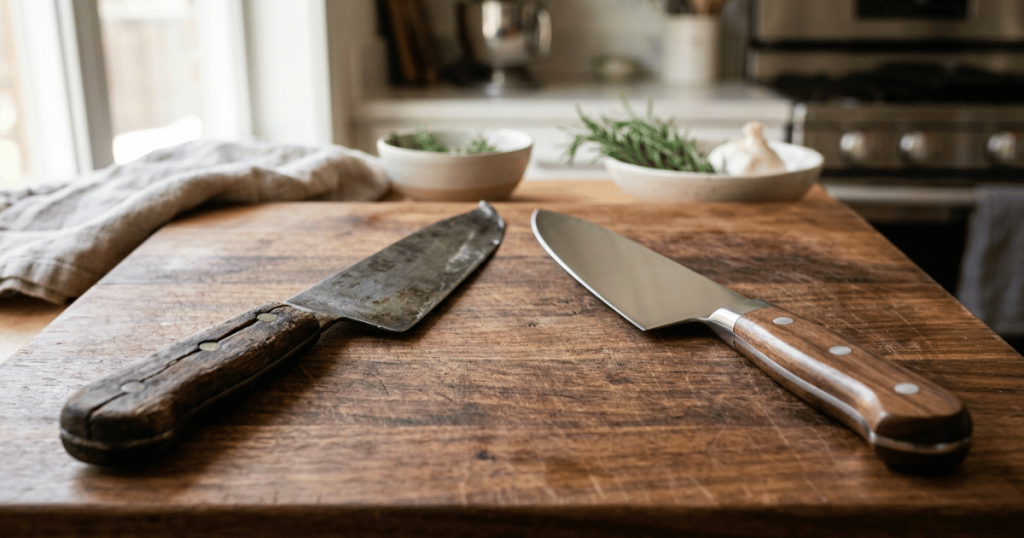
The one question that decides it: edge or knife?
A kitchen knife is two very different things joined together. The edge is the last few millimeters of steel, and it is designed to be consumed. Sharpening grinds a fresh edge out of the metal behind the old one, which is why a knife can be sharpened for decades. The knife is everything else: the body of the blade, the tang running into the handle, the handle, and the joint between them. None of that is meant to wear, and none of it regrows.
That gives you a simple test. If the problem can be ground away within the edge zone, it is a maintenance job. If the problem is in the body, the tang or the handle, sharpening cannot reach it, and the knife is either a repair job for a professional or finished.
When to replace kitchen knives versus restore them: the triage table
| What you see | What it usually is | Verdict | Who fixes it |
|---|---|---|---|
| Slides off tomato skin, tears instead of slicing | Rolled or worn edge | Restore | You: hone first, sharpen if honing fails |
| Small nick in the edge | Minor chip | Restore | You or a sharpener |
| Deep chip or several chips | Major edge damage | Restore at a real cost in blade height | A professional sharpener, after a quote |
| Tip snapped off | Broken tip | Restore, but the knife ends up shorter | A professional, or the maker’s service |
| Orange bloom that wipes or scrubs away | Surface rust | Restore | You |
| Dark pits that stay after the orange is gone, reaching the edge | Pitting corrosion | Usually replace | A professional can sometimes grind past shallow pits |
| Blade visibly bent | Deformed steel | Usually replace | Not a kitchen job |
| Any crack in the blade | Structural failure | Replace, stop using now | Nobody |
| Handle twists, rattles or has lifted | Failed handle joint | Re-handle or replace, stop using now | The maker’s repair service or a knifemaker |
| Heel no longer touches the board, bolster stands proud of the edge | Years of sharpening | Near end of life | A professional can regrind; ask whether it is worth it |
| Will not hold an edge even after correct sharpening | The limit of the steel | Replace if it bothers you | Nobody; the steel is what it is |
Read the right-hand columns together and a pattern appears. The problems you can fix yourself are all edge problems. The ones marked “stop using now” are all structural, and they are the ones that can hurt someone.
Dull is not broken: restore the edge first
The most common reason people think about replacing a knife is that it no longer cuts, and that is almost never a reason to replace it. A knife that feels dull has usually just had its edge bent over to one side in use. A honing rod pushes it back in seconds and removes almost no metal. Shun’s own FAQ describes it the same way: honing straightens out a rolled edge without removing blade material. If the rod no longer brings the edge back, the edge is worn rather than bent, and it needs sharpening. The difference between those two fixes is laid out in our guide to honing versus sharpening, and the technique for the rod is in our guide on how to use a honing steel.
Before you decide either way, check the edge properly instead of by feel. A thumb across the edge tells you very little and risks a cut. Our guide on how to tell if a knife is sharp covers safer tests that also show you where along the edge the problem is.
Chips and broken tips: fixable, paid for in steel
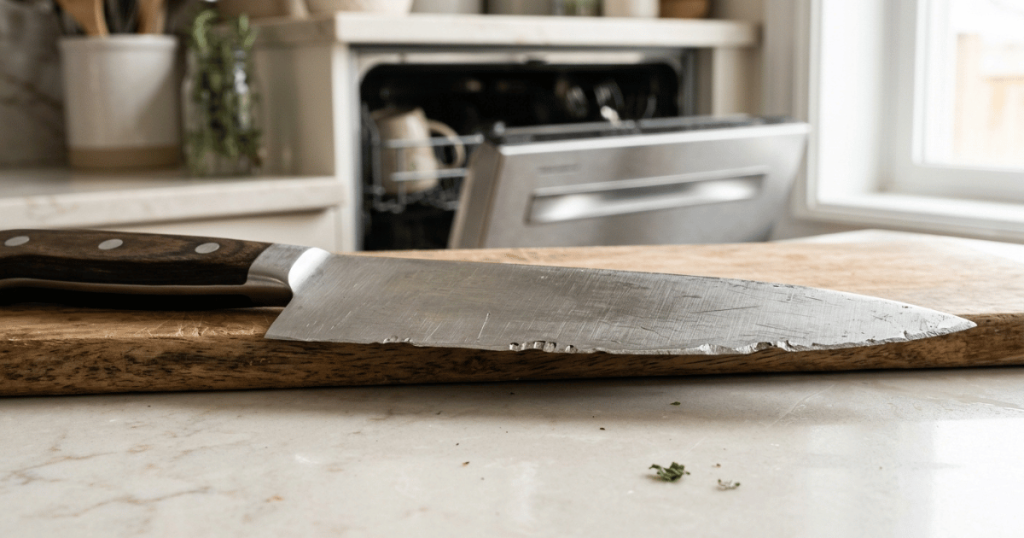
A chip is removed by grinding the whole edge back until it is level with the bottom of the chip. That works, but the knife gets narrower from spine to edge at the same time. Shun states the limit for its own repair service plainly: it can sharpen out small chips of 2mm or under, and doing so means removing metal in line with the chip, which makes the blade narrower. For a broken tip, Shun explains that re-forming it means removing material from both the spine and the edge, so the repaired blade has a slightly different shape and is shorter.
Those figures are one maker’s policy for its own knives, not a universal rule, and Shun also says it can attempt a repair but is not responsible if the attempt proves unsatisfactory. The general lesson holds, though. Small chips are routine. A deep chip is a choice between accepting a narrower blade and replacing the knife, and it is worth getting a sharpener’s opinion before any grinding starts. Harder, thinner blades are more prone to chipping in the first place, which is worth remembering when the repaired knife goes back into use.
Rust: surface rust restores, pitting often does not
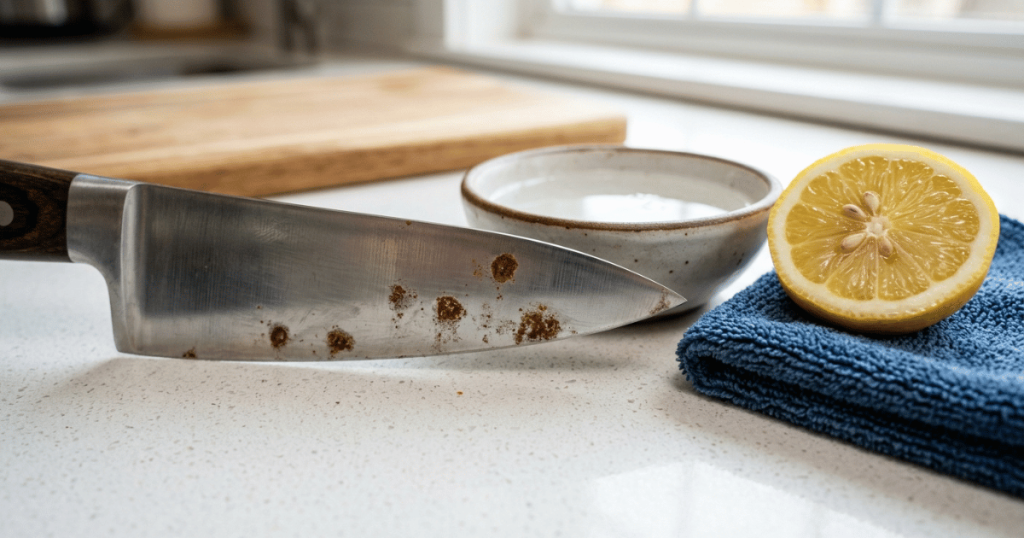
Rust is on almost every “time to replace” list, and on its own it rarely should be. Orange bloom on the surface that comes off with gentle cleaning has not yet eaten into the steel. Once it is removed and the knife is washed and dried, the knife is back in service, and the only real task is finding what kept it wet.
Pitting is different. Pits are small cavities left where corrosion has consumed metal, and they stay dark after the orange is gone. Shallow pits on the flat of the blade are cosmetic, although they hold moisture and food residue and need more careful cleaning. Pits that reach the cutting edge are a real problem, because the edge now has holes in it. A professional can sometimes grind the edge back past shallow edge pitting, with the same cost in blade height as a chip. Deep pitting through the edge usually means the knife is finished. Whatever the verdict, rust comes off a food-contact blade before the knife cuts food again.
Stop conditions: when to put the knife down today
Some damage is not a question of performance. It is a question of whether the knife will fail while your hand is pushing on it. Stop using the knife immediately if any of these is true:
- There is a crack anywhere in the blade. Do not flex the blade to see how far it goes. A cracked blade can snap under ordinary cutting force.
- The blade is bent. Straightening hardened steel at home risks cracking or snapping it, and a harder blade is more likely to break than bend back.
- The handle moves on the tang at all, or a scale has lifted, or a rivet is loose. All the force you apply runs through that joint.
- Corrosion has pitted through the edge so the edge is broken up.
A handle that moves is the one most often ignored. It still cuts, so it stays in the drawer, until the day it lets go mid-cut. Wusthof describes the full bolster and finger guard on its Classic knives as being there for balance and safety, which is a useful reminder that the handle end of a knife is a safety part, not trim. A loose handle goes to the maker’s repair service or a knifemaker for re-handling. Household glue is not made for heat, repeated wetting or food contact.
If a failing knife does cut someone, MedlinePlus advises washing the cut with mild soap and water and using direct pressure to stop the bleeding, and says to call emergency services if bleeding is severe or cannot be stopped, for example after 10 minutes of pressure. It also advises contacting a provider for a wound that is large or deep, or if the person has not had a tetanus shot within the last 10 years.
Worn out by sharpening: the slow way a knife ends
The knife that dies of old age does not break. It shrinks. Every sharpening removes a little steel, and after years the blade is noticeably narrower, the heel has worn higher than the bolster so the rear of the edge no longer meets the board, or the profile has gone concave in the middle where it was sharpened most.
How fast that happens depends heavily on how the knife is sharpened. Methods that take off more steel than the job needs shorten a knife’s life, which is why the choice of method matters as much as the frequency. Our guide on how to sharpen kitchen knives compares methods by what they remove. A professional can regrind a worn profile or thin a blade that has grown thick behind the edge, and on a good knife that is often worth asking about. On an inexpensive stamped knife, the regrind may cost more than a replacement.
The economics, without made-up numbers
We are not going to quote repair or replacement prices, because they vary by region and by shop and date quickly. The reasoning does not need them. A budget knife that needs anything beyond a normal sharpening is usually cheaper to replace than to repair. A mid-range or premium knife with a sound blade and handle is almost always worth restoring, and even a re-handle can make sense if the steel is good.
Check the warranty before paying for anything. Policies differ, so read your own maker’s page. Shun, for example, says its Limited Lifetime Warranty applies whether or not the knife is registered, but that damage caused by misuse or accident is not a defect, and that normal wear and edge maintenance are excluded. In other words, a lifetime warranty generally covers a knife that was made wrong, not one that was used up or dropped.
Retiring a knife safely
A knife you are replacing is still a sharp object, and it can cut whoever handles the trash. Wrap the blade in thick cardboard or several layers of newspaper, tape it closed, and mark the package as a sharp object. Check your local waste or recycling program’s rules for sharp metal before you put it out, since some accept knives as scrap metal and some want them handled separately. Never drop a bare knife into a trash bag.
Frequently asked questions
How often should kitchen knives be replaced?
There is no fixed interval. A well-made knife that is honed, sharpened sensibly and kept dry can last for decades. Replace a knife when it shows structural damage, such as a crack, a bend, a loose handle or pitting through the edge, or when years of sharpening have worn the blade to the point that it no longer works properly.
Can a chipped kitchen knife be fixed?
Usually, yes. Small chips are ground out by sharpening the edge back past them, which narrows the blade slightly. Shun, for its own knives, says its service can sharpen out chips of 2mm or under. Deeper chips can often still be removed, but at a larger cost in blade height, so get a professional sharpener’s opinion first.
Is a rusty knife ruined?
Not if the rust is on the surface. Orange rust that comes off with gentle cleaning leaves the steel intact, and the knife can be washed, dried and used. Dark pits that remain after cleaning are permanent. On the flat of the blade they are mostly cosmetic, but pitting that reaches the cutting edge usually means the knife should be replaced.
Does a lifetime warranty cover a worn-out knife?
Generally not. Warranties typically cover manufacturing defects rather than wear or accidents. Shun, for example, excludes normal wear, edge maintenance, and damage from misuse or accident. Read your own maker’s warranty page, because the terms differ from brand to brand.