Wash a wooden-handled knife by hand, quickly, and never let the handle sit in water. Dry it immediately, including the seam where the wood meets the blade. Keep it out of the dishwasher without exception, because heat plus a soaking-then-drying cycle is the specific thing that splits handles. Oil the wood when it starts to look or feel dry, using whatever oil the knife’s own maker recommends, and understand that oiling slows moisture loss rather than waterproofing anything. And if the handle moves on the tang, or a crack reaches the tang or a rivet, stop using the knife.
Almost every care article gives you the first four of those. Very few explain why they work, which is a shame, because the mechanism makes the rules obvious and tells you which ones actually matter.
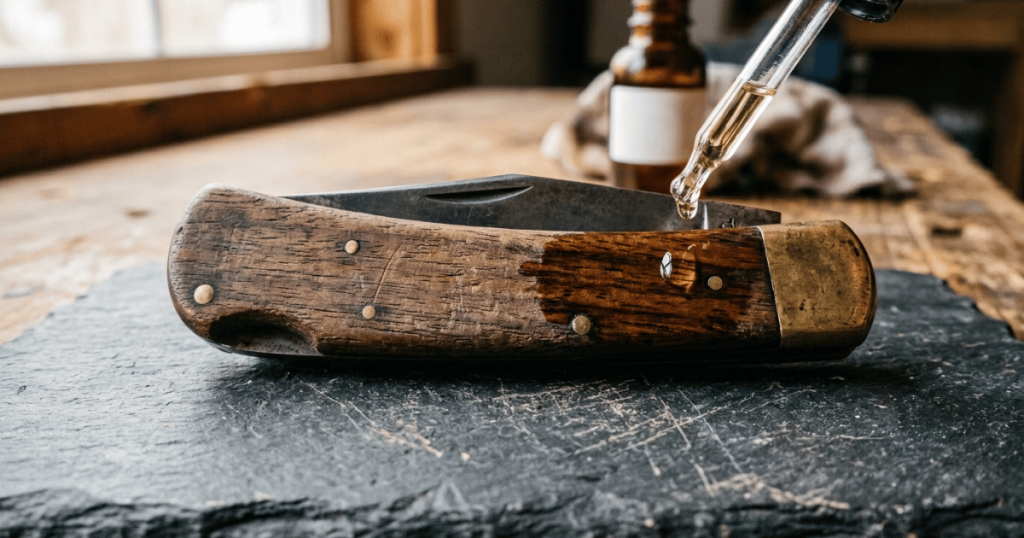
Why a wooden handle cracks
Wood is hygroscopic. It takes up moisture from its surroundings and gives it back, and as it does, it swells and shrinks. That never stops, in every wooden object you own, and by itself it is harmless: a handle in a normal kitchen moves a fraction of a percent through the year and nothing happens.
The damage comes from the speed and the size of the swing, and from the fact that a knife handle is not free to move. It is pinned to a steel tang, usually with rivets, and steel does not swell. So when the wood soaks up water fast, it tries to expand and the tang and rivets hold it, which compresses the fibers against themselves. When it then dries fast, the compressed wood shrinks past where it started, and the stress has to go somewhere. It goes into splits along the grain, into fine surface checking, and into gaps around the rivets and at the front of the scales.
That is the whole story, and it explains every rule on the list:
- Soaking is worse than washing, because it is the fast, deep swing rather than a brief wetting of the surface.
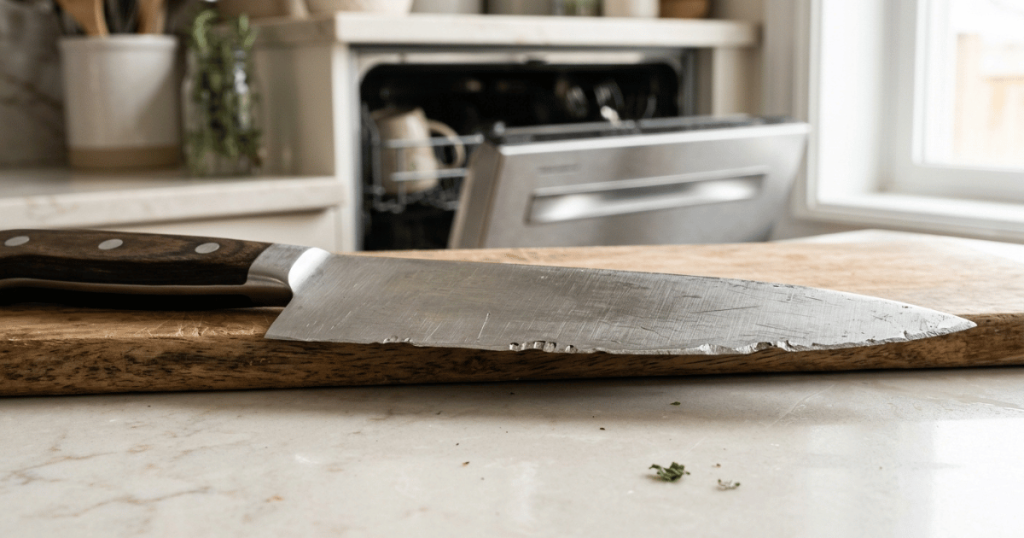
- The dishwasher is the worst case available, because it soaks and heats and then dries hard, in one cycle, repeatedly. Messermeister describes the outcome plainly: the high heat and warm, humid environment can cause wood handles to “swell, crack, and splinter.” Made In warns that the wood dries out in a way that leaves it prone to cracking “that not even regular oiling can resolve.”
- Drying immediately matters more than drying thoroughly later, because you are shortening the wet phase.
- Oiling helps, because a wood surface carrying oil exchanges moisture more slowly, which flattens the swing.
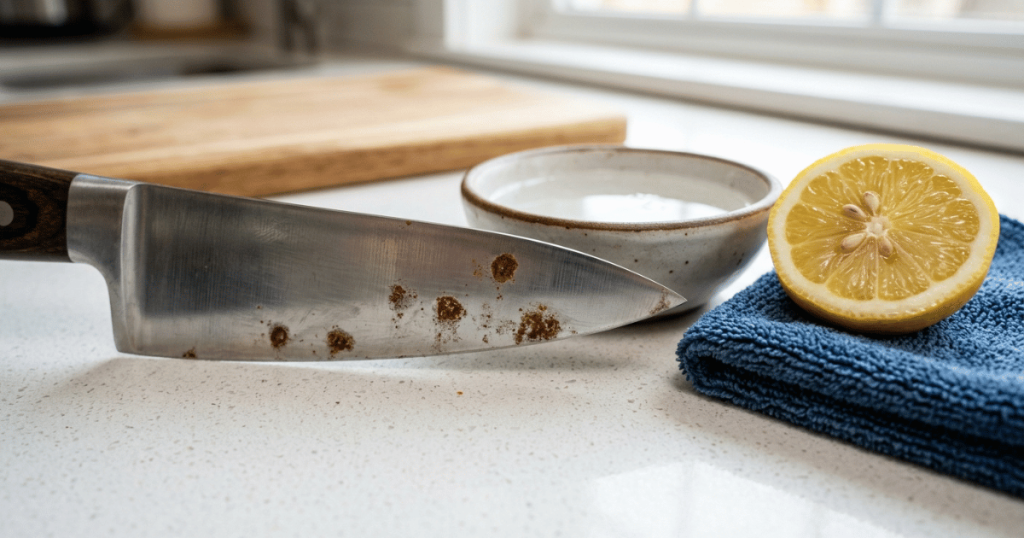
There is a second problem hiding inside the first. The joint between wood and tang is a capillary path, and water that gets in there does not just swell the wood: it sits against steel, in the dark, where no towel reaches. Handles are the most common place people find rust with no obvious cause.
The routine
Made In’s guidance for its own wood-handled knives is the short version of what most makers publish: wash by hand with warm soapy water while avoiding harsh detergents, do not let the handle soak or sit in water, and carefully dry both blade and handle immediately after washing.
In practice:
- Wash the blade, not the handle. Most of what needs cleaning is on the steel. Run the cloth over the handle rather than submerging it.
- Do not leave the knife in the sink. Wusthof’s care page makes this point for the blade, and it goes double for wood, because a knife in a full sink is a handle underwater.
- Dry the handle as carefully as the blade, and pay particular attention to the seam at the front of the scales and around each rivet.
- Let it finish drying in open air before it goes anywhere enclosed.
- Keep it out of the dishwasher. Every maker we checked agrees on this one, including the ones that permit their knives in the machine, because those permissions are for synthetic handles.
One more that gets missed: keep wooden handles out of prolonged direct sun and off hot surfaces. Wusthof warns owners to keep its cream and white handled knives out of direct sunlight because the handles can be sensitive to UV, and dry heat does to wood what a hot drying cycle does, just more slowly.
What oiling actually does
Less than the internet implies, and it is still worth doing.
Oil soaks into the surface layer of the wood and slows the rate at which that surface takes on and gives off moisture. Flattening the swing is the real benefit: the handle still moves with the seasons, but less abruptly, so it is less likely to check. Oil also replaces some of what washing removes, restores color, and leaves the surface smoother, which is why an oiled handle feels better in the hand than a dry one.
Here is what it does not do:
- It does not waterproof the handle. An oiled handle left soaking still swells.
- It does not close an existing crack, and it will not stop one growing.
- It does not tighten a loose handle. Nothing you wipe on will.
- It does nothing at all for sealed, lacquered or resin-stabilized handles, which cannot absorb it. If oil sits on the surface and never soaks in, the handle is finished or stabilized and the oil is just sitting there, so wipe it off.
- It does not reach the inside of the joint, which is where the water that matters actually goes.
Which oil, and why the makers disagree
This is worth knowing before you follow a blog post over your own knife’s care page, because the companies that build these handles do not give the same answer.
| Maker | What it tells its own owners |
|---|---|
| Made In | Use a “food safe oil, like mineral oil, or our Wood Conditioner”, and plan on oiling wood-handled knives at least twice a year, more often if the handle feels dry |
| Robert Welch | Periodically apply a mineral oil to the handles to maintain their color, and remove any excess |
| Victorinox | Treat the handle with a conventional cooking oil or its own protective wax now and again to prevent moisture entering the wood, and prefer a cold pressed oil, which does not clog the wood’s fine pores and gets into the grain better |
Two of those say mineral oil and one says cooking oil, and neither camp is being careless. Mineral oil is chemically stable, so it will not go rancid or cure into a sticky film, which is why it is the standard recommendation for anything that touches food. Cold-pressed cooking oils penetrate the grain better, which is a real advantage on a bare wood handle, at the cost of eventually oxidizing. Victorinox is giving advice for its own handle material and finish, and it is the authority for its knives.
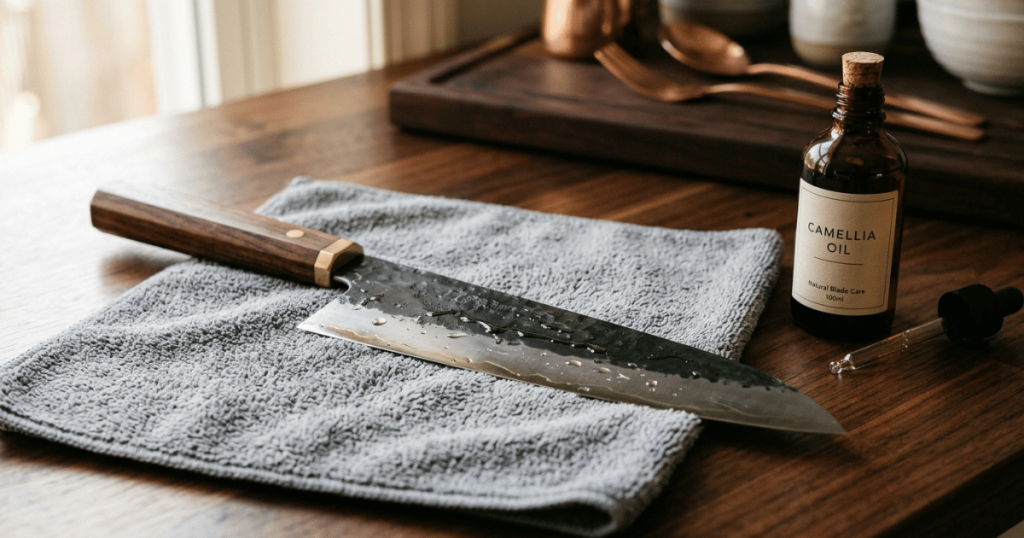
Our position: follow your own maker’s page. Where there is no maker page, or the knife is old and anonymous, mineral oil sold for food contact is the low-risk default, and camellia oil is the traditional choice on Japanese handles. Whatever you use, the claim that a product is suitable for food contact belongs on its own label, not in an article. One thing to check rather than assume: walnut oil appears in a lot of handle advice and it is a tree nut product, and the FDA lists tree nuts among the major food allergens, so read the ingredients if anyone in the house has an allergy.
How to oil a handle
Start with a clean, completely dry handle. Put a few drops of oil on a soft lint-free cloth rather than pouring it onto the wood. Wipe it on along the grain, covering the whole handle including the butt end and the area around the rivets. Give it time to soak in, then wipe off everything that has not absorbed. A handle should feel dry to the touch afterward, not slick. If the wood drank it all and still looks dry, it was overdue, and a second light pass is reasonable.
Do not oil on a schedule you read online. Oil when the wood looks pale, chalky or feels rough, which is the wood telling you. Made In’s twice a year is a maker’s figure for a maker’s product, and it is a sensible starting point rather than a law.
If the surface has raised grain or roughness, very fine abrasive paper used lightly along the grain before oiling will smooth it. Keep it away from the rivets and the blade, keep the pressure low, and stop if you are removing color rather than roughness. If the handle has a factory finish on it, sanding takes that finish off, which is a decision rather than a maintenance step.
When a handle stops being a maintenance job
This is the part the care guides leave out, and it is the part that matters most, because a knife handle is a load path. Every bit of force you apply goes through it, and if it lets go while the blade is in something, your hand keeps moving.
Stop using the knife, and have it re-handled or retire it, if any of these is true:
- The handle moves, twists or rattles on the tang. Any movement at all. This is the one that hurts people.
- A crack runs to the tang, through a rivet hole, or all the way across a scale. Surface checking in the finish is cosmetic; a split through the structure is not.
- A scale is lifting, or a gap has opened at the front of the handle that you can get a fingernail into. That gap holds water and food debris in a place you cannot clean or dry, so it is a hygiene problem as well as a structural one.
- A rivet is proud, missing or turning.
- A Japanese wa handle has split at the ferrule, or the blade can be rotated in it.
- There is rust coming out of the joint. What you can see is the small part of it.
A loose or cracked handle is a re-handling job, which means the maker’s repair service, a professional sharpener who does handle work, or a knifemaker. It is not a glue job at the kitchen table. Household adhesives are not chosen for heat, repeated wetting or food contact, and a glued repair on the load path can hold long enough to be trusted and then fail under force, which is worse than a handle that was obviously loose.
Two ordinary tasks put more force through a handle than cutting does, and both are worth checking the handle before you start. Sharpening on a stone means minutes of sustained pressure through the handle at an angle, which is exactly the load a loose scale will find, so the handle check belongs in the setup described in our guide to sharpening kitchen knives with a stone. And on Japanese knives, the friction-fit wa handle is designed to be removable and replaceable, which is genuinely good news if yours has split, since re-handling is a normal service rather than the end of the knife. Our guide to sharpening Japanese kitchen knives covers how those knives are put together.
Frequently asked questions
How do I care for a wooden knife handle?
Hand wash the knife quickly without submerging the handle, avoid harsh detergents, and dry the handle immediately including the seam at the blade and around the rivets. Keep it out of the dishwasher entirely. Oil the wood when it starts to look or feel dry, using the oil your knife’s maker recommends, and wipe off whatever does not soak in.
Why did my wooden knife handle crack?
Because it got wet and then dried out fast, probably more than once. Wood swells when it takes on moisture and shrinks when it loses it, but the steel tang and the rivets hold it in place, so the stress goes into splits along the grain and gaps around the rivets. Soaking and dishwasher cycles are the fastest way to produce that swing.
What oil should I use on a wooden knife handle?
Whatever your maker recommends, because they differ. Made In and Robert Welch both point at mineral oil for their own knives, while Victorinox recommends a conventional cold-pressed cooking oil or its own protective wax for its wooden handles. Absent a maker’s instruction, mineral oil sold for food contact is the low-risk default, and camellia oil is traditional on Japanese handles.
Can I fix a loose wooden knife handle at home?
We would not try. A handle that moves on the tang is a safety problem rather than a cosmetic one, because all the force you apply to the knife runs through it. Household glue is not made for heat, repeated wetting or food contact, and a repair that holds until it does not is more dangerous than an obviously loose handle. Take it to the maker’s repair service or a knifemaker for a re-handle.
How often should wooden knife handles be oiled?
There is no universal number, and the wood tells you: pale, chalky or rough means overdue. As a starting point, Made In tells its own owners to plan on oiling wood-handled knives at least twice a year and to do it again any time the handle feels dry. Sealed, lacquered and stabilized handles do not absorb oil at all and do not need it.