The major kitchen knife brands fall into a few families. Germany has Wüsthof and Zwilling, with Henckels as Zwilling’s everyday brand. Japan has Shun, made by Kai in Seki, Miyabi, a Zwilling brand made in Seki, and Global, made by Yoshikin in Niigata. Switzerland has Victorinox, a stamped restaurant workhorse. The brand name tells you less than the line does: steel, construction and even country of origin can change from one line to the next under the same name, so compare the specific line, not the logo.
This page lays out who makes what, where each maker says its knives are made, what that means for the steel and edge, and which kind of cook each brand suits. Every origin and specification below comes from the maker’s own page or its official distributor, read on October 2, 2026.
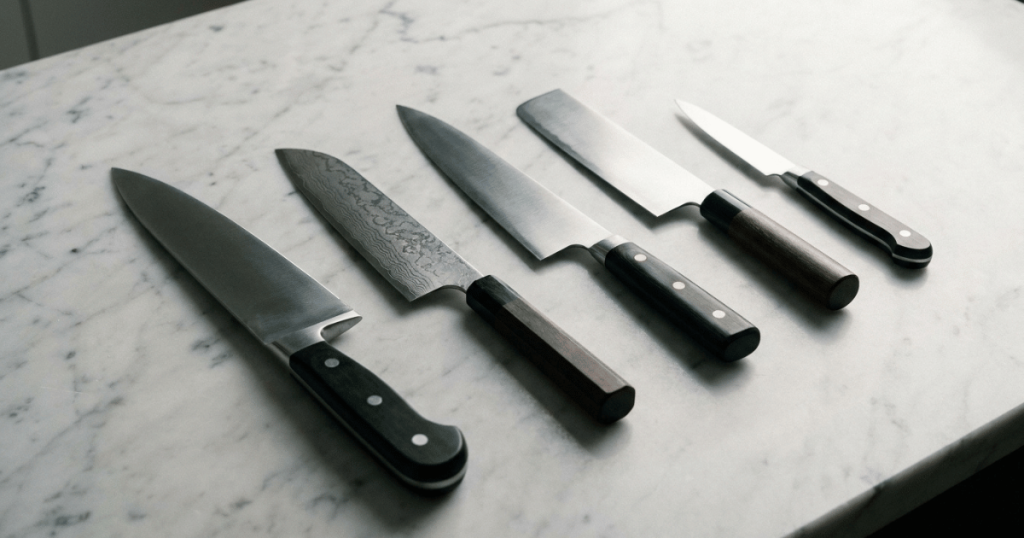
Kitchen knife brands at a glance
| Brand | Who makes it | Where the maker says it is made | Construction noted by the maker | Tradition |
|---|---|---|---|---|
| Wüsthof | Wüsthof, family owned | Forged knives in Solingen, Germany | Forged lines | German |
| Zwilling | Zwilling J.A. Henckels | “Crafted in Solingen, Germany since 1731” | Varies by line | German |
| Henckels | Zwilling J.A. Henckels | Not stated on the brand page | Varies by line | German-style, everyday |
| Miyabi | Zwilling J.A. Henckels | “Handcrafted in Seki, Japan” | Varies by line | Japanese |
| Shun | Kai | Seki City, Japan | Varies by line | Japanese |
| Global | Yoshida Metal Industry (Yoshikin) | Japan; Yoshikin founded in Tsubame City, Niigata | All-stainless, hollow handle | Japanese |
| Victorinox | Victorinox | Switzerland (Fibrox chef’s knife) | Fibrox chef’s knife: not forged | Swiss, restaurant |
Two things stand out. First, three of these names belong to one company. Second, the “where made” column is a property of a line or product, not always of a whole brand, which is why the sections below quote the exact page.
Why the brand tells you less than the line
Knife companies are often groups of brands, and a single brand often makes different products in different places.
Zwilling is the clearest example. Its own page explaining ZWILLING and HENCKELS (read October 2, 2026) describes two distinct brands from the same Zwilling J.A. Henckels heritage: ZWILLING, with “cutlery crafted in Solingen, Germany since 1731,” and HENCKELS, established in 1895 and aimed at everyday cooks with the tagline “For every kitchen.” The same page lists MIYABI and DEMEYERE as part of the company’s family of brands. Zwilling’s page does not say where Henckels-branded knives are made, so check the country of origin on the specific listing.
Wüsthof shows the same thing inside one brand. Its company history page (read October 2, 2026) says: “We have stayed loyal to the City of Blades, and still produce our forged knives only in Solingen, Germany.” That sentence is about forged knives. Wüsthof’s own product page for its brushed stainless come-apart kitchen shears, read the same day, lists them as “Manufactured in Spain.” Both statements are true at once, and that is the point: origin belongs to the product.
German and Japanese: the metallurgy behind the two traditions
The split between German and Japanese brands is real, but it is a split in edge philosophy more than in nationality.
The traditional German approach pairs a tougher steel with a thicker blade and a more robust edge. The traditional Japanese approach pairs a harder steel with a thinner blade and a more acute edge. Both are answers to the same trade-off. As metallurgist Larrin Thomas explains in his Knife Steel Nerds article “What is Edge Stability?” (read October 2, 2026), “Higher hardness is required to avoid edge rolling but higher hardness also reduces toughness which increases the possibility of edge chipping.” A thicker, tougher German-style edge is more likely to roll than chip, and a rolled edge can be straightened on a honing steel. A thinner, harder Japanese-style edge resists rolling but is more prone to chipping if twisted or used on bone.
The published numbers show the line between the two is blurrier than the labels suggest. Wüsthof lists 58 HRC on its Classic tomato knife and soft cheese knife pages. Global’s official UK distributor states that Global blades use CROMOVA 18 stainless steel “hardened to Rockwell C56-58.” A Japanese brand and a German brand, on their own published figures, sit in overlapping hardness ranges. The “Japanese means harder” rule holds for many Japanese lines but not for every Japanese brand.
The edge angle a knife ships with also follows its tradition, and it matters when you sharpen. Our guide on what angle to sharpen kitchen knives explains how to find the angle your own knife was given.
The German brands
Wüsthof
Wüsthof’s history page says Johann Abraham Wüsthof founded his “Shears Factory, Steel and Iron Works” in 1814, that the company “remains in family hands,” and that “the seventh-generation of Wüsthof family members” runs it today. Its forged knives are made only in Solingen, by its own statement.
Who it suits: cooks who want a classic German forged knife with a robust edge that tolerates regular honing.
What to know: a forged German blade is usually thicker and heavier than a thin Japanese blade, which some cooks find tiring over long prep. And as noted above, not every Wüsthof product is made in Solingen.
Zwilling
Zwilling presents itself as the premium brand of the Zwilling J.A. Henckels group, with Solingen craftsmanship since 1731 by its own account.
Who it suits: cooks who want German construction from a company with many lines to choose from.
What to know: with that many lines, the brand name alone tells you little. Check the line’s construction and origin on the product page.
Henckels
Henckels is the group’s everyday brand, established in 1895 and positioned “For every kitchen.” It now has its own website, which lists Zwilling, Staub, Miyabi and Demeyere as part of its family of European brands.
Who it suits: cooks who want a familiar name at a lower price than Zwilling.
What to know: the brand page does not state where its knives are made. If origin matters to you, read the listing for each knife.
The Japanese brands
Shun
Shun is made by Kai. Shun’s own page states: “In Seki City, each Shun knife is crafted through more than 100 steps of artistry and precision.” The page names VG10 and VG2 stainless steels, including a Dual Core construction of “71 alternating micro layers of VG10 and VG2 stainless steels.”
Who it suits: cooks who want a Japanese-made knife with a thin, keen edge.
What to know: thin, hard Japanese edges reward careful use and the right sharpening method. Our guide on how to sharpen Japanese kitchen knives without chipping covers the difference.
Miyabi
Miyabi is a Zwilling brand made in Japan. Its pages on Zwilling’s site describe the knives as “Handcrafted in Seki, Japan,” and state: “It takes over 100 steps and 42 days to make one knife worthy of the MIYABI brand.” Lines differ in steel; the Birchwood 5000 MCD is described as having a “premium micro-carbide powder steel blade,” and the Kaizen II 5000 FC-D a “double ice-hardened blade.”
Who it suits: cooks who want Japanese-made blades with a choice of steels across several lines.
What to know: a German parent company and Japanese manufacture are not a contradiction. “German brand” or “Japanese brand” describes ownership; where the knife is made is a separate fact. Our guide to real vs Japanese-style kitchen knives explains why that distinction matters.
Global
Global’s official UK distributor states that “GLOBAL Knives are made in Japan by Yoshida Metal industry (Yoshikin),” that Yoshikin began as a stainless-steel cutlery maker “in 1954, in Tsubame City, Niigata Prefecture,” and that the knives were “first designed in 1985” by Komin Yamada. It describes “an all-stainless steel kitchen knife with an integrated structure” and “a hollow handle which is filled with just the right amount of sand to create a perfect balance.”
Who it suits: cooks who like a light knife and an all-steel handle with no seams between blade and handle.
What to know: an all-steel handle feels very different from wood or synthetic. Whether it suits you depends on your hand and grip, so hold one before you buy if you can.
The Swiss restaurant workhorse
Victorinox
Victorinox’s product page for its Fibrox chef’s knife lists the country of origin as Switzerland and answers “No” to “Forged.” In other words, it is a stamped knife.
Who it suits: cooks who want a light, practical knife at a modest price and do not need a bolster or a heavy blade.
What to know: a stamped blade is usually thinner and lighter than a forged one. That makes it nimble but gives it a less substantial feel, which some cooks miss.
Kitchen knife brands by who they suit
- You want a heavier, forgiving German knife you can hone often: Wüsthof or Zwilling forged lines.
- You want a German-style name at a lower price: Henckels, after checking where the specific knife is made.
- You want a thin, keen Japanese-made edge: Shun or Miyabi lines, chosen by steel.
- You want a light, all-steel Japanese knife: Global, if the handle suits your grip.
- You want an inexpensive, practical workhorse: Victorinox Fibrox.
None of these is the right answer for everyone, and no brand is the right answer for every knife type. For choosing the knife type and steel first and the brand second, see our guide to the best kitchen knives by type, steel and budget.
How to check a line yourself
Before you buy any knife, look for four things on the maker’s own product page, not a reseller’s copy:
- Country of origin, stated for that product.
- Steel, named specifically. “German stainless” or “high-carbon” alone tells you little.
- Hardness, if published, as an HRC figure.
- Construction, forged or stamped, and whether the blade is clad or layered.
If any of these is missing, treat it as unknown rather than assuming it matches the brand’s other lines.
FAQ
Are Zwilling and Henckels the same company?
Yes. Zwilling’s own page describes ZWILLING and HENCKELS as two distinct brands from the Zwilling J.A. Henckels heritage. ZWILLING is presented as the premium line made in Solingen; HENCKELS is the everyday brand.
Is Miyabi German or Japanese?
Both, in different senses. Miyabi is part of the Zwilling family of brands, and Zwilling’s Miyabi pages say the knives are handcrafted in Seki, Japan.
Where are Wüsthof knives made?
Wüsthof says it produces its forged knives only in Solingen, Germany. Some other products differ; its come-apart shears page lists Spain as the place of manufacture.
Are Japanese knife brands always harder than German ones?
Not always. Wüsthof lists 58 HRC on some of its knives, and Global’s distributor lists Rockwell C56 to 58 for Global blades. Many Japanese lines are harder, but check each line’s published figure.
Which kitchen knife brand should I buy?
Choose the line, not the brand. Decide between a heavier German-style knife and a thinner Japanese-style one, then compare specific lines on steel, construction and origin from the maker’s own pages.