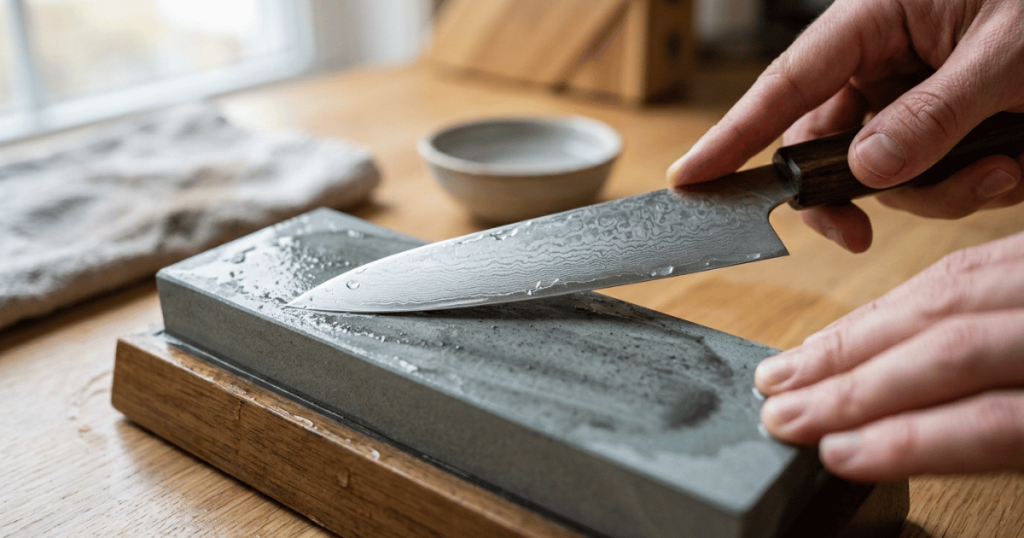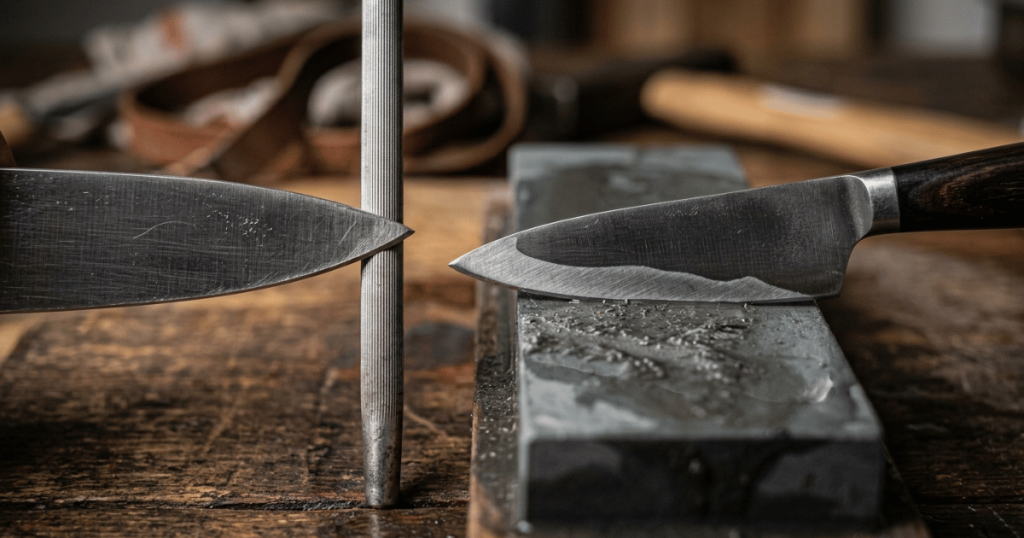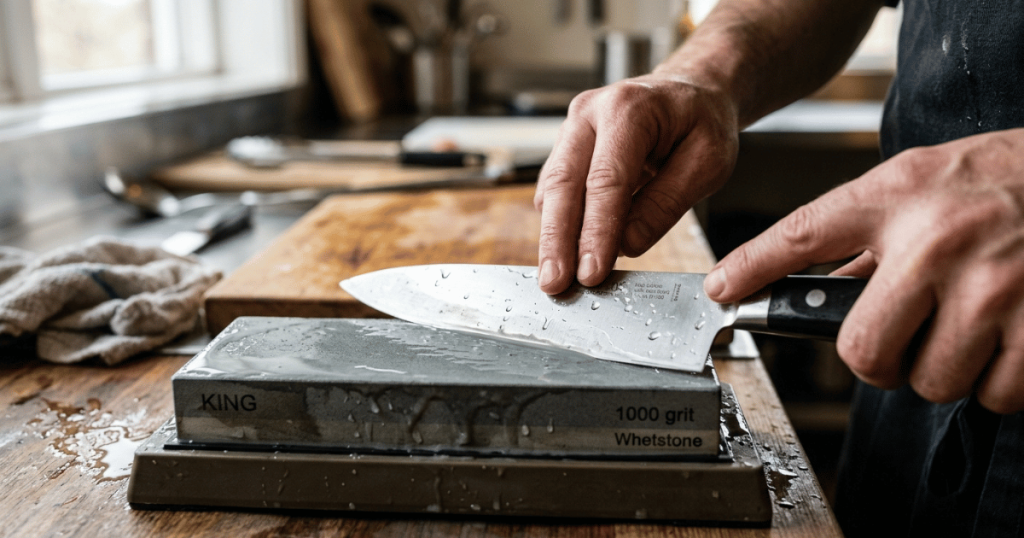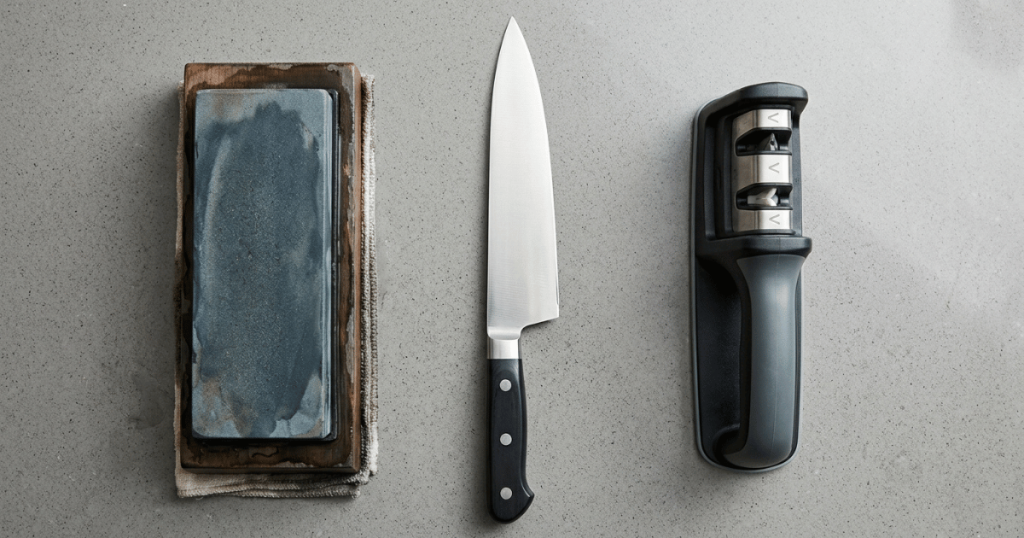
Two stones cover almost every knife in a home kitchen: one near 1000 grit to do the actual sharpening, and one somewhere in the 3000 to 6000 range to refine the edge afterward. Anything coarser than about 800 is a repair tool for chips and reshaping, not a Tuesday-night stone. Anything above 8000 is polishing, and most home cooks never need it. And one thing the box will not tell you: a grit number is a name inside a national standard, not a measurement, so numbers from different systems do not line up.
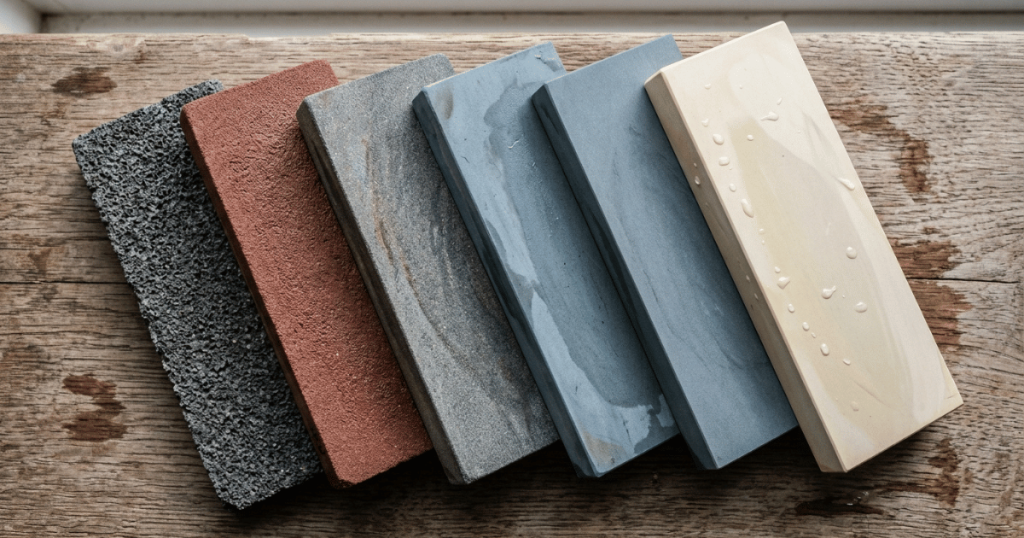
What a grit number is actually describing
Grit refers to the size of the abrasive particles bonded into the stone. Lower numbers mean bigger particles, which cut faster and leave deeper scratches. Higher numbers mean smaller particles, which cut slowly and leave a smoother surface. Sharpening is scratching, done deliberately: you are cutting a series of parallel grooves into the steel until the two faces of the bevel meet in a line thin enough to sever things.
That is the whole mechanism, and it explains the ladder. A coarse stone gets you to that meeting point fast but leaves an edge that is jagged at the microscopic level. A finer stone replaces those deep scratches with shallower ones. Where you stop on the ladder decides whether the edge tears through a tomato skin or slides through it.
The part the box will not tell you: grit numbers are not one scale
This is the single most useful thing to know before you buy a stone, and almost no product page says it.
There are several abrasive grading systems in use. JIS is the Japanese Industrial Standards scale, FEPA is the European one from the Federation of European Producers of Abrasives, and ANSI is the American. Microns are different in kind, because a micron is an actual measurement of particle size rather than a label.
Knivesandtools, writing about how grain sizes are expressed, makes the distinction plainly: microns are an absolute size, while JIS and FEPA numbers are nominal, meaning “the number that is used to express the size doesn’t have a unit of measurement, but is only a name.” The consequence it draws is the one that matters at the counter: a standardized 16,000 grain is not necessarily twice as large as an 8,000 grain. Its own comparison table puts JIS 8,000 at roughly FEPA-F 2,000 and about 1.2 microns.
So two stones can both say 1000 on the label and be meaningfully different stones. In practice most water stones sold for kitchen knives are graded on JIS, because most of them come from Japan. Japanese Knife Lab notes that the JIS scale is the reference used by Naniwa, Shapton, King and most quality stones. Diamond plates and oil stones are frequently rated on other systems, which is why a diamond plate labeled 1000 can feel far coarser than a JIS 1000 water stone.
The practical rule: compare grit numbers within one system, or by microns, and treat a number from a different family of stone as a rough hint rather than a match.
The four grit bands
Japanese Knife Lab groups stones into four working bands, and they map cleanly onto four different jobs:
- Coarse, roughly 220 to 400. Chip repair, reshaping a bevel, rescuing a badly neglected edge. Removes metal quickly, which is exactly why it is not a routine stone.
- Medium, roughly 800 to 1500. The workhorse. Japanese Knife Lab calls 1000 “the universal standard,” and this is the band where sharpening actually happens on a normally dull knife.
- Finishing, roughly 3000 to 6000. Refines the scratch pattern left by the medium stone into a cleaner, smoother edge.
- Polishing, 8000 and up. Mirror finishes. Real, and almost entirely optional for a kitchen.
Knife makers who sell their own stones sit inside those bands. Shun’s three-piece sharpening system pairs “1000 grit on one side, 6000 grit on the other” in a single combination stone. Global’s care guidance says that “normally a medium grit stone is sufficient to start with. However, if the blade is blunt or damaged, it may be necessary to start with rough grit.” Both of those are the same advice from opposite directions: medium sharpens, coarse repairs.
Match the grit to the problem, not to the knife
Most grit guides start from the knife. It is more useful to start from what is wrong with it.
| What is wrong | Where to start | Why |
|---|---|---|
| Edge feels dull but looks intact, and honing used to fix it | No stone yet | The apex has rolled, not worn. A honing rod may be all it needs. |
| Ordinary dull: slides off a tomato skin | 1000 | Enough abrasion to raise a fresh apex without eating the blade. |
| Very dull, or you are changing the angle | 400 to 600, then 1000 | You are removing real metal. Doing that at 1000 takes an hour. |
| Visible chip in the edge | 220 to 400, then up the ladder | You have to grind the edge back behind the deepest point of the chip. |
| Sharp, but you want a cleaner slice on soft food | 3000 to 6000 | Refining only. No metal removal worth speaking of. |
| You want a mirror | 8000 and up | Appearance and a very smooth push cut. Optional. |
That first row is worth pausing on, because it is the most common wasted evening in this hobby. If the edge has rolled rather than worn, no grit is the right grit, and the difference between the two failures is explained in our guide to sharpening kitchen knives without ruining them. The chip row deserves care for the opposite reason: grinding out a chip is a long job that removes a lot of steel and changes the profile of the blade, so decide whether the knife is worth it before you start.
Where to stop, by knife
Finishing higher is not automatically better. Softer steel will not hold a highly refined apex for long, so the polish you put on it disappears in a week of cutting and you have spent the time for nothing.
| Knife | Reasonable stopping point | Reasoning |
|---|---|---|
| Western stainless chef’s knife | 1000, or 3000 if you enjoy it | Softer steel deforms rather than holding a fine apex. The extra polish is not durable. |
| Japanese double bevel (gyuto, santoku) | 3000 to 6000 | Harder steel holds a refined edge, and the makers’ own combination stones stop here. |
| Single bevel (yanagiba, deba, usuba) | 6000 and up | These edges are built for a clean release on raw fish and are traditionally finished higher. The technique is different too. |
| Serrated | Not on a flat stone at all | The working surface is inside each scallop, where a flat stone cannot reach. |
| Ceramic | Diamond only | Ceramic is harder than the abrasive in an ordinary water stone. |
If you are not sure which group your knife falls into, the method-by-knife matrix in the pillar guide sorts the five types and says which tools are safe on each.
Stone type changes what a number feels like
Water stones cut fast and wear fast, which is why they need flattening. Oil stones cut more slowly and hold their shape longer. Diamond plates are a metal surface with diamond particles bonded to it, they do not dish, and they are usually graded on a different system than Japanese water stones. Ceramic stones are hard and slow and often want only a splash of water.
The result is that “1000 grit” describes the abrasive, not the experience. A 1000 diamond plate will remove metal faster than a 1000 water stone, and a hard ceramic 1000 will feel finer than either. This is another reason to buy your first two stones from the same family, so the step between them is a step in one scale.
Soaking and flatness, in two paragraphs
Some stones soak and some do not, and the maker decides which. Japanese Knife Lab describes traditional stones such as King and Naniwa Pro as needing 5 to 15 minutes of soaking until bubbles stop rising, while Shapton Glass and most ceramic stones are splash-and-go. Shun’s instruction for its own combination stone is simply “soak stone in water before using; use stone with water only.” Follow the maker’s line rather than a general rule, because soaking a stone that was not designed for it can damage the bond that holds the abrasive together.
Flatness matters more than most beginners expect. A stone wears in the middle first, and a dished stone rounds the edge you are trying to sharpen no matter how steady your hands are. Japanese Knife Lab puts it flatly: a flat stone is non-negotiable. Check yours with a straightedge or a pencil grid every few sessions.
If you are only going to own one stone
This site does not rank or sell stones, so treat what follows as a description of what the makers themselves pair rather than a recommendation. The combinations you see most are 1000 with 6000, which is what Shun packages alongside its own knives, and 1000 with 3000, which Japanese Knife Lab says covers nearly every situation for a home cook. Both are the same idea: one side that sharpens, one side that finishes. A coarse stone is a separate purchase for a separate problem, and you will know when you have that problem, because you will be looking at a chip.
Frequently asked questions
Is a 1000 grit stone enough on its own?
For a Western stainless kitchen knife, yes. A 1000 finish cuts food perfectly well, and on softer steel a finer polish will not last long enough to justify the extra stone. The finishing stone matters more as the steel gets harder.
What grit do I need for a very dull knife?
Start at 400 to 600 and then move to 1000. Bringing a badly dull knife back at 1000 alone is possible and slow. Global’s own guidance says the same thing in reverse: medium grit normally, rough grit if the blade is blunt or damaged.
Do I need an 8000 grit stone?
Almost certainly not for a kitchen. It is a polishing stone. It makes a beautiful edge on a hard, thin Japanese blade and it is close to pointless on a German chef’s knife, where the steel will not hold that apex long enough for you to notice.
Are the grit numbers on a diamond plate the same as on a water stone?
No. Diamond plates are commonly rated on a different standard, and because JIS and FEPA numbers are names rather than measurements, they do not convert cleanly. Compare within one system, or by microns.
Can I use both sides of a combination stone in the same session?
Yes, that is what it is for. Sharpen on the coarser side until you have a burr along the whole edge, then move to the finer side to refine and remove it. Rinse the blade and your hands between sides so you are not dragging coarse particles onto the fine face.