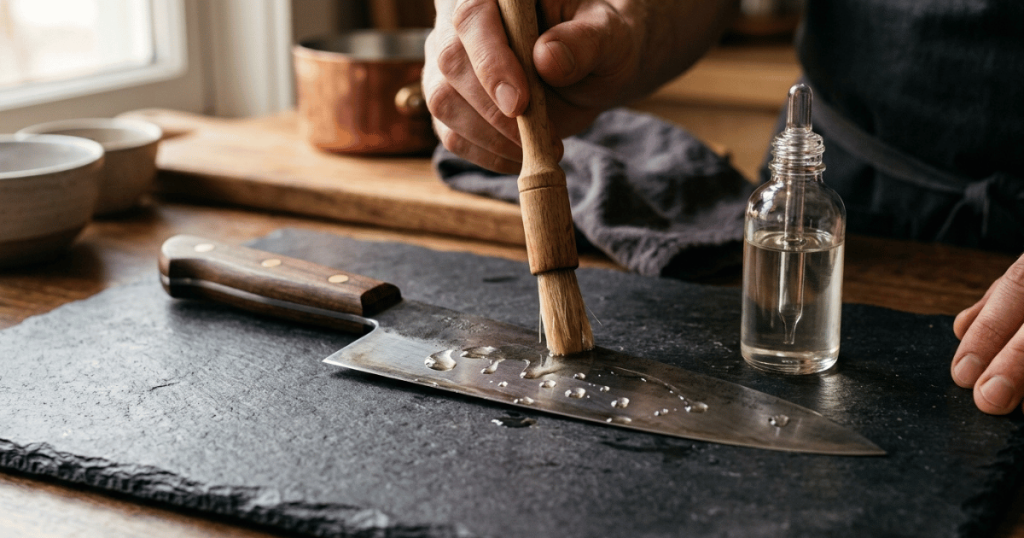
Two oils are traditionally used on kitchen blades: highly refined mineral oil sold for food contact, and camellia oil, known in Japan as tsubaki oil. Both are chemically stable, which is the whole requirement. Apply a few drops to a clean, dry blade with a soft cloth, spread a thin even film over the whole steel surface, wipe off the excess, and wipe or wash the blade again before you cut food with it. Most stainless knives in daily use never need this. Carbon steel does, mainly before any stretch where the knife will sit unused. And do not take our word that a given bottle is safe for food contact: that claim belongs to the product’s own label.
That last point is the one this page is really about, because “food safe” gets used online as though it were a description rather than a claim with rules behind it.
What “food grade” actually rests on
In the United States, the phrase points at the Food and Drug Administration’s regulations rather than at anyone’s opinion. Three places are worth knowing about, because they are what the makers of these products are pointing to when they use the words:
- 21 CFR 172.878, “White mineral oil.” This sits in the FDA’s food additive regulations, which cover substances permitted in food itself under stated conditions. Highly refined white mineral oil is listed there, which is the origin of the pharmacy-grade mineral oil people buy for cutting boards and blades.
- 21 CFR 178.3620, mineral oil in the manufacture of nonfood articles. This is the indirect route, covering mineral oil used in things that contact food rather than in food.
- 21 CFR 178.3570, lubricants with incidental food contact. This is the category for oils that may unavoidably touch food in small amounts during use, and it is the basis NSF International uses when it registers a lubricant in its H1 category, the one intended for equipment where incidental food contact can happen.
You do not need to read any of those to buy a bottle. What they give you is a test for the label in your hand. A product intended for food contact will say so in the maker’s own words, and will usually point at one of those regulations, at a pharmacopeia grade such as USP, or at an NSF registration. A product that says nothing about food is telling you something by its silence.
We are not going to tell you that any specific product is food safe. We do not manufacture, test or certify anything, and a general article cannot know what is in the bottle on your shelf. Read the label, and if the label does not make the claim, do not make it on the manufacturer’s behalf.
The two traditional choices, and what each is actually for
Mineral oil is a refined petroleum product with no unsaturated fats in it, which is why it does not go rancid and does not gum up. That chemical dullness is the feature. It is odorless and tasteless in the food-contact grades, it is cheap, and it is what several knife makers point their own customers at. Robert Welch, for instance, tells owners to periodically apply a mineral oil to its knife handles to maintain their color, and to remove any excess. Made In names “food safe oil, like mineral oil” for its wood-handled knives. Two cautions: fragranced mineral oil sold as baby oil is a different product, and the grade matters, so buy something whose label addresses food contact.
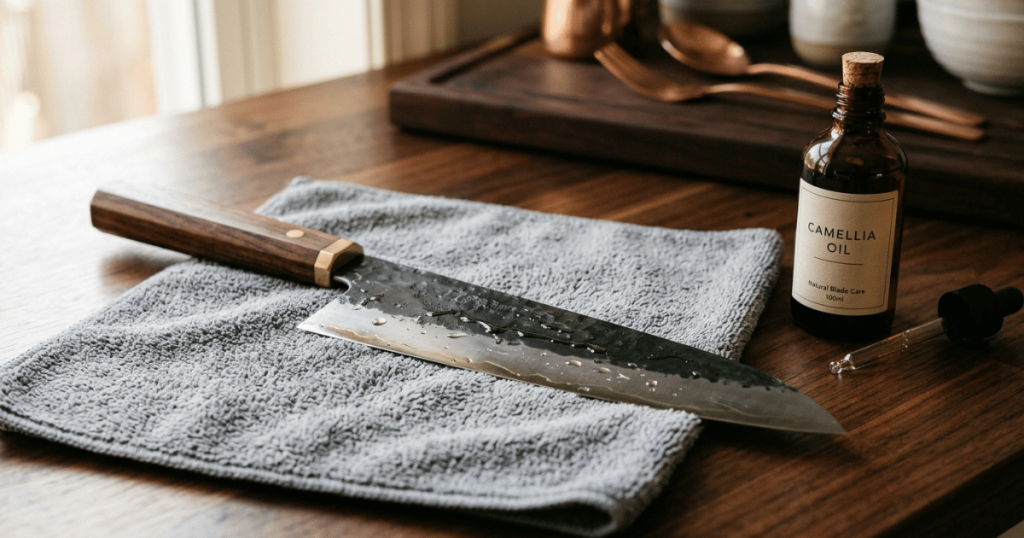
Camellia oil, tsubaki, is pressed from camellia seeds and has been used in Japan on blades and tools for a very long time. Korin, the Japanese knife specialist, describes it on its own product page as “a natural oil used to prevent rust on carbon steel knives, like traditional Japanese blades,” and its application instruction is to use a few drops on the blade, spread it evenly without missing any spots, and wipe off the residue with a soft towel. It is thin, it does not leave a heavy film, and it is the traditional answer for reactive Japanese steels.
Here is the detail worth pausing on. Korin’s page describes what the oil does and how to apply it, and it does not make a food-safety claim. That is not a criticism of the product. It is a demonstration of the point above: even a specialist retailer states what it can state. If food contact matters to you, and on a kitchen knife it does, the claim has to come from the specific product’s own labeling.
One more thing to check rather than assume: plant-derived oils are agricultural products with ingredients. Walnut oil turns up in wooden-handle advice and it is a tree nut product, and the FDA lists tree nuts among the major food allergens. If anyone in the house has a food allergy, read the ingredient list rather than trusting a category name.
Why cooking oils are the wrong tool, in two different ways
The bottle of olive oil is right there, and it seems like the obvious substitute. It fails for two separate reasons, and they produce two different messes.
Rancidity. Most culinary oils, olive, canola, sunflower, grapeseed, corn, contain unsaturated fats that react with oxygen over time. On food that is a shelf-life question. On a blade that sits in a drawer, it means the film you applied to protect the knife slowly turns into something that smells and tastes bad, and it is sitting on the surface you cut food with.
Polymerization. Some oils do the opposite of going liquid and rancid: they cure. Linseed and flaxseed oils are the extreme case, and walnut oil moves in the same direction. That reaction is exactly what you want when seasoning a cast iron pan or finishing a piece of furniture, because it builds a hard film. On a knife blade it is a nuisance, because the hard film is uneven, it collects where you did not want it, and taking it back off means abrasives on a surface you were trying to protect.
Between rancid and sticky there is no version of a cooking oil that behaves like mineral or camellia oil. That is the entire argument, and it does not require anyone to claim cooking oil is dangerous.
When a knife actually needs oiling
This is where most articles overreach, usually because they are selling the oil. Oiling is a barrier for the periods a knife is not being used and dried by hand. It is not a daily ritual.
| Situation | Oil? |
|---|---|
| Stainless knife, used and dried most days | No. Washing and drying is the whole routine |
| Carbon steel knife, used most days | Rarely. Wipe during the job, dry after, let the patina do its work |
| Any carbon steel knife going unused for a while | Yes. This is the main case. Korin’s own advice is to apply tsubaki oil when storing knives for an extended period, such as while you are away |
| Humid or coastal kitchen | Worth doing more often on carbon steel, judged by whether marks appear rather than by a calendar |
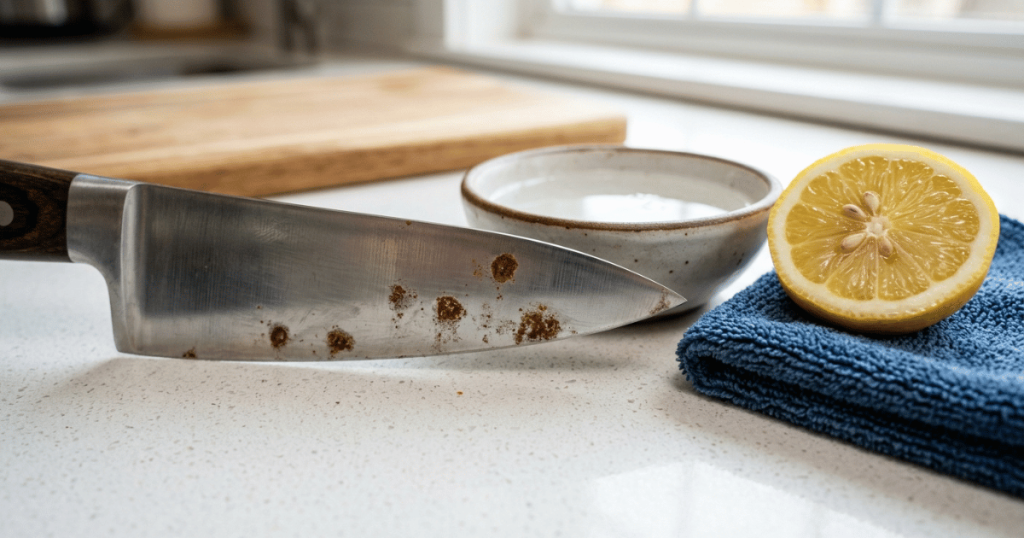
| Right after removing rust | Yes, once the blade is washed, rinsed and completely dry |
| Over the top of existing rust | Never. Oil over active corrosion seals the moisture in rather than out |
| A knife that is about to be transported | Yes, on carbon steel, because it will be enclosed and unattended |
We are not going to print an interval. Every “oil your knives every X weeks” figure we found online was stated without a source, and the honest answer depends on your steel, your climate and how often the knife is used. Where a maker publishes an interval for its own knives, that is the number to follow. Made In, for example, says to plan on oiling wood-handled knives at least twice a year and to do it again whenever the handle feels dry, which is a maker’s figure for a maker’s product and a sensible way to state one.
How to apply it
- Wash the knife and dry it completely. Oil traps whatever is underneath it, so anything left on the blade, water included, stays there.
- Put the oil on the cloth, not on the knife. A few drops on a soft lint-free cloth or a folded paper towel gives you control over how much goes on.
- Lay the blade flat on a folded towel, edge pointing away from your working hand, and wipe along the length of the blade rather than across it. Never wipe toward an edge with a cloth wrapped around your fingers.
- Cover the whole steel surface, both sides, the spine, and the part of the tang you can reach. Rust starts at the edges of what you protected.
- Wipe off the excess. You want a film, not a coat. Korin’s instruction is exactly this: apply evenly, then wipe off residue.
- Wipe or wash the blade before the knife goes back to cutting. A film meant to sit on steel for a month is not meant to transfer to your food.
Keep oil off wooden handles unless you are deliberately treating the handle, which is a different job with different products, and keep it off the working face of your sharpening stones entirely.
The overlap with sharpening, which is where the bare steel is
A freshly sharpened edge is the most exposed metal on the knife, because grinding removes both the oxide layer and anything else on the surface. That is the moment carbon steel is at its most reactive, and it usually happens while the blade is soaking wet. Rinse and dry each knife as you finish it rather than at the end of the session, which is part of the working sequence in our guide to sharpening kitchen knives with a stone. If the knife is then going away for a while, that is the moment to oil it.
On many Japanese knives the reactive core steel is exposed only at the bevel and the edge, with a stainless jacket over the flats, so the strip that needs the oil most is the strip you just ground. Our guide to sharpening Japanese kitchen knives covers where that core sits on the common grinds.
Frequently asked questions
What oil is safe to use on a kitchen knife?
The two traditionally used are highly refined mineral oil sold for food contact and camellia, or tsubaki, oil. Both are stable, so they neither go rancid nor cure into a sticky film. Whether a particular bottle is suitable for food contact is a claim the product’s own label has to make, and it is worth checking for a USP or food-contact statement or an NSF registration before you buy.
Can I use olive oil or vegetable oil on my knife?
We would not. Culinary oils high in unsaturated fats go rancid on the blade over weeks, and the drying oils such as linseed and to some extent walnut do the opposite and cure into a hard uneven film that has to be abraded off. Neither failure is dangerous, and both defeat the point of oiling.
How often should I oil my knives?
There is no universal interval, and any single number you see online is a guess about your steel and your climate. Oil carbon steel before periods when it will not be used, after rust removal, and before transport. Stainless knives in regular use generally need none. Where the maker of your knife publishes an interval, use theirs.
Do I need to wipe the oil off before using the knife?
Yes. Wipe the blade with a clean cloth, or wash and dry it, before it touches food. Even a product intended for food contact is applied as a storage film, not as something to cut through.
Does oiling replace drying the knife?
No, and applying oil to a blade that is not fully dry makes things worse, because the film holds the water against the steel. Wash, dry completely, then oil. If there is already rust on the blade, remove it first: oil on top of active corrosion seals it in.