Sometimes, and the only authority for your knife is the company that made it. Wusthof tells owners not to place knives in the dishwasher at all. Victorinox states that its household knives with synthetic handles are dishwasher safe, then recommends hand washing anyway. Robert Welch says all of its knives are dishwasher safe and also recommends hand washing for best results. What none of them dispute is that a dishwasher cycle is harder on a knife than two minutes at the tap, that wooden handles must stay out, and that hand washing is what they would rather you did.
The more useful question is not whether the knife survives one cycle. It is which of the four things happening inside that machine is damaging your particular knife, because they are not the same problem and they do not have the same answer.
What three makers actually publish
| Maker | Its own instruction | What it recommends instead |
|---|---|---|
| Wusthof | “Do not place knives in the dishwasher” | Hand wash right after use in warm water with mild dish soap, dry immediately with a soft cloth, and do not leave knives soaking in the sink |
| Victorinox | “All of our household knives with synthetic handles are dishwasher-safe”, with large knives excepted because they can damage the cutlery basket, which can itself cause corrosion | Rinse under the tap right after use, and towel dry rather than air dry, which leaves limescale spots |
| Robert Welch | “All Robert Welch knives are dishwasher safe, however, for best results we do recommend washing them by hand” | Warm soapy water with a microfiber cloth or non-abrasive brush, no soaking, no scouring pads, dry thoroughly and immediately |
| Messermeister | Not dishwasher safe, and it publishes its reasons | “Hand wash your knives by hand with mild soap and water and dry them right away” |
Notice what the two permissive answers have in common. Both are conditional on the handle material, both come with a hand-washing recommendation attached, and both are statements about that company’s own construction. Victorinox is describing synthetic handles bonded to its own blades. Robert Welch even publishes cycle conditions for its knives: the top rack, short hot cycles it gives as 65 to 75 C, roughly 149 to 167 F, and quality all-in-one tablets. A permission with that many conditions on it is not a general permission.
The four damage paths, and what each one ruins
1. Detergent chemistry
Dishwasher detergent is not dish soap in powder form. It is formulated to break down baked-on food without scrubbing, and Messermeister states the consequence for knives directly: “Dishwasher detergents contain aggressive alkalis, acids, and salts, which can contribute to corrosion on the knife blades.”
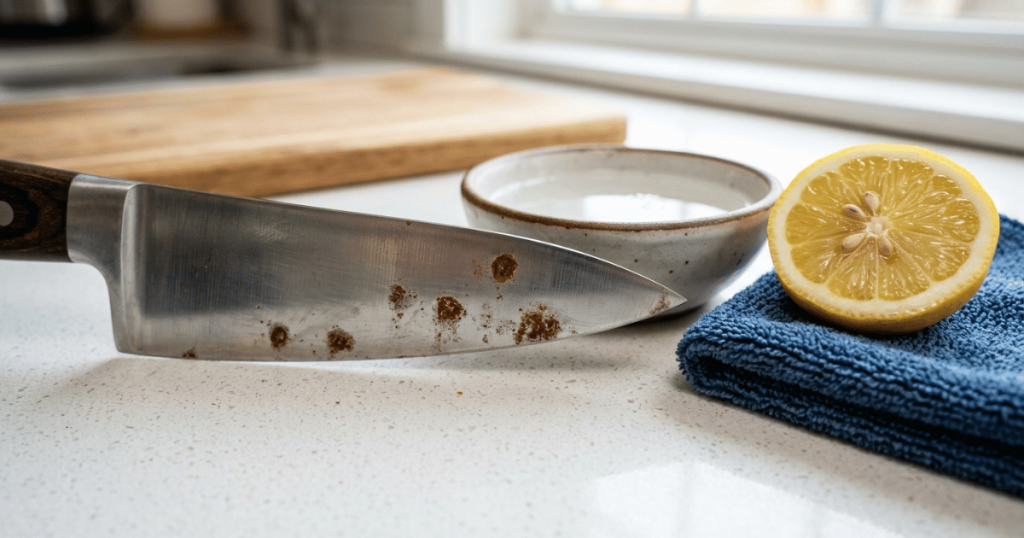
That matters more than it sounds because of how stainless steel works. Its corrosion resistance comes from a chromium-rich passive oxide film that forms on the surface and regenerates in oxygen, as the World Stainless Association describes it. Salts and aggressive chemistry are precisely what breaks that film down locally. Where it is broken faster than it repairs, you get a stain first and a pit later. This is why dishwasher damage on stainless usually shows up as small brown or dark spots rather than as blade-wide rust, and why it appears gradually over many cycles rather than after one.
Detergent chemistry is the path that damages stainless blades. It is also the one owners notice last.
2. Prolonged wet contact
A wash cycle keeps a knife wet, in hot humid air, for far longer than any hand wash does, and the machine finishes with the blade sitting in a closed box full of steam. Everything we know about rust prevention comes down to shortening the time steel spends wet, and a dishwasher lengthens it deliberately.
On carbon steel this is not a slow effect at all. A carbon blade can come out of a cycle already blooming orange, which is why no maker of carbon steel kitchen knives permits it. On stainless the same exposure feeds the pitting described above, and it is worse if the knife is left in the machine after the cycle ends.
3. Impact against everything else in there
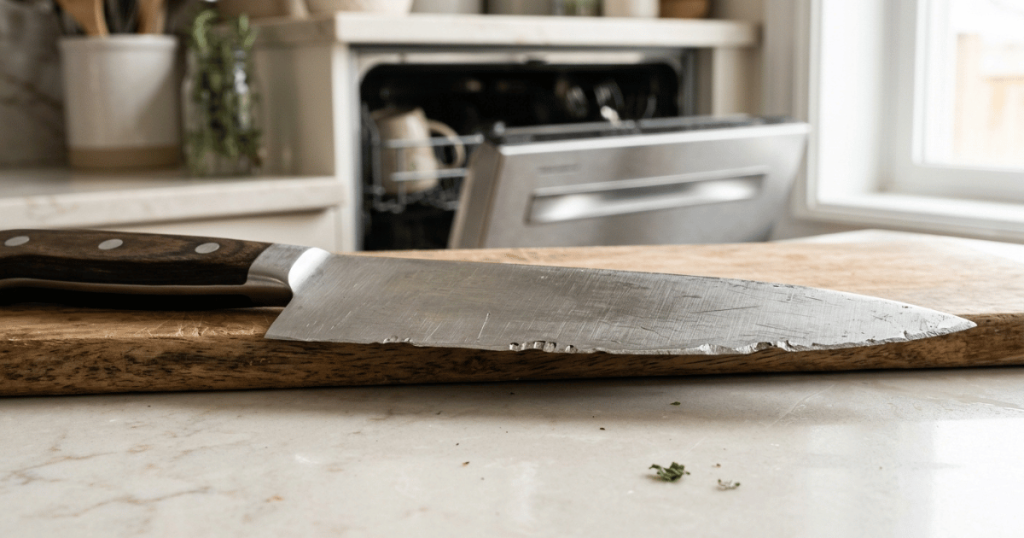
A cutting edge is a very thin apex of steel, and it does not need much to bend or break. Messermeister’s description is the plain one: “your knife can easily knock against other utensils or even the rack itself. This jostling during the washing process can dull, nick, or even chip the knife edge.”
This is the fastest path of the four, and it is the one that produces the complaint people actually notice, which is that the knife came out dull. It usually has not lost its edge to corrosion at all. The apex has been rolled sideways by contact with steel. If a knife feels dull after a cycle, check it properly before assuming the worst: our guide to telling whether a knife is really sharp covers checks that separate a rolled edge from a worn one. A rolled edge is recoverable in seconds with a rod, which is what our guide to using a honing steel is for. A chipped one is not.
4. Heat, and the claim we could not verify
Heat is the mechanism most often cited and the one we are least able to stand behind. Messermeister states that “the extended exposure to the high heat of a dishwasher can alter the tempering on the blade.” That is a knife maker’s published position about its own products and we report it as such.
What we did not find is a published figure showing at what temperature a domestic dishwasher cycle would change the heat treatment of a hardened kitchen blade. Plenty of blogs assert both sides of that argument with numbers we could not trace to a maker or a standard, so we are not going to pick one. What heat does that we can support is simpler and does not require any metallurgy: it accelerates the chemistry in path one, it keeps the blade in humid air through the drying stage in path two, and it is genuinely destructive to handles, which is path five if you count handles separately, and you should.
Handles fail differently, and faster
Most kitchen knives that die in a dishwasher die at the handle, not the blade. The materials behave nothing alike.
- Wood. The clear no, from every maker including the permissive ones. Wood takes on and gives off moisture with its surroundings, and a wash cycle is a violent version of that swing. Messermeister puts it as heat and a warm humid environment causing wood handles to “swell, crack, and splinter.” Swelling also works the wood against the tang and the rivets, which is how a handle ends up loose.
- Natural materials such as horn, bone and stabilized woods. Same problem, sometimes worse, and generally not replaceable.
- Synthetic handles. This is the category the permissions cover, and it is genuinely more durable. It is not indestructible: the adhesive and the joint between scale and tang still take the heat and the water, and gaps that open there hold water against steel afterward.
- One-piece steel handles. No handle joint to fail, so paths one to three are the whole story.
Robert Welch, which permits the machine, still publishes a handle instruction that tells you what the cycle takes out: periodically apply a mineral oil to the handles to maintain their color, and remove the excess. That is a maker acknowledging that repeated washing strips something.
What “dishwasher safe” actually means
It means the manufacturer expects that specific product to survive the cycle without failing. It is a durability claim about the object, not a recommendation about how to look after it, which is exactly why both makers who grant it immediately recommend something else in the same sentence.
It is also a claim about the knife as sold. It does not cover a knife that has been re-handled, a knife whose scales have already loosened, or a vintage carbon steel knife that happens to look similar to a modern one.
If the machine is going to happen anyway
Plenty of households will keep using it, and pretending otherwise helps nobody. If that is your kitchen, the harm reduction is real:
- Check the care page for your actual brand first. Two of the four makers above permit it and two do not.
- Keep wooden and natural-handled knives out entirely. This one is unanimous.
- Rinse the blade before it goes in, which is Victorinox’s own advice, so acidic and salty residue is not sitting on steel through the cycle.
- Give the knife space so it is not touching other metal. Victorinox makes the point in reverse: a large knife can damage the cutlery basket, and a damaged basket causes corrosion.
- Take it out and towel it dry as soon as the cycle finishes rather than letting it cool in the steam.
- Keep the expensive knives, the carbon steel, and anything with a handle you cannot replace out of it, and let the machine have the paring knives you would not mind replacing.
The honest accounting over years
One cycle rarely ruins a knife. That is why the advice feels overblown to anyone who has been doing it for a decade without incident, and it is a fair point. The cost is cumulative and it lands in three places: an edge that spends its life being knocked out of true and therefore gets sharpened more often, which is the one thing that permanently spends a knife’s blade height; spotting and pitting on stainless that no longer cleans off; and a handle joint that eventually moves. If a knife has been through the machine for years and now needs an edge rebuilt behind the damage, our guide to sharpening kitchen knives covers what that costs the blade.
Hand washing one knife takes about as long as loading it. That is the whole trade.
Frequently asked questions
Can you put knives in the dishwasher?
It depends on the maker, and they disagree. Wusthof says do not place knives in the dishwasher. Victorinox says its household knives with synthetic handles are dishwasher safe but recommends hand washing. Robert Welch says all its knives are dishwasher safe and also recommends hand washing for best results. Wooden handles are excluded by all of them, and carbon steel should never go in.
What does a dishwasher actually do to a knife?
Four separate things. Alkaline detergent chemistry attacks the passive film that protects stainless steel, long wet contact and a steamy drying stage feed corrosion, contact with other items rolls, nicks and chips the edge, and heat and humidity swell and crack wooden handles and stress handle joints.
Why does my knife come out of the dishwasher dull?
Usually because the thin apex of the edge has been knocked sideways against other items or the rack, not because the steel has worn away. A rolled edge often comes back with a honing rod in seconds. If it is chipped rather than rolled, honing will not help and it needs sharpening.
Are wooden-handled knives ever dishwasher safe?
No. This is the one point every maker we checked agrees on. Heat and a warm humid environment make wood swell, crack and splinter, and the swelling also works the wood against the tang and rivets, which loosens the handle.
Is a knife safe to use after it has been in the dishwasher?
The blade generally is, once you check the edge and the handle. Stop using a knife whose handle has become loose or cracked, or whose blade has pitting on or through the cutting edge, because a pitted apex cannot be sharpened clean without grinding the edge back behind the damage.